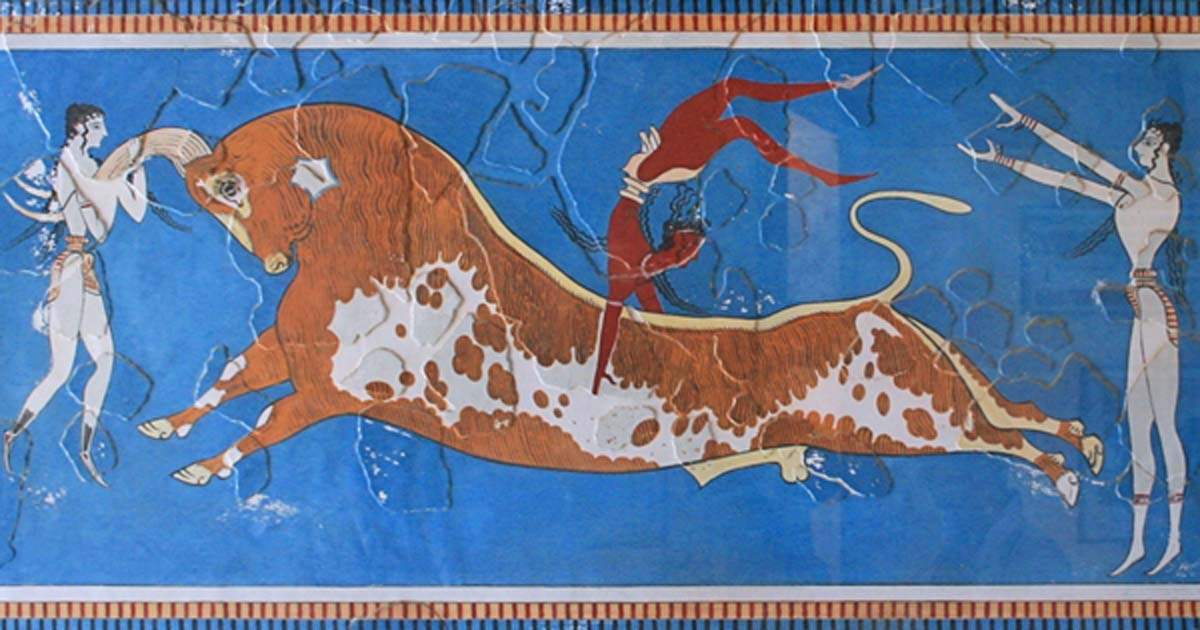
Few ancient images are as captivating—or as physically baffling—as the Minoan Bull-Leaping Fresco discovered at the Palace of Knossos on Crete.
Dating to the Bronze Age (c. 1400 BCE), the vivid painting depicts a charging, powerful bull caught mid-gallop, while three young acrobats execute a daring, high-stakes gymnastic routine directly over its horns and back.
Ever since Arthur Evans unearthed the fresco in the early 20th century, archaeologists, sports scientists, and historians have been locked in a fierce debate: Was this an actual, death-defying sport, a highly stylized religious ritual, or a purely foundational myth that birthed the legend of the Minotaur?
1. The Physics and Mechanics of the Leap
To understand why scholars are skeptical about bull-leaping being a literal, everyday sport, we have to look at the sheer physics of the stunt. Sir Arthur Evans originally proposed a specific three-step sequence based on the fresco's layout:
The Approach: The acrobat runs head-on at the charging bull, grabs its massive horns as it lowers its head to gore them.
The Launch: As the bull jerks its neck upward in a natural tossing motion, the acrobat uses the animal's massive upward momentum to launch themselves into a high, backward flip.
The Landing: The acrobat completes the somersault over the bull's back, landing cleanly on their feet behind the animal, where an assistant stands ready to catch them.
The Biomechanical Reality Check
Modern rodeo professionals and sports biologists have repeatedly pointed out that Evans's theory is practically a death sentence.
Unlike horses, which run with a relatively smooth, predictable stride, a charging bull moves with an incredibly erratic, violent, and jerky motion. Furthermore, a bull doesn't just toss its head straight up; it twists, hooks to the side, and shakes its neck to gore a target. Trying to grab the horns of a charging, 1,500-pound animal to hitch a ride would result in immediate trampling or dismemberment, long before any momentum could be transferred to the human body.
2. If Not Evans's Method, Then How?
If the "horn-grabbing" technique is a mechanical impossibility, did bull-leaping happen at all? Archaeology suggests yes, but the actual mechanics were likely closer to modern vaulting.
Alternative theories propose that acrobats didn't run straight at the horns. Instead, they may have used side-approaches, or utilized a small spring-board or vaulting platform to leap over the horns entirely, using their hands briefly on the bull's broad, muscled shoulders or back to push off and execute the flip.
This matches the bronze figurine above, where the leaper's body is arched in a tight, extreme crescent shape. The sheer volume of material culture—found not just on frescos, but on carved soapstone vessels, gold signet rings, and ivory figurines—strongly implies that the Minoans were depicting something they were actively witnessing, even if the frescoes took artistic liberties with the exact staging.
3. The Ritual: A Sacred Dance of Cosmic Dominance
In Minoan culture, the bull wasn't just livestock; it was the ultimate symbol of the raw, violent forces of nature—associated with the thunderous shaking of earthquakes, which frequently devastated Crete.
Therefore, bull-leaping wasn't a competitive "sport" with scores or trophies like the later Greek Olympics. It was a deeply sacred, theatrical ritual.
 [ RAW FORCE OF NATURE ]                           [ HARMONY & CONTROL ]
   The Charging Bull        vs.   The Fluid, Flexible Human Acrobat
(Earthquakes / Destruction)                 (Divine Grace / Agility)
By leaping over the beast without weapons—never harming or killing the bull during the performance—the young acrobats demonstrated the ultimate triumph of human agility, intellect, and divine protection over chaos.
The Gender Dynamic in the Arena
Notice the striking color differences in the Knossos fresco: two figures are painted with stark white skin, while the central flipping acrobat is a deep reddish-brown. Following standard Egyptian and Mediterranean artistic conventions of the Bronze Age, dark skin typically designated males (who worked outdoors in the sun), while pale white skin designated females.
If this convention holds true for Crete, it reveals a fascinating cultural detail: Minoan bull-leaping was a co-ed ritual. Young women and young men trained alongside each other to perform these terrifying, high-status athletic feats for the court.
4. The Seed of the Minotaur Myth
When the Minoan civilization collapsed around 1450 BCE, the memory of these terrifying spectacles didn't completely vanish; instead, it morphed into folklore.
Centuries later, when the early Mycenaean Greeks explored the ruins of Knossos, they encountered a sprawling, multi-story palace with an incredibly complex, labyrinthine floor plan. On the crumbling walls, they saw ancient paintings of terrifying, giant bulls and blood-pumping human sacrifices or performances.
It takes very little imagination to see how the Greeks stitched these real-world elements together into one of history's greatest myths:
Complex Palace Layout (Knossos) ──► The Labyrinth
Sacred Bull Iconography        ──► The Minotaur (Half-Man, Half-Bull)
Young Leapers from the Mainland  ──► Athenian Tributes sacrificed to the Beast
The Minoan bull-leaper wasn't fighting a monster in a dark maze; they were dancing with a god in a sunlit central courtyard, performing a high-wire balancing act between life and death that defined the golden age of Bronze Age Crete.