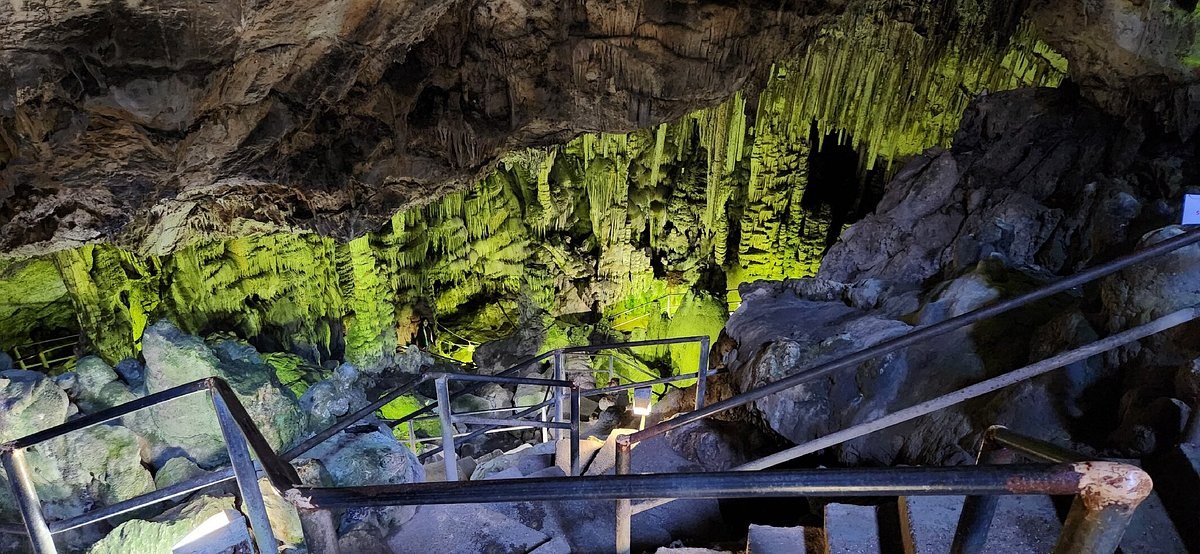
The Idaean Cave (Idaeon Antron), located high on the slopes of Mount Ida (Psiloritis) in central Crete, is one of the most significant and storied sanctuaries in the Greek world. While both the Idaean Cave and the Diktaean Cave (in the Lasithi Plateau) claim to be the birthplace of Zeus, the Idaean Cave held a unique status as a site of elite pilgrimage, mystery cults, and international exchange.
I. The Mythical Landscape
According to the Cretan tradition, the cave served as the nursery of the infant Zeus. To protect him from his father, Cronus—who sought to devour his children to prevent being overthrown—Rhea hid the infant in the cave. Legend tells that the Kouretes, semi-divine guardians, stood at the entrance and clashed their bronze shields to drown out the infant’s cries, a myth that likely explains the extraordinary quantity of bronze weaponry and shields recovered by archaeologists at the site.
II. Archaeological Significance
Unlike many other Greek sanctuaries that evolved into formalized temple structures, the Idaean Cave remained a "sanctuary of the earth." Its archaeological record provides a rare, unbroken timeline of worship:
Continuous Veneration: The site was in use from the Neolithic period (as a habitation) through the Minoan Bronze Age and reached its zenith during the Geometric and Archaic periods (c. 900–600 BCE). It continued to attract pilgrims well into the Roman era.
The Votive Cache: Excavations, most notably the systematic work of Yiannis Sakellarakis in the 1980s, revealed an astonishing wealth of votives. These include bronze tripod cauldrons, weapons, double axes, and jewelry.
International Connections: The cave is famous for the high concentration of "orientalia"—imports from North Syria, Phoenicia, and Egypt. The presence of ivory, gold, and fine metalwork suggests that the sanctuary was a focal point for elite gift exchange and a hub where Mediterranean trade networks intersected with Cretan religious life.
III. A Sanctuary of Mysteries
The sanctuary served a different function than the standard "city temples" of the Classical period. Its remote, high-altitude location (over 1,500 meters) and harsh winter climate made it accessible only during the summer months, lending it an air of exclusivity and sanctity.
Cult of the Cretan Zeus: The god worshipped here was often distinguished from the Olympian Zeus; he was a "dying and rising" god of vegetation, representing the seasonal cycles of birth and rebirth.
Initiation and Ritual: The cave was not just a place for casual prayer but a center for mystery initiations. Inscriptions confirm that high-ranking Roman officials traveled to the cave to be initiated into its specific mysteries, indicating that the site retained its spiritual gravity long after the collapse of the Bronze Age palaces.
IV. Excavation and Preservation
The history of the site's modern exploration is as dramatic as its myths. Following accidental discovery by local shepherds in 1884, the cave suffered from extensive looting before the first professional excavations were carried out by Italian pioneers like Federico Halbherr in 1885. Modern archaeological standards applied in the 1980s confirmed that the cave was a highly structured ritual space, featuring a rock-cut altar just outside the entrance and complex stratigraphy that traces the shifting nature of the cult over three millennia.
The Idaean Cave remains a liminal space—a bridge between the wild, rugged geography of Crete’s highest mountain and the sophisticated, international world of the ancient Mediterranean.