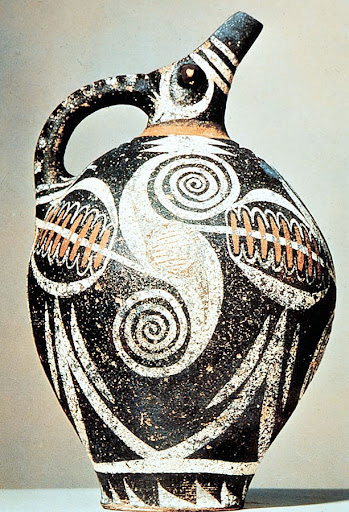
The evolution of Minoan pottery aesthetics reflects a profound shift in both their artistic philosophy and their social structure. By moving away from the rigid, courtly precision of the earlier period and toward a celebration of the natural world, the Minoans signaled their transition into a true maritime power.
I. Kamares Ware: The Abstract Zenith
Kamares ware, dating to the Middle Minoan period, is defined by its extreme technical refinement. It is the hallmark of the early palace era, where specialized workshops produced objects of incredible fragility.
Aesthetic Complexity: These vessels utilized a dark background—often black—adorned with vibrant, polychrome patterns in white, orange, and deep red. The motifs were almost entirely abstract: intricate spirals, radiating bands, and complex, swirling geometric shapes that emphasized symmetry and precision.
Engineering Perfection: The "eggshell" thinness of the walls remains a testament to the skill of the Minoan potter. Producing these required mastery over the potter's wheel and perfectly controlled firing cycles.
Elite Symbolism: Because they were so delicate, they were not meant for daily use. They served as high-prestige objects exchanged between the elites of the Minoan palaces and their contemporaries in Egypt and the Levant, functioning as markers of a highly stratified, courtly society.
II. The Marine Style: The Fluidity of the Sea
By the Late Minoan period, the abstract geometricism of the previous era gave way to the exuberant, naturalistic Marine Style. This transition represents a shift in focus from the internal, controlled world of the palace to the expansive, unpredictable environment of the Aegean.
The Aesthetics of Nature: The palette became simpler, typically featuring dark figures painted onto a light, buff-colored background. The rigid geometry of the past was abandoned for organic, flowing lines that prioritized movement.
The Octopus Motif: The most famous manifestation of this style is the octopus, with its tentacles sweeping across the curved surface of the vessel. The artists were masters of "spatial awareness," carefully manipulating the limbs of sea creatures to fit the shape of the pot, making the object itself feel dynamic and fluid.
Cultural Identity: The inclusion of nautiluses, sea urchins, coral, and dolphins shows a deep, observational connection to the marine environment. This style transformed the pottery into a canvas for the Minoans' identity as a seafaring people. It wasn't just decorative; it was a celebration of their mastery of the sea.
III. The Cultural and Economic Shift
The transition from Kamares to the Marine Style mirrors the broader trajectory of Minoan history. While Kamares ware suggests an inward-looking society focused on the rigid hierarchy and technical mastery of the palace workshops, the Marine Style reflects a culture that was looking outward.
The widespread adoption of the Marine Style across the Aegean islands serves as a clear archaeological marker of the "Minoanization" of the Mediterranean. It suggests that as Minoan trade networks expanded to their absolute peak, their aesthetic began to define the culture of the region. Where the geometric precision of the Kamares era was meant to impress the courts of other nations, the Marine Style communicated a sense of vitality and dominance that became the trademark of the Minoan "Thalassocracy."