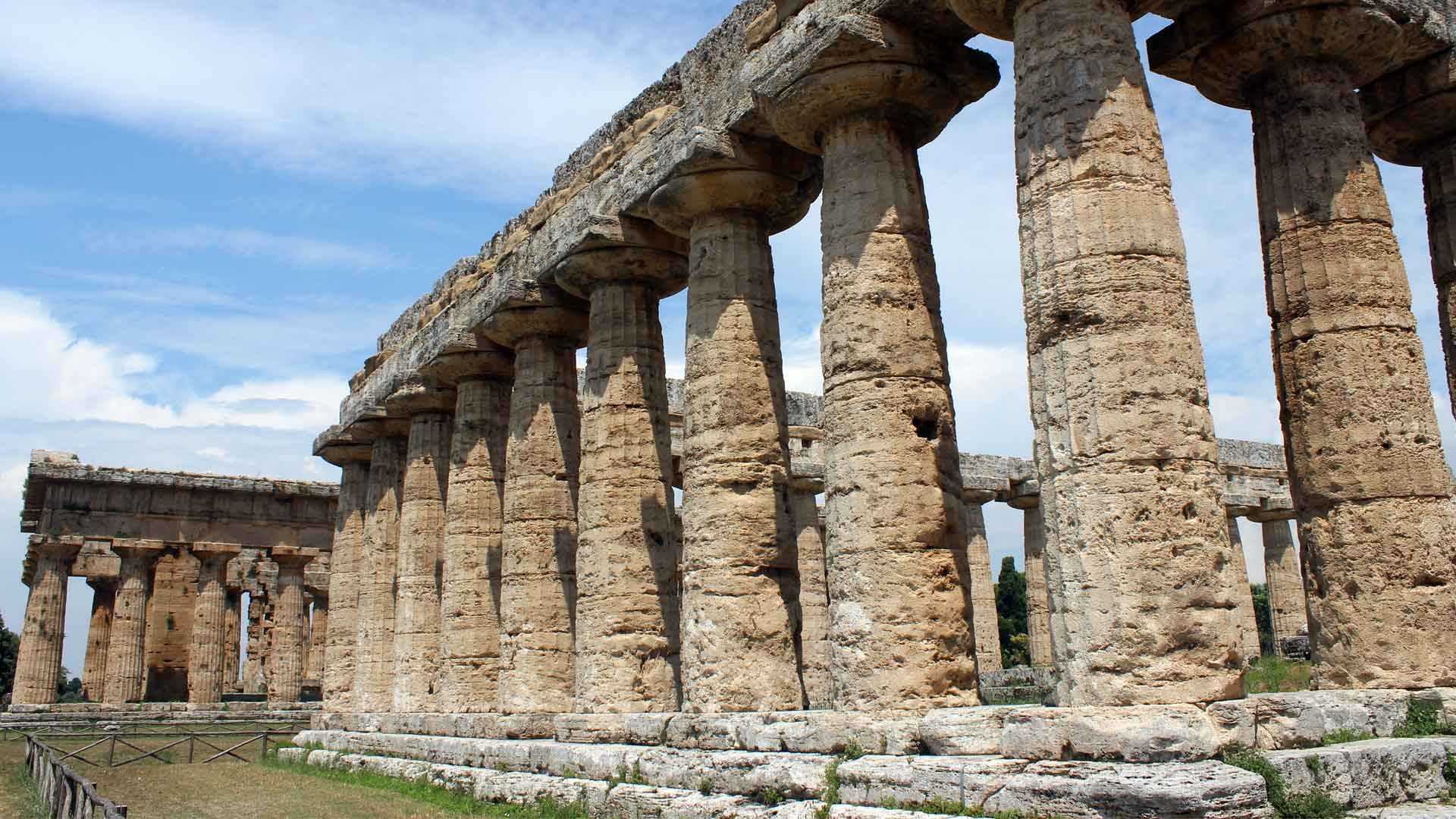
The Greeks did not just build temples; they created a sophisticated architectural language based on mathematical proportion and aesthetic harmony. These "orders" are not merely decorative styles; they are distinct structural systems that dictate how the entire building holds itself up, from the foundation to the roof.
Each order—Doric, Ionic, and Corinthian—reflects a different era of Greek philosophy and a different understanding of how stone, as a material, should behave.
1. The Doric Order: The Language of Strength
The Doric is the oldest and most austere of the three. It first appeared in the Archaic period (c. 7th century BCE) and became the signature style of mainland Greece and the western colonies.
The Philosophy: It was designed to look "masculine" and robust. The columns are heavy, lack a base (they sit directly on the floor), and have simple, unadorned circular capitals.
The Engineering Challenge: Because the order relies on a specific sequence of "triglyphs" (three-grooved vertical panels) and "metopes" (square spaces often featuring sculpture) in the frieze above the columns, architects often struggled with the "corner conflict." Making the spacing work at the corners of a building required complex geometric adjustments.
Famous Example: The Parthenon in Athens is the ultimate expression of the Doric order. Even there, the columns are not perfectly straight; they use entasis (a slight swelling in the middle) to counter the optical illusion that a straight column looks "thin" or "weak" to the human eye.
2. The Ionic Order: The Language of Elegance
Developing in the 6th century BCE along the Ionian coast (modern-day Turkey) and the Aegean islands, the Ionic order reflects a shift toward grace, slender proportions, and decorative complexity.
The Philosophy: Often associated with "feminine" elegance, the Ionic column is taller and thinner than the Doric. It always rests on a decorative circular base.
The Signature Feature: The volute—the scroll-like, spiral design atop the capital. These volutes are inspired by the natural curl of shells or the horns of a ram.
Engineering Advantage: Unlike the rigid Doric frieze, the Ionic frieze is often a continuous band of sculpture. This allowed architects to create long, flowing narrative reliefs that wrap around the entire building, making the structure feel lighter and more unified.
Famous Example: The Temple of Athena Nike on the Acropolis of Athens.
3. The Corinthian Order: The Language of Luxury
The Corinthian order is the latest, most ornate, and most expensive of the three. It did not become a standard architectural staple until the Hellenistic and Roman periods, though it was invented in Athens in the late 5th century BCE.
The Philosophy: This is the order of display and wealth. It is structurally almost identical to the Ionic order, but the capital is completely reimagined.
The Signature Feature: The acanthus leaf. The capital is shaped like an inverted bell covered in layers of intricately carved acanthus leaves, often topped with small, delicate scrolls. The story goes that the architect Callimachus invented it after seeing an acanthus plant grow around a basket left on a young girl's grave.
Famous Example: The Temple of Olympian Zeus in Athens. By the time this massive temple was completed, the Corinthian order had become the preferred style of the Mediterranean elite, as it conveyed unparalleled status.
The Evolutionary Summary
OrderStructural FeelSignature CapitalHistorical VibeDoricRobust, muscular, directSimple, circular discArchaic, grounded, civicIonicGraceful, fluid, airySpiraling volutesSophisticated, narrativeCorinthianLuxurious, vertical, ornateAcanthus leavesImperial, celebratory
How to Tell Them Apart (The "Checklist")
If you are looking at a Greek building and need to identify the order, follow this sequence:
Check the Base: If the column stands directly on the stone floor without a base, it is likely Doric.
Look at the Top (Capital):
Simple circular top? = Doric.
Scrolls/Spirals (Volutes)? = Ionic.
Leafy plant shapes? = Corinthian.
Analyze the Frieze (The horizontal band above the columns):
Divided by vertical grooves (triglyphs)? = Doric.
Continuous, smooth band of art? = Ionic or Corinthian.