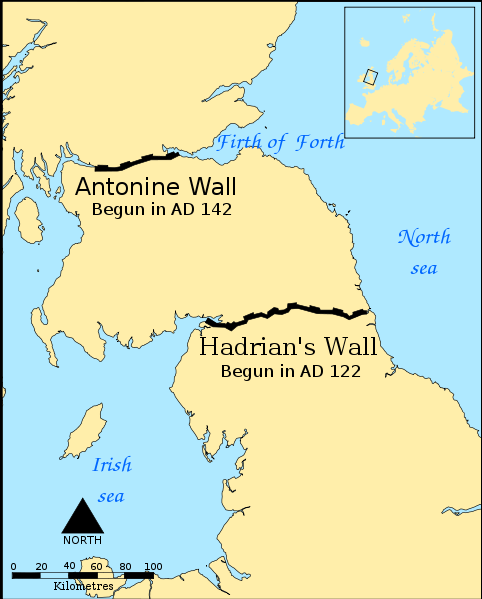
The Antonine Wall represents one of the most ambitious—and shortest-lived—military projects of the Roman Empire. Constructed around 142 CE under the orders of Emperor Antoninus Pius, it was intended to serve as the new northern frontier of Roman Britain, pushing the empire’s reach well beyond the earlier boundary of Hadrian’s Wall.
Key Characteristics
Location: Stretching 39 miles (63 km) across Scotland's "Central Belt," it ran from Old Kilpatrick on the River Clyde in the west to Bo’ness on the Firth of Forth in the east.
Design: Unlike the stone-built Hadrian’s Wall, the Antonine Wall was primarily a turf rampart constructed on a stone foundation. It was fronted by a deep, wide ditch on its northern side and accompanied by a "Military Way"—a road running parallel to the wall to facilitate the rapid movement of troops.
Infrastructure: The frontier featured approximately 17 to 19 forts, which served as garrisons and logistical hubs, interspersed with smaller fortlets.
Strategic Purpose vs. Reality
The wall was designed to project Roman authority and pacify the northern tribes, but its tenure as a functional frontier was incredibly brief. It was occupied for only about 20 years before the Roman military decided to retreat back to the more established, defensible line of Hadrian’s Wall in the 160s CE.
Historians suggest several reasons for its abandonment:
Resource Strain: Maintaining a frontier so far north was logistically difficult and costly.
Hostility: The tribes in the region were particularly fierce and persistent in their attacks, making the new border difficult to hold.
Strategic Consolidation: Roman leadership eventually shifted its focus toward consolidating existing territories rather than continuing the costly expansion into northern Scotland.
Archaeological Significance
Despite its short use, the wall is a vital part of the UNESCO-designated Frontiers of the Roman Empire World Heritage Site. Archaeological excavations have been remarkably productive, revealing that the wall was not just a military zone but a place where people lived and worked. Finds include:
Daily Life Items: Leather shoes (showing women and children lived at the forts), gaming boards (Ludus Latrunculi), and even cheese presses.
Art and Votive Objects: The wall has yielded a significant collection of Roman sculptures and "distance slabs"—inscribed stones that recorded which legions built specific sections of the wall, providing rare insights into the soldiers who served there.
Technology: Evidence of hypocaust systems (underfloor heating) in bathhouses illustrates the reach of Roman engineering even at the empire's northernmost edge.
Today, one-third of the original wall remains visible in the landscape, serving as a testament to Rome’s determination to push its influence into the rugged terrain of Scotland.