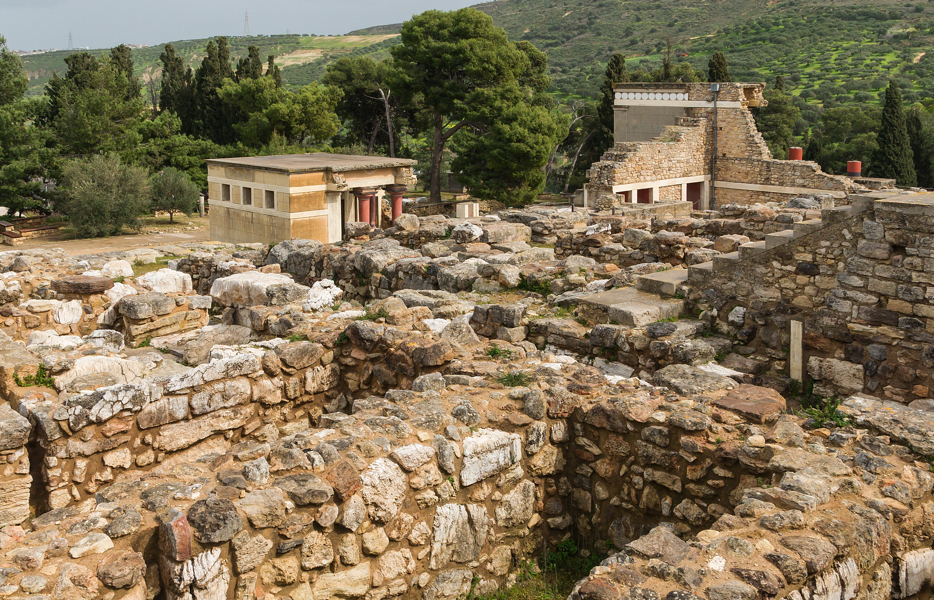
The restoration of the Palace of Knossos, led by British archaeologist Sir Arthur Evans between 1900 and 1931, remains one of the most polarizing case studies in the history of archaeology. It is a classic tension between archaeological preservation (the conservative act of stabilizing ruins) and reconstructive restoration (the interpretative act of rebuilding them).
The "Evans Vision" vs. Archaeological Rigor
Evans’s objective was to make the Bronze Age Minoan civilization tangible for a public that had only known it through mythology. To achieve this, he took risks that modern professional archaeology generally rejects:
Use of Modern Materials: Evans and his architects (Christian Doll, Theodore Fyfe, and Piet de Jong) used reinforced concrete and steel joists to rebuild staircases, columns, and upper stories. While this prevented the ruins from collapsing further, it created an irreversible physical structure.
Artistic Interpretation: Evans frequently commissioned artists to recreate frescoes based on small, fragmented pieces. By combining these fragments with painted plaster, he "completed" the images according to his own scholarly—and at times, Victorian—intuitions. This resulted in iconic but potentially inaccurate representations, such as the "Prince of the Lilies" or the elaborate Throne Room designs.
The "Palace" Concept: Evans was convinced he had found the legendary Labyrinth of King Minos. Consequently, his restoration emphasized a centralized, palatial, and ritualistic layout that may have oversimplified the actual architectural and administrative complexity of the site.
The Impact of His Methods
The controversy surrounding his work can be boiled down to three main points of criticism:
Imposed Narrative: Scholars argue that Evans’s work made it impossible to separate the authentic Bronze Age ruins from his 20th-century interpretation. Visitors today often leave with a "Minoan" vision that is actually a "Mycenaean-influenced Evans-Minoan" hybrid.
Irreversibility: Modern archaeological ethics demand that interventions be minimal and reversible so that future discoveries or better technologies can refine interpretations. Evans’s concrete structures are essentially permanent, "locking" the site into an early-20th-century perspective.
Destruction of Evidence: In the process of rebuilding, some original layers of history were covered or damaged, making it harder for later archaeologists to conduct stratigraphical analysis.
The Modern Legacy: Conservation vs. Modernization
Today, Knossos is caught between its status as a world-famous monument and the need to protect its fragile archaeological reality. Current efforts, led by the Hellenic Ministry of Culture, have pivoted away from "Evans-style" reconstruction toward preservation and infrastructure:
Structural Maintenance: Ongoing work focuses on stabilizing the concrete structures that Evans built, as these now require their own conservation to prevent them from damaging the original ruins beneath them.
Infrastructure for Tourism: The Hellenic Ministry of Culture’s current projects prioritize visitor management, accessibility, and site integration rather than architectural rebuilding. The goal is to manage the nearly one million annual visitors without further impacting the delicate ancient masonry.
Balancing Authenticity: While scholars acknowledge that Evans’s work has been historically "inaccurate" by modern standards, they also recognize that it saved the site from total disintegration and fostered the global public interest that drives the funding for today’s preservation.
Ultimately, Knossos stands as a "museum of a museum." You are not just visiting a Bronze Age site; you are visiting an early-20th-century interpretation of one. Modern conservationists now focus on treating the concrete-and-steel additions as historic artifacts in their own right, even as they work to ensure the ancient stone remnants survive the pressures of mass tourism.