Ancient Greek Temples: The Temple of Apollo at Bassae
Introduction
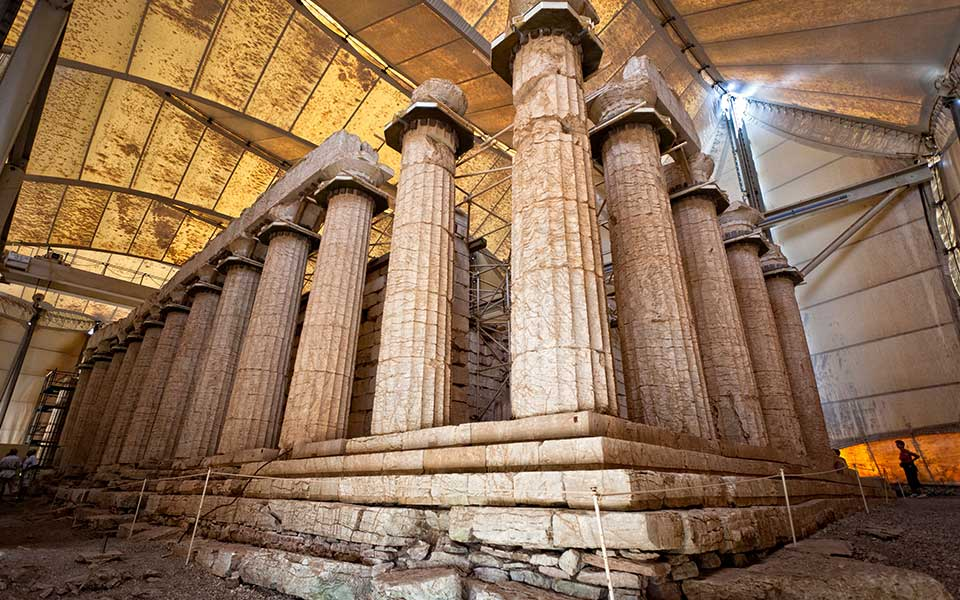
Ancient Greek temples were central to religious life, serving as sacred homes for the gods and as symbols of civic pride. One of the most remarkable and best-preserved examples is the Temple of Apollo Epicurius at Bassae, built in the 5th century BCE in a remote mountain region of Arcadia. It is famous for its unusual design and its blend of architectural styles.
Location and Discovery
The temple is located at Bassae, in the Peloponnese region of Greece, near the ancient city of Phigaleia.
It was designed by the architect Iktinos, who also worked on the Parthenon in Athens. Because of its remote location, the temple remained well preserved for centuries.
Dedication to Apollo
The temple was dedicated to Apollo, under the title Apollo Epicurius (“Apollo the Helper”). It was believed that Apollo protected the region from plague and hardship.
Architectural Features
Unusual Orientation
Unlike most Greek temples, which face east, the Temple of Apollo at Bassae is oriented north–south. This unusual design reflects both geographical constraints and possible religious symbolism.
Mixed Architectural Styles
The temple is famous for combining three major Greek architectural orders:
Doric (outer columns)
Ionic (interior columns)
Corinthian (one of the earliest known uses of this style)
This combination makes it a key example of architectural innovation in ancient Greece.
Interior Design
Inside the temple:
A central cult statue of Apollo once stood
A single Corinthian column is placed uniquely in the interior
A long sculpted frieze once decorated the cella walls, showing mythological battles
Artistic Significance
The sculpted frieze of the temple depicts scenes such as:
The battle between Greeks and Amazons
The struggle between Lapiths and Centaurs
These mythological scenes emphasized themes of order versus chaos, a common idea in Greek art.
Construction and Materials
The temple was built using high-quality limestone from the region. Marble was used for decorative elements and sculptures. Despite its remote location, the craftsmanship is comparable to major Athenian monuments.
Preservation and Recognition
Because of its remote mountainous setting, the Temple of Apollo at Bassae survived relatively intact compared to many other Greek temples.
Today, it is recognized as a UNESCO World Heritage Site, highlighting its global historical importance.
Historical Importance
The temple is significant because it:
Demonstrates architectural experimentation in classical Greece
Shows the evolution of Greek temple design
Reflects regional religious practices outside major city-states like Athens
Preserves early examples of Corinthian architecture
Conclusion
The Temple of Apollo at Bassae is one of the most unique and innovative temples of ancient Greece. Its blend of architectural styles, remote location, and artistic detail make it a key monument for understanding Greek religion and design. It stands as a lasting example of how Greek architects pushed the boundaries of tradition while honoring the gods.