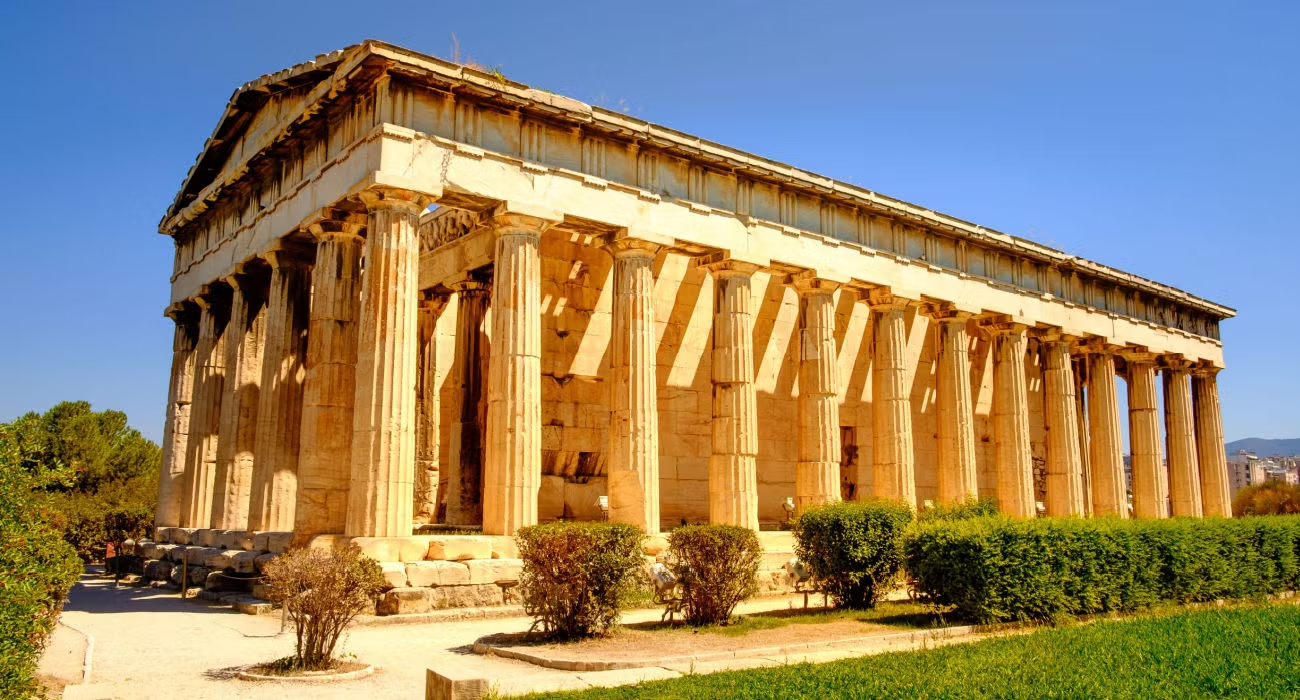
The Temple of Hephaestus, often called the Hephaisteion or historically the Theseion, stands as the most intact example of a Doric temple from Classical antiquity. Perched atop the Kolonos Agoraios hill on the northwest edge of the Ancient Agora, it offers a rare, near-complete view of 5th-century BCE Athenian religious architecture.
Architectural Mastery and Design
Constructed between approximately 449 and 415 BCE, the temple was designed by the same anonymous architect who worked on the Parthenon. Despite its smaller scale, it mirrors the Parthenon’s aesthetic grandeur and structural precision.
Doric Peripteral Plan: The structure is a classic "peripteral" temple, meaning it is surrounded by a continuous colonnade. It features a hexastyle layout—six columns on the front and back facades, and thirteen columns along the sides.
Materiality: Built primarily from luminous Pentelic marble—the same material used for the Parthenon—the temple possesses a natural resistance to weathering, which has significantly contributed to its survival.
Structural Features: It is unique for being the only temple of its period in Athens to retain its original roof. The internal layout includes the pronaos (entrance portico), the cella (or naos, the main chamber housing the cult statues), and the opisthodomos (the rear compartment).
Artistic Decoration: The exterior is adorned with metopes and friezes. While the front metopes depict the labors of Heracles and the legends of Theseus, the interior frieze illustrates the mythical battle between the Centaurs and the Lapiths.
Dedication and Symbolism
The temple was dedicated to Hephaestus, the god of fire, metalworking, and craftsmanship, and Athena Ergane, the patroness of pottery and the arts.
Its location was deeply intentional. The Agora was the industrial hub of Athens, and the temple overlooked the Street of the Marble Workers and numerous bronze and iron foundries. By placing the temple here, the Athenians honored the craftsmen who powered the city's economy and built its monuments, elevating the status of manual labor within the civic landscape.
A Legacy of Survival
The temple’s exceptional preservation is not merely a result of its sturdy materials, but of its continuous use:
Christian Conversion: In the 7th century CE, the temple was repurposed as the Christian Church of Saint George (Agios Georgios Akamates). This transition protected the building from the systematic dismantling and quarrying that destroyed many other civic structures in the Agora during Late Antiquity and the Byzantine era.
A Living Monument: As a functioning church, it remained well-maintained for over a millennium. It served this religious role until 1833, when the last liturgy was held.
Modern Status: After Greek independence, it was briefly converted into a museum before becoming a dedicated archaeological site in 1934.
Because it was never abandoned, its original roof, colonnades, and decorative friezes were spared the environmental and human-led destruction that claimed so many other monuments of the Classical world.
Would you be interested in learning more about the metopes specifically, or perhaps how other ancient structures in the Agora compare to this well-preserved site?The Temple of Hephaestus, often called the Hephaisteion or historically the Theseion, stands as the most intact example of a Doric temple from Classical antiquity. Perched atop the Kolonos Agoraios hill on the northwest edge of the Ancient Agora, it offers a rare, near-complete view of 5th-century BCE Athenian religious architecture.
Architectural Mastery and Design
Constructed between approximately 449 and 415 BCE, the temple was designed by the same anonymous architect who worked on the Parthenon. Despite its smaller scale, it mirrors the Parthenon’s aesthetic grandeur and structural precision.
Doric Peripteral Plan: The structure is a classic "peripteral" temple, meaning it is surrounded by a continuous colonnade. It features a hexastyle layout—six columns on the front and back facades, and thirteen columns along the sides.
Materiality: Built primarily from luminous Pentelic marble—the same material used for the Parthenon—the temple possesses a natural resistance to weathering, which has significantly contributed to its survival.
Structural Features: It is unique for being the only temple of its period in Athens to retain its original roof. The internal layout includes the pronaos (entrance portico), the cella (or naos, the main chamber housing the cult statues), and the opisthodomos (the rear compartment).
Artistic Decoration: The exterior is adorned with metopes and friezes. While the front metopes depict the labors of Heracles and the legends of Theseus, the interior frieze illustrates the mythical battle between the Centaurs and the Lapiths.
Dedication and Symbolism
The temple was dedicated to Hephaestus, the god of fire, metalworking, and craftsmanship, and Athena Ergane, the patroness of pottery and the arts.
Its location was deeply intentional. The Agora was the industrial hub of Athens, and the temple overlooked the Street of the Marble Workers and numerous bronze and iron foundries. By placing the temple here, the Athenians honored the craftsmen who powered the city's economy and built its monuments, elevating the status of manual labor within the civic landscape.
A Legacy of Survival
The temple’s exceptional preservation is not merely a result of its sturdy materials, but of its continuous use:
Christian Conversion: In the 7th century CE, the temple was repurposed as the Christian Church of Saint George (Agios Georgios Akamates). This transition protected the building from the systematic dismantling and quarrying that destroyed many other civic structures in the Agora during Late Antiquity and the Byzantine era.
A Living Monument: As a functioning church, it remained well-maintained for over a millennium. It served this religious role until 1833, when the last liturgy was held.
Modern Status: After Greek independence, it was briefly converted into a museum before becoming a dedicated archaeological site in 1934.
Because it was never abandoned, its original roof, colonnades, and decorative friezes were spared the environmental and human-led destruction that claimed so many other monuments of the Classical world.