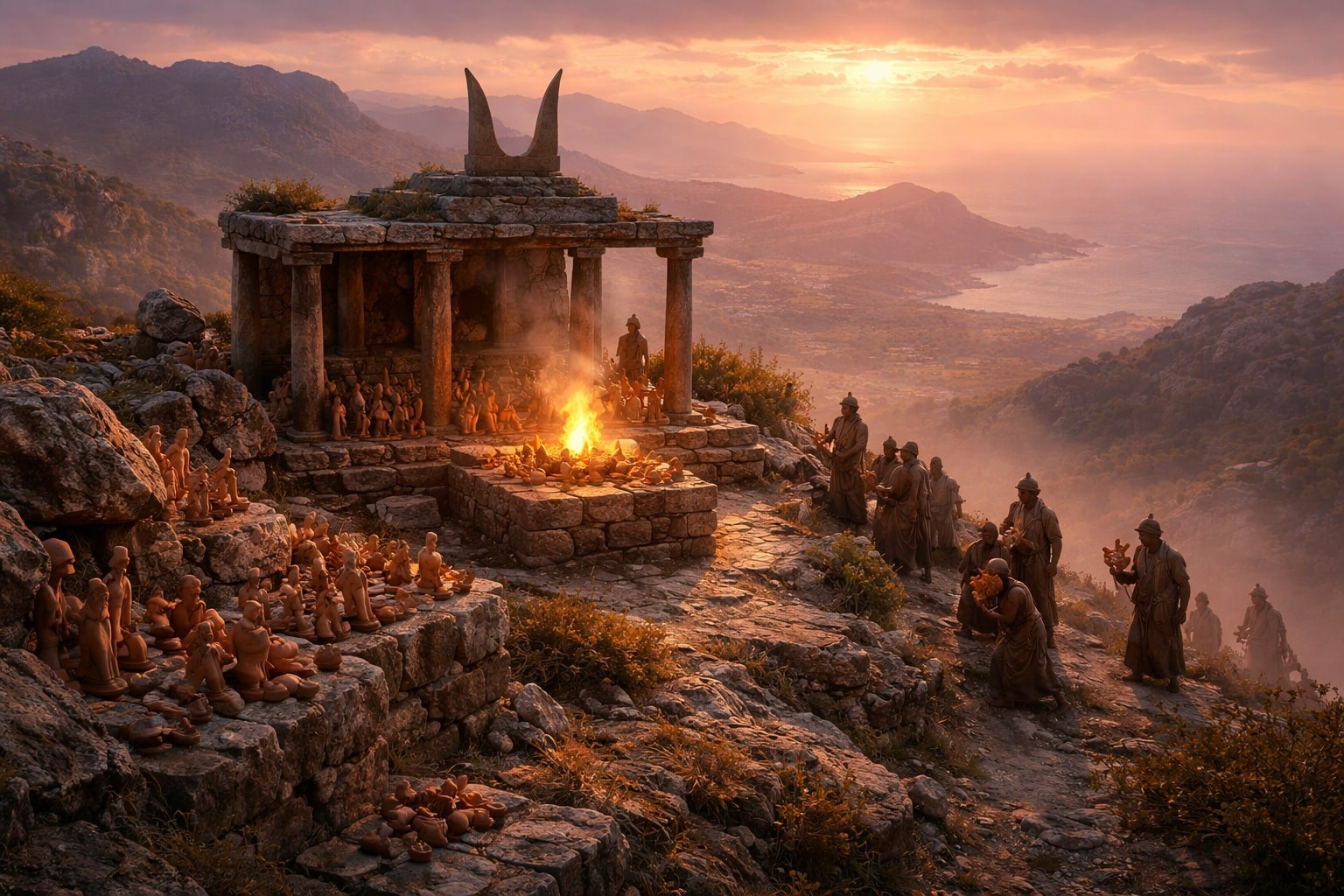
Minoan peak sanctuaries were distinctive open-air religious sites established on the summits or prominent ridges of mountains across Crete during the Bronze Age (roughly 2100–1400 BCE). They represent a core aspect of Minoan spirituality, serving as a focal point for communal interaction with the divine and the natural landscape.
Characteristics and Purpose
These sites were intentionally located to dominate the local landscape, offering panoramic views of both the sky and the surrounding valleys, settlements, and grazing lands.
Communal Worship: Scholars believe these sites began as popular shrines used by peasants and shepherds to petition the gods for agricultural success, protection of livestock, and healing.
Ritual Offerings: Excavations consistently reveal large deposits of votive offerings, including:
Clay Figurines: Representations of human worshippers in gestures of adoration, as well as animals like wild goats, cattle, and bulls.
Anatomical Votives: Clay models of limbs, eyes, and other body parts, which are believed to be requests for healing or bodily restoration.
Evidence of Ritual: Many sites contain evidence of bonfires (ash layers), altars, and small architectural structures. At sites like Anemospilia on Mount Juktas, archaeologists found more complex temple-like structures, suggesting intense, organized rituals.
Evolution and Centralization
The role of these sanctuaries shifted as Minoan society became more centralized around palace centers like Knossos.
Protopalatial Heyday: During the Protopalatial period (c. 1900–1700 BCE), there was a dense, widespread network of these sanctuaries across the island.
Neopalatial Centralization: In the Neopalatial period (c. 1700–1400 BCE), the number of active sanctuaries declined significantly, with only about eight major sites remaining. These surviving sanctuaries—most notably Mount Juktas—became much wealthier, featuring high-quality votive objects (such as inscribed libation tables and bronze double-axes). This suggests that the ruling elites had appropriated these sites to exert ideological and religious control over the rural population.
Significance
The Sacred Landscape: The sanctuaries were likely viewed as "liminal" spaces—places where the divine could be accessed more directly. Their intervisibility (the ability to see one sanctuary from another) created a "network of sacred beacons" that may have served both as ritual infrastructure and as a means of communication or territorial signaling.
Symbolic Power: By the Neopalatial period, the imagery of the "Mountain Mother" (a goddess often depicted on mountain peaks) became a powerful symbol of authority, linking the sanctity of the mountains to the power of the palace and the ruler.
In essence, these sanctuaries evolved from grassroots responses to the concerns of rural life into formal, state-sponsored landmarks that legitimized the power of the Minoan elite while grounding the civilization's religion in the rugged Cretan landscape.