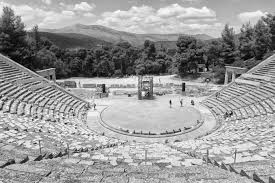
The Theatre of Epidaurus, constructed in the 4th century BC by Polykleitos the Younger, is widely considered the masterpiece of Greek theatrical architecture. While it is famous for its stunning symmetry and capacity to hold 14,000 spectators, its most enduring legacy is its "perfect" acoustics. Even today, a spectator sitting in the highest row—some 60 meters from the stage—can clearly hear a coin drop or a match strike in the center of the performance space.
1. The Mathematical "Old Style" of the Cavea
The seating area, or Cavea, was not built as a simple semi-circle. It was designed with two distinct slopes.
The Lower Tier: Features 34 rows of seats for the elite and officials.
The Upper Tier: Added later, this tier has 21 rows at a slightly steeper angle.
The Result: This dual-inclination creates a "parabolic" effect that helps project sound upward while maintaining a clear line of sight for every spectator.
2. Acoustic Filtering: The Limestone Secret
For decades, researchers wondered how the Greeks managed to "amplify" the human voice without modern technology. Recent studies have revealed that the limestone used for the seats acts as a natural sophisticated sound filter.
Low-Frequency Suppression: The rows of corrugated limestone seats serve as a "high-pass filter." They absorb or suppress low-frequency background noise—such as the wind or the rustle of the crowd.
High-Frequency Reflection: Simultaneously, the stone reflects high-frequency sounds (the human voice) back toward the audience. This makes the speech of the actors seem "brighter" and more intelligible at a distance.
3. The Role of the Orchestra and Skene
In the "Old Style" of theater, the performance was centered on the Orchestra, the circular "dancing floor" where the Chorus performed.
Reflection Surfaces: The flat, hard-packed surface of the Orchestra acted as a primary reflective plane. Sound waves hitting the floor would bounce directly toward the rising tiers of seats.
The Skene: Behind the Orchestra stood the Skene (stage building). This structure acted as a massive "backboard" or sounding board, preventing sound from escaping behind the actors and instead pushing it forward into the audience.
4. The Parodoi and Sound Containment
The theatre features two massive stone gateways called Parodoi, through which the Chorus entered.
Structural Funneling: These walls helped "trap" the sound within the bowl of the theater, preventing acoustic energy from dissipating out the sides.
Symmetry: The absolute mathematical symmetry of the theater ensured that the sound reached the far-left and far-right seats at the exact same volume and timing as the central seats.
5. Masks as Resonators
While the architecture did the heavy lifting, the actors themselves utilized specialized gear to project their voices.
The Mouth Opening: Greek theatrical masks featured large, funnel-shaped mouth openings. These acted as primitive megaphones, concentrating the actor's vocal energy into a directional beam.
Material: Made of stiffened linen, wood, or cork, the masks vibrated slightly, adding a resonant "metallic" quality to the voice that carried better over long distances.
6. The Healing Power of Sound
Epidaurus was not just a theater; it was part of a larger Asklepieion, a sanctuary dedicated to Asklepios, the god of healing.
Therapeutic Drama: The Greeks believed that watching tragedies and comedies provided a catharsis—an emotional "purging" that was essential for physical health.
Harmonic Environment: The perfect acoustics were intended to create a sense of divine order and harmony, helping patients who had traveled from across the Greek world to find peace and recovery through the "Old Style" of musical and dramatic performance.