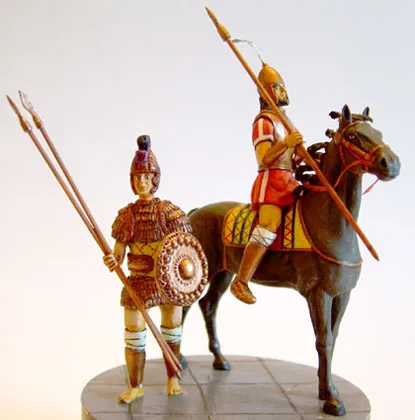
During the Classical era of ancient Greece, warfare was defined by the clashing of bronze-armored infantrymen locked within the rigid walls of the hoplite phalanx. On these traditional battlefields, cavalry was largely an afterthought, relegated to scouting, skirmishing, or chasing down fleeing enemies.
However, the rise of Macedonia under Philip II and his son, Alexander the Great, sparked a total military revolution. In the subsequent Hellenistic Era (323–31 BCE), the cavalry transformed from a minor support unit into the premier, battle-winning shock weapon of the ancient world, permanently altering the tactics, scale, and geometry of Mediterranean warfare.
1. The Technological Paradigm Shift
To understand how Hellenistic cavalry achieved such devastating battlefield dominance, it is essential to recognize the extreme physical limitations under which these ancient horsemen operated:
The Saddle and Stirrup Void: Hellenistic riders possessed neither rigid saddles nor stirrups. They rode bareback or balanced atop a simple quilted leather or felt blanket (ephippion), gripping the horse's barrel tightly with their inner thighs.
The Physics of Shock: Without stirrups to anchor their weight, a rider executing a direct, frontal charge would be thrown clean off the back of their horse by the sheer kinetic recoil of the impact.
To overcome this structural barrier, Macedonian and Hellenistic weapon designers engineered the Xyston—a formidable, nine-foot-long lance carved from resilient cornel wood.
Rather than couching the lance firmly under the arm like a medieval knight, Hellenistic cavalrymen held the xyston with an flexible overhand or underhand grip. This technique allowed them to strike downward at the exposed faces, necks, and shoulders of enemy infantrymen, utilizing the horse's forward momentum without absorbing the catastrophic physical shock of a rigid collision.
2. Alexander the Great and the Companion Cavalry
The true blueprint for Hellenistic cavalry tactics was established by the Macedonian Companion Cavalry (Hetairoi). Recruited from the aristocratic elite of Macedonia, these horsemen were trained to act as an unyielding tactical hammer.
Alexander’s fundamental battlefield doctrine was the "Hammer and Anvil" maneuver, a synchronized combined-arms strategy:
      [ Enemy Army ] ◄─────── [ Macedonian Phalanx ] (The Anvil)
             ▲
             │ (Pinned in place by infantry)
             │
      [ Shock Charge ] ◄───── [ Companion Cavalry ]  (The Hammer)
The Anvil: The massive Macedonian infantry phalanx, armed with 18-foot pikes (sarissas), would advance and lock the enemy army in a brutal, immovable frontal engagement.
The Hammer: While the enemy was completely pinned by the pikes, Alexander would personally lead the Companion Cavalry around the unprotected flanks or directly into any breaking gaps in the enemy line, striking them from the side or rear with a crushing shock charge.
The Wedge Formation
To maximize the impact of the hammer, Philip and Alexander adopted the Wedge Formation from the Thracians. Instead of charging in a flat, square block, the cavalry rode in a tight triangle, with the squadron leader riding at the absolute apex.
This geometric layout offered distinct tactical advantages. The apex functioned as a physical spearhead that could wedge open narrow cracks in an enemy formation. Furthermore, it allowed the entire unit to pivot and wheel instantly in any direction, as every rider simply followed the movements of the leader at the front tip.
3. The Hellenistic Evolution: Specialized Horsed Units
Following Alexander's death in 323 CE, his warring successor generals—the Diadochi—divided his empire into competing massive kingdoms (such as the Seleucid, Ptolemaic, and Antigonid empires). In their relentless wars against one another, they pushed cavalry specialization to its absolute limits, dividing horsemen into distinct, tactical categories:
Heavy Shock Cavalry: The Cataphracts
Confronted by the elite horse archers and nomadic cultures of Persia and Central Asia, the Seleucid Empire engineered the ultimate evolution of heavy armor: the Cataphract (Kataphraktos).
In a cataphract unit, both the rider and the horse were completely encased in protective mail, scale, or segmented bronze and iron armor. The riders abandoned the agile xyston for the Kontos, a massive, two-handed lance up to 14 feet long. These lumbering, armored tanks were designed to do what classical cavalry never could: smash directly through the front lines of heavy infantry purely through weight, mass, and psychological terror.
Light and Skirmishing Cavalry
To counter heavy shock charges and disrupt enemy infantry lines before the main clash, Hellenistic armies deployed agile light cavalry:
Tarentine Cavalry: Highly popular mercenaries who rode unarmored horses, carrying a bundle of light javelins. They excelled at advanced feigned retreats, riding up to pepper slow infantry with missiles before wheeling away safely out of range.
Mounted Archers: Recruited from the steppes of Central Asia and the deserts of Syria, these horsemen specialized in the "Parthian shot," raining arrows down upon the flanks of slow-moving phalanxes to force them to break their tight shield walls.
4. The Limits of Dominance
Despite its tactical brilliance, Hellenistic cavalry possessed distinct operational vulnerabilities. Because the horses lacked metal horseshoes, prolonged operations on rocky, unforgiving terrain would quickly split their hooves, rendering entire units combat-ineffective.
Furthermore, the high-density shock tactics relied entirely on maintaining tight, rigid formations. If a cavalry charge was lured into broken, uneven ground, marshes, or hidden ditches, the horses would trip, the wedge would fracture, and the unanchored riders would be easily pulled down and isolated by light infantrymen.
Ultimately, the Hellenistic era elevated the horse from a luxury status symbol into an indispensable asset of global military science. By engineering the combined-arms doctrine of the hammer and anvil and pushing body armor to the extremes of the cataphract, the successor states proved that mobility and kinetic shock could systematically dismantle the most disciplined infantry walls of antiquity—establishing a martial tradition that would dominate the battlefields of Europe and Asia for the next fifteen hundred years.