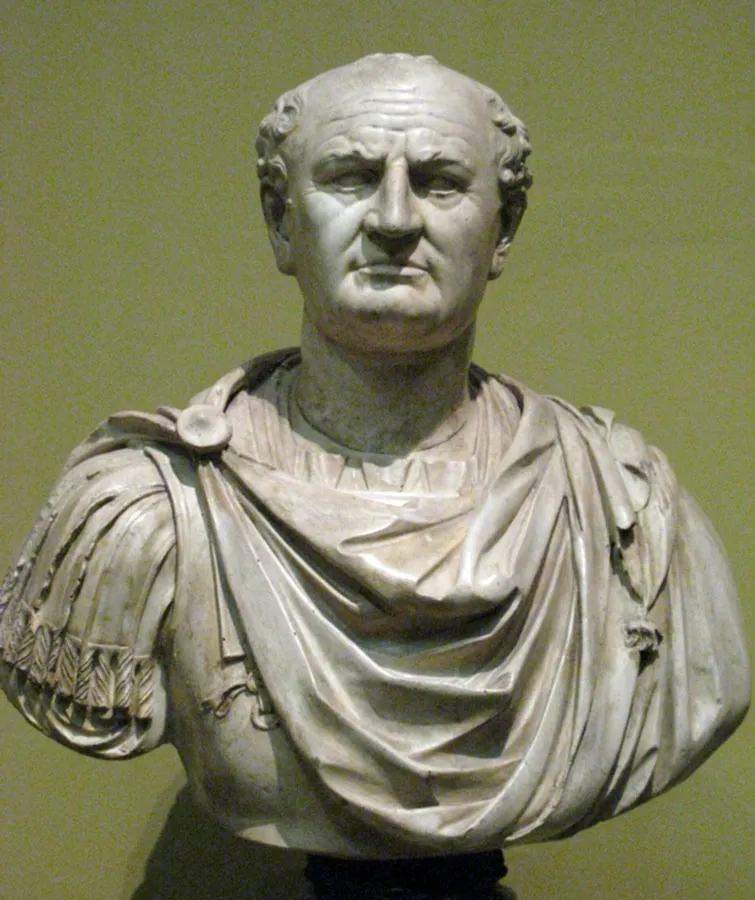
The reign of Emperor Vespasian (69–79 CE)—the pragmatic founder of the Flavian Dynasty—marked a critical period of physical and political reconstruction for Rome. Vespasian inherited an empire fractured by a chaotic civil war and deeply traumatized by the tyrannical excesses of the late Emperor Nero.
To heal these wounds, stabilize the state, and legitimize his new dynasty, Vespasian embarked on the most ambitious public building project in history: the Flavian Amphitheatre, universally known today as the Colosseum.
1. Political Propaganda in Stone
The construction of the Colosseum was an extraordinary, calculated stroke of populist propaganda. Following Nero’s forced suicide, his massive imperial palace, the Domus Aurea (Golden House), was left taking up over 200 acres of prime land in the center of Rome. Nero had artificially re-engineered the city topography, tearing down neighborhoods to install private gardens, gilded colonnades, and a massive artificial lake.
Vespasian systematically reclaimed this land from royal luxury and gifted it back to the public.
   [ Nero's Domus Aurea ] ───► Tyrannical, Private Pleasure Lake
                                      │
                               (Vespasian Drains Lake)
                                      │
   [ Flavian Amphitheatre ] ──► Populist, Monument of Public Entertainment
He ordered Nero's artificial lake to be completely drained and laid the foundations of the Colosseum directly onto the dry lakebed. By placing a venue for free public entertainment on the exact spot where a tyrant had built an exclusive playground, Vespasian sent a powerful message: the Flavian Dynasty existed to serve the Roman people.
2. Engineering the Arena: Travertine and Volcanic Concrete
To construct a free-standing monument capable of holding over 50,000 screaming spectators on top of a soft, drained lakebed, Flavian engineers had to push Roman construction technology to its absolute limit.
The Ring Foundations: Builders dug a massive, elliptical trench nearly 40 feet deep and packed it with a dense, uninterrupted ring of volcanic concrete to create a solid bedrock foundation that could prevent the building from sinking.
The Structural Arcades: The exterior wall was constructed out of 100,000 cubic meters of high-quality travertine limestone, quarried in nearby Tivoli. Rather than building solid stone walls, engineers utilized a complex network of 80 interlocking concrete and brick arches. This architectural grid distributed the immense weight of the stadium downward and outward, ensuring structural integrity while keeping the building lightweight.
The Iron Clamps: The massive travertine blocks were cut precisely and assembled entirely without mortar. Instead, workers bound the stones together using an estimated 300 tons of iron clamps, creating a tight, unyielding structural weave.
3. Crowded Control: The Vomitoria
The Colosseum was a marvel of ancient logistics, designed to pack in and evacuate up to 65,000 spectators smoothly and safely within a matter of minutes.
The exterior of the building featured 80 numbered arched entrances. Citizens held a pottery shard ticket (tessera) stamped with a specific entry gate, section, and seat row.
The interior staircases and corridors were completely vaulted in concrete, guiding spectators directly to their designated seating tiers while preventing different social classes from intermingling. The exit tunnels were named vomitoria (derived from the Latin vomere, meaning "to spew forth"), because of the rapid, fluid way they could empty a crowded stadium directly out into the surrounding streets.
4. The Architecture of Imperial Hierarchy
The interior seating (cavea) of the Colosseum functioned as a rigid, physical map of the Roman social hierarchy. The closer you sat to the action on the arena floor, the higher your social status:
The Podium (First Tier): This premium, marble-clad level was reserved exclusively for the elite: senators, foreign ambassadors, vestal virgins, and the Emperor himself, who sat in a fortified imperial box.
The Maenianum Primum (Second Tier): Reserved for the equites (the wealthy knight/merchant class), dressed in their pristine white tunics.
The Maenianum Secundum (Third Tier): Divided into sections for ordinary Roman plebeians and citizens, separated by legal and military status.
The Porticus (Top Attic Tier): The furthest, highest wooden benches were reserved for those at the absolute bottom of Roman society: working-class women, slaves, and the destitute poor.
5. The Hypogeum: The Special Effects Machine
Vespasian died in 79 CE, just a year before the amphitheatre was officially inaugurated by his eldest son, Titus, in 80 CE. Titus's successor, Domitian, put the finishing touches on the stadium by constructing the Hypogeum—a massive, two-story subterranean labyrinth directly beneath the wooden arena floor.
The Hypogeum functioned as a high-tech backstage production area. It featured a complex network of tunnels, cages for wild animals, and gladiator staging areas.
Engineers installed dozens of manual windlass elevators and capstans powered by teams of slaves. These lifts allowed stage hands to lift massive, ferocious beasts—lions, leopards, and bears—and heavy theatrical scenery directly through trapdoors in the wooden arena floor above, creating a seamless, terrifying spectacle of spontaneous violence that kept the Roman crowds enthralled.
The construction of the Colosseum permanently redefined the relationship between the Roman state and its citizens. By replacing a tyrant's lake with a monument of architectural genius, Vespasian utilized the raw engineering power of concrete and travertine to cement his family's legacy—creating an enduring symbol of imperial majesty that outlasted the Roman Empire itself.