Ancient Royal Burials in Korea Reveal Possible Family Sacrifices
A major new genetic study of human remains from southeastern South Korea suggests that entire families may have been sacrificed and buried alongside elites during the era of the Silla Kingdom. The findings come from analysis of skeletons discovered in the burial complex at Gyeongsan.
Researchers describe the evidence as some of the strongest scientific support yet for ritual human sacrifice and highly structured social hierarchy in ancient Korea.
A Massive Burial Site With a Hidden Story
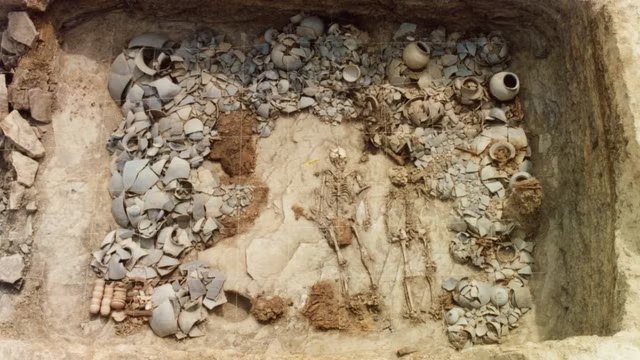
The burial complex, known as the Imdang-Joyeong burial complex, was first uncovered in 1982. Dating to roughly the 4th–6th centuries AD, it contains:
Over 1,600 tombs
Remains of around 260 individuals
Evidence of elite and non-elite burials
Early interpretations suggested the site held members of ruling families, but the relationships between individuals remained unclear for decades.
Genetic Study Reveals Family Relationships
A recent genomic analysis examined 78 individuals from 44 tombs. The results revealed surprising patterns:
Some tombs contained entire families, including parent and child buried together
At least three cases confirmed closely related individuals interred in the same grave
In one burial, both parents and their child were found together
These findings suggest that burial practices were not random but followed strict social or ritual rules.
Evidence of Ritual Sacrifice (“Sunjang”)
Researchers identified signs of a practice known as sunjang, in which individuals were reportedly sacrificed and buried alongside elite dead.
At least 20 tombs showed indications of this practice.
The study suggests that these individuals may have been:
Servants
Dependents
Retainers of elite families
Or members of a socially designated group
Their role may have been tied to a belief that the dead required attendants in the afterlife.
A Possible “Sacrificial Caste”
One of the most striking conclusions is the possibility that sacrificial individuals belonged to a hereditary social group.
Researchers found that:
Some sacrificial individuals were genetically related across generations
Certain groups may have inherited their roles over time
This suggests a structured system of obligation or caste-like social division
This challenges earlier assumptions that such practices were random or symbolic.
Close-Kin Marriages Among Elites
The study also found evidence of close-kin marriages among both elites and sacrificial individuals. Several individuals showed genetic signs of parents who were closely related.
This suggests that consanguineous marriage practices may have been part of maintaining elite status or social structure within the Silla Kingdom.
Rethinking Ancient Korean Society
The findings provide rare large-scale biological evidence for how society may have been organized during the Silla period. Researchers argue that the data reveals:
Strong social hierarchy
Possible institutionalized violence
Complex kinship structures
Ritualized burial systems involving human sacrifice
These patterns differ significantly from burial customs observed in ancient Europe and other regions, suggesting a distinct cultural evolution in East Asia.
A Window Into Life and Death in the Silla Kingdom
The evidence from Imdang-Joyeong burial complex offers a rare and intimate look into ancient beliefs about death, loyalty, and social order during the Silla Kingdom.
While researchers caution that interpretations of ritual sacrifice and “caste-like” systems are still under study, the genetic data strongly suggests that burial practices were deeply structured—and sometimes involved entire families.
Continuing Questions
Despite the breakthrough, many questions remain:
Were sacrificial individuals willingly chosen or forcibly selected?
How widespread was the practice across the kingdom?
Did it change over time as Silla society evolved?
Future research may help clarify whether these burials represent a regional tradition or a broader cultural system.
This discovery reshapes our understanding of early Korean civilization, revealing a society where family, hierarchy, and ritual death may have been tightly intertwined—offering one of the most detailed biological snapshots yet of ancient social structure in East Asia.