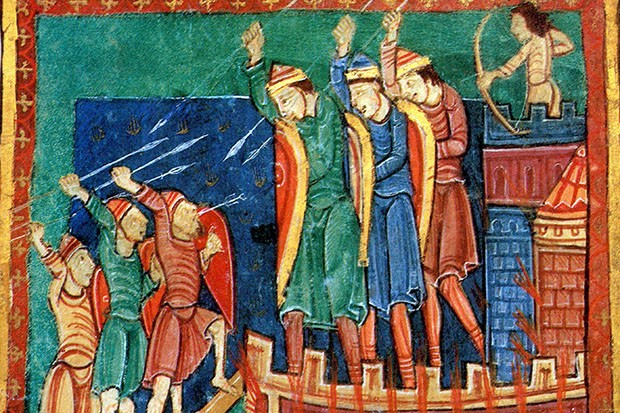
For decades, the Viking presence in Anglo-Saxon England followed a predictable, terrifying pattern: hit-and-run raids. Norse longships would materialize out of the morning mist, plunder a wealthy coastal monastery like Lindisfarne, and vanish back across the North Sea before a local militia could even assemble.
But in the autumn of 865 CE, the nature of the Scandinavian threat shifted fundamentally. A massive, unified coalition of Norse warriors landed on the coast of East Anglia. They did not come to plunder; they came to conquer, settle, and permanently redraw the geopolitical map of Britain. The Anglo-Saxon chroniclers, horrified by this unprecedented host, gave them a name that would echo through history: The Great Heathen Army (mycel hæðen HERE).
1. A Fractured Target: The Four Kingdoms
The army, led by legendary Norse chieftains like Halfdan Ragnarsson, Ubba, and Ivar the Boneless (traditionally said to be the sons of Ragnar Lothbrok), arrived at a time when England was intensely divided. There was no single "Kingdom of England"—instead, the land was split into four independent, often rival Anglo-Saxon realms.
By avoiding unified resistance, the Great Heathen Army was able to use its superior mobility to systematic advantage. Instead of relying on longships for deep inland travel, they quickly extorted horses from the East Anglians, transforming themselves into a highly mobile, mounted infantry unit capable of striking deep into the heart of the Anglo-Saxon interior.
2. The Campaign of Conquest: 865–874 CE
The Norse war machine moved through the fractured Anglo-Saxon kingdoms like wildfire, using a combination of psychological warfare, tactical brilliant maneuvers, and political manipulation.
1.The Fall of Northumbria:866–867 CE.
The army marched north and seized the city of York (Eoforwic). Exploiting a bitter civil war between two rival Northumbrian kings, Osberht and Ælla, the Vikings crushed both factions in a brutal battle outside the city walls. They established a puppet regime and renamed the region Jórvík.
2.The Execution of East Anglia:869 CE.
Turning back south, the army overran East Anglia. King Edmund resisted but was captured. Refusing to renounce his Christian faith or rule as a Viking vassal, he was tied to a tree and executed by Norse archers, instantly becoming a martyr (Saint Edmund).
3.The Subjugation of Mercia:873–874 CE.
The Great Heathen Army invaded Mercia, England’s central powerhouse. They captured the sacred royal center at Repton and drove King Burgred into exile. The Vikings carved up eastern Mercia for themselves and installed a compliant English king, Ceolwulf II, to govern the rest.
By 874 CE, three of the four traditional Anglo-Saxon kingdoms had utterly collapsed. Only one line of resistance remained on the entire island: the southern kingdom of Wessex.
3. The Stand of Wessex and Alfred the Great
The defense of the final Anglo-Saxon stronghold fell to a young, scholarly king named Alfred, who ascended the throne of Wessex in 871 CE. Alfred's reign nearly ended in total disaster. In the dead of winter in 878 CE, a splinter faction of the Viking army led by Guthrum launched a surprise attack on the royal estate at Chippenham.
Alfred was forced to flee into the treacherous, flooded marshes of Athelney in Somerset with a tiny band of loyal followers. It was during this desperate guerrilla campaign that the famous legend of Alfred burning the cakes took root—a psychological low point for the Anglo-Saxon cause.
From his swamp fortress, Alfred engineered one of the most stunning military comebacks in British history:
The Gathering: Alfred sent out a call to the local militias (fyrds) of Somerset, Wiltshire, and Hampshire.
The Battle of Edington (878 CE): The gathered Anglo-Saxon army met Guthrum's forces. Using a tightly locked, dense shield-wall, Alfred’s men withstood the initial Viking onslaught and successfully broke the Norse lines, chasing them back to their fortress at Chippenham.
4. The Treaty of Wedmore and the Creation of the Danelaw
The victory at Edington did not expel the Vikings from England; Alfred lacked the manpower to accomplish that. Instead, it forced them to the negotiating table. Under the Treaty of Wedmore, a historic compromise was reached:
The Baptism of Guthrum: Guthrum agreed to convert to Christianity, with Alfred acting as his godfather, establishing a mutual framework of spiritual legitimacy.
The Partition of England: The island was cut diagonally along an old Roman road known as Watling Street.
The Danelaw: The territory to the north and east of this line fell under Scandinavian law and administration, while Alfred retained absolute control over Wessex and western Mercia.
5. Alfred's Military Revolution: The Burh System
Recognizing that the peace treaty was merely a strategic pause, Alfred completely overhauled the infrastructure of Wessex to ensure the Great Heathen Army could never catch them off guard again. He realized that traditional, reactive defensive strategies were completely useless against high-velocity Viking warfare.
Defensive InnovationMechanical FunctionStrategic PurposeThe BurhsA network of 33 fortified, walled towns spaced within a single day's march (approx. 19 miles) of one another.Ensured no village in Wessex was defenseless; provided rapid refuge and local military staging grounds.The Standing ArmySplitting the local militia (fyrd) into two rotational shifts—one half farming at home, the other half garrisoning the forts.Prevented economic collapse from long campaigns while maintaining constant, active military readiness.The NavyDesigning long, swift, custom warships that were both larger and higher out of the water than traditional Norse vessels.Met the raiders at sea, breaking their amphibious operational capabilities before they could ever hit the beaches.
Alfred's structural genius transformed Wessex into an unassailable fortress. When subsequent waves of Viking armies returned in the 890s, they found a land fortified by stone, fully garrisoned, and impossible to easily conquer.
By holding the line at the edge of the marshes, Alfred did more than save his own crown—he preserved the English language, culture, and legal traditions, laying the institutional foundations for his children and grandchildren to step forward and forge a unified Kingdom of England.