If you drop a block of modern standard concrete into the ocean, the salty seawater will slowly chew it apart. Within a few decades, chemical reactions erode the material, causing micro-cracks that eventually lead to catastrophic structural failure.
Yet, two-thousand-year-old Roman piers, breakwaters, and harbor structures still stand completely intact across the Mediterranean coastline. Even more baffling to modern geologists and engineers: these structures are actually stronger today than they were when the Romans built them.
For centuries, the exact chemical recipe for this generational durability was lost. Thanks to advanced X-ray micro-diffraction and electron microscopy, scientists have finally unlocked the hidden mineral blueprint of Opus Caementicium—Roman concrete.
1. The Key Ingredients: Volcanic Catalyst
The Romans didn't just stumble onto this longevity; it was a deliberate, highly engineered material science. As the architect Vitruvius documented in the 1st century BCE, the secret lied in a very specific geographic pairing of raw materials:
Quicklime (Calx): Calcium oxide created by baking limestone at high temperatures.
Pozzolana (Pulvis Puteolanus): A highly reactive, glassy volcanic ash gathered from the slopes surrounding the Bay of Naples, particularly near the town of Pozzuoli.
When Roman engineers mixed this volcanic ash with slaked lime and packed it into wooden frames submerged directly into the sea, an aggressive, high-temperature chemical reaction triggered. The volcanic silica, aluminum, and lime fused together to form a highly resilient matrix. But the real magic occurred decades, and eventually centuries, after the construction crews went home.
2. Bending the Elements: The Active Chemistry of Seawater
Modern concrete is passive—it is meant to remain inert, and any post-curing chemical change usually signals decay. Roman marine concrete, conversely, is an active, living material.
When seawater permeates the porous matrix of a Roman breakwater, it doesn't degrade the interior. Instead, the naturally occurring sodium, potassium, and magnesium in the water actively dissolve the microscopic volcanic glass remnants hidden inside the concrete.
This slow dissolution kicks off an extraordinary secondary crystallization loop:
 [ Seawater Seeps In ] ───► Dissolves Volcanic Glass ───► Releases Silica & Aluminum
                                                                  │
                                                                  ▼
 [ Massive Crystal Interlocking ] ◄─── Grows Al-Tobermorite & Phillipsite Minerals
As these elements are released into the fluid channels of the concrete, they precipitate out into two exceedingly rare, interlocking crystalline structures: Aluminous Tobermorite ($ \text{Al-tobermorite} $) and Phillipsite.
These flat, blade-like crystals slowly grow directly inside the microscopic voids and micro-cracks of the structure. Rather than widening the cracks and splitting the stone, the dense web of interlocking crystals binds the concrete tighter together, actively reinforcing the matrix against shear stress.
3. Comparing the Masterpieces: Roman vs. Modern Concrete
The fundamental differences between these two material philosophies highlight why ancient structures outlast our modern high-rise foundations:
PropertyModern Portland ConcreteAncient Roman Marine ConcretePrimary BinderPortland Cement (Calcium Silicate Hydrate)Volcanic Ash + Lime PasteEnvironmental ReactionSeawater corrodes the binder and rusting steel rebar.Seawater acts as a vital fluid catalyst for mineral growth.Structural BehaviorRigid; micro-cracks expand over time, causing failure.Self-healing; micro-cracks are naturally filled by new crystals.Carbon FootprintMassive; high-kiln firing releases roughly 8% of global greenhouse gases.Significantly lower; fired at much lower initial kiln temperatures.
4. The "Hot Mixing" Revelation: Lime Clasts as Healing Elements
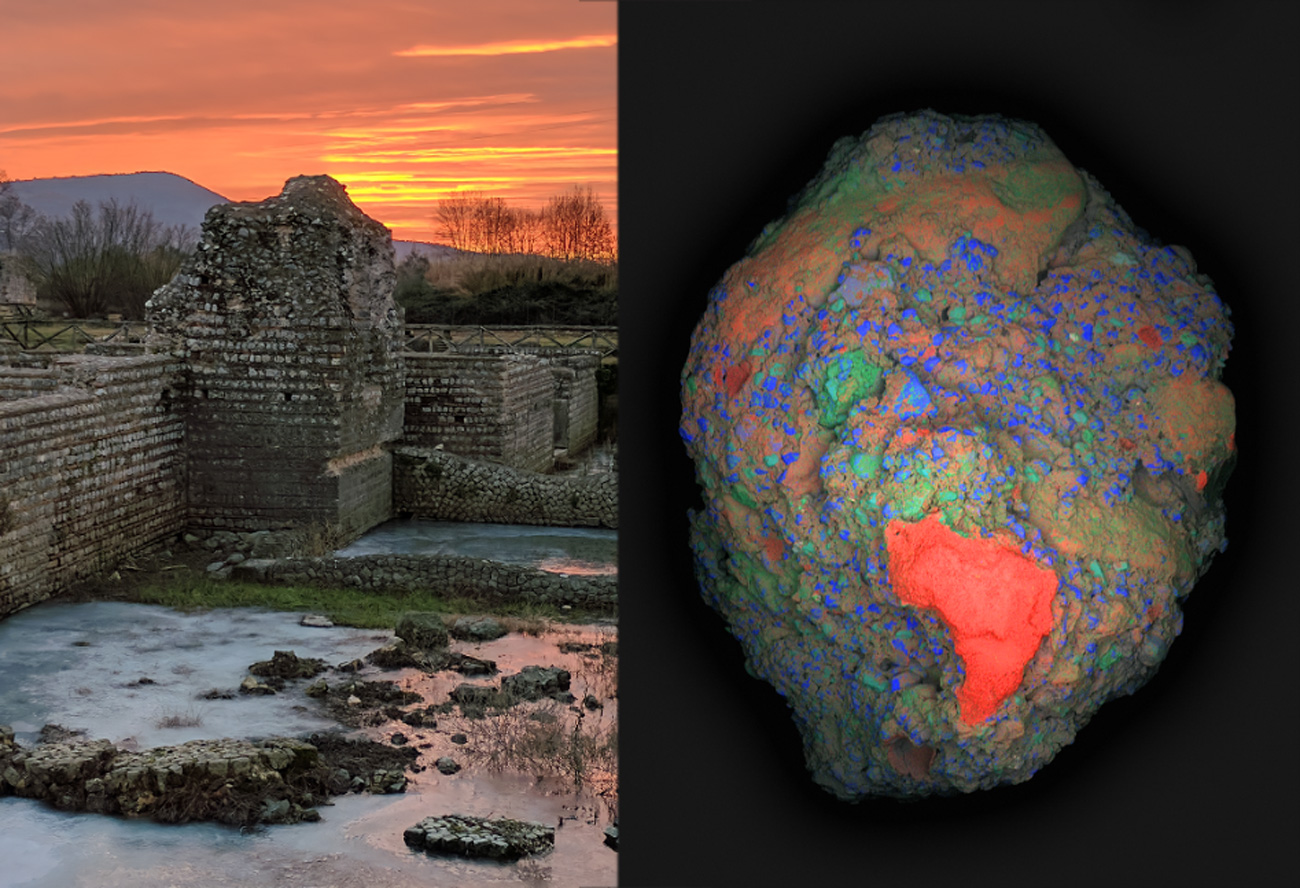
A parallel breakthrough in understanding Roman concrete on land (such as the massive, unreinforced dome of the Pantheon) revealed another layer to this ancient self-healing mystery: lime clasts.
For generations, archaeologists looked at the small, white, microscopic chunks of white lime scattered throughout Roman concrete mixes and assumed it was just the product of sloppy, poor mixing habits.
  [ Structural Stress ] ───► Micro-Crack Forms ───► Tears Open a Lime Clast
                                                            │
                                                            ▼
  [ Instant Seal ] ◄─── Calcium Carbonate Solidifies ◄─── Rainwater Dissolves Lime
Instead, researchers discovered these clasts were created intentionally through a process called hot mixing. By mixing quicklime directly with volcanic ash at extreme temperatures before adding water, the lime forms small, highly concentrated, fragile reservoirs throughout the concrete.
When a microscopic crack inevitably forms in the structure due to tectonic shifts or weathering, it tears right through one of these fragile lime clasts. The next time it rains, water seeps into the crack, dissolves the highly reactive calcium inside the clast, and flushes it into the fracture. The liquid quickly recrystallizes into solid calcium carbonate, effectively soldering the crack shut from the inside out before it can compromise the building.
By viewing engineering not as a battle against the natural elements, but as a collaborative system that harnesses them, Roman engineers created an architectural legacy that quite literally uses the passage of time to cement its own survival.