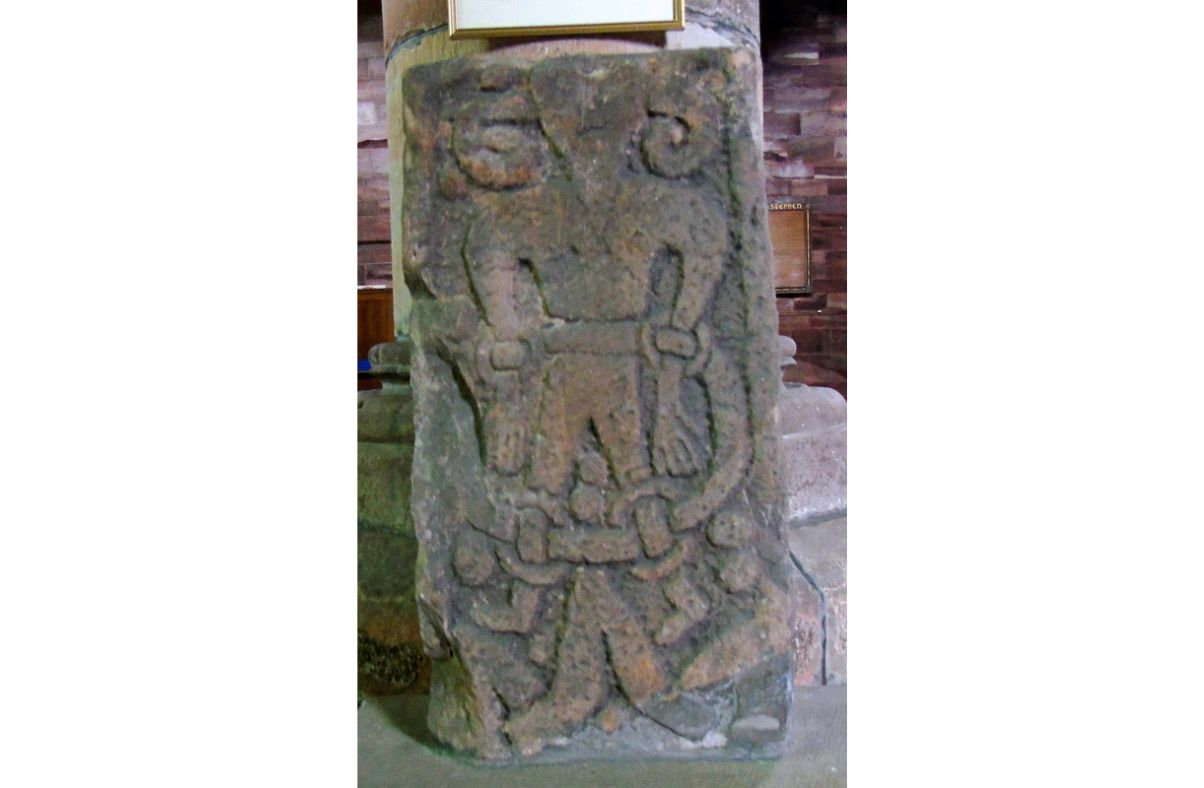
The Loki Stone Mystery: A Viking Carving Reinterpreted in Cumbria
Inside Kirkby Stephen Parish Church, a striking Viking-era sandstone carving continues to fuel debate among historians and archaeologists. Known as the Loki Stone, this 10th-century relief has long been one of the most discussed examples of Norse imagery in Britain.
At the heart of the discussion is a simple but unresolved question: does the carving actually depict the Norse trickster god Loki, or has its meaning been misunderstood for generations?
A 10th-Century Viking Image in Stone
The carving, likely created in the 900s AD, is etched into pink sandstone and shows a bound humanoid figure. For decades, it has been interpreted through the lens of Norse mythology and popularly identified as Loki—who, according to legend, was punished by being restrained.
Because of this mythological connection, the stone became widely known as a rare visual representation of Norse belief in early medieval Britain.
The Traditional Interpretation: Loki Bound in Punishment
The long-standing theory suggests that:
The figure is Loki, the Norse trickster god
The bindings represent his punishment by the gods
The imagery reflects mythological storytelling brought by Viking settlers
This interpretation made the stone an important cultural artifact linking Viking mythology with early medieval Britain.
A New Reading Challenges the Myth
Recent discussion led by archaeologist Steve Dickinson of the Cumbria Viking Project has reopened the debate.
According to this reinterpretation:
Features once thought to be chains or restraints may actually represent attacking animals or symbolic beasts
Damage to one of the figure’s eyes could suggest a connection to Odin, who is famously associated with the sacrifice of an eye for wisdom
The posture and carving style may not match traditional depictions of Loki at all
This alternative view challenges decades of established interpretation.
Odin, Loki, or Something Else Entirely?
The suggestion that the figure could represent Odin rather than Loki has significant implications. Odin is typically associated with wisdom, war, and sacrifice, while Loki represents chaos, trickery, and instability in Norse myth.
However, experts caution that Viking-age imagery is rarely straightforward. Symbols were often:
Open to multiple interpretations
Influenced by local artistic traditions
Subject to wear and damage over centuries
Not always literal representations of myths
Why the Debate Matters
The reinterpretation of the Loki Stone is not just about one carving—it reflects a broader challenge in Viking archaeology:
Many Norse images in Britain are fragmentary or eroded
Symbolism may differ between regions and time periods
Modern labels may oversimplify complex cultural meanings
As a result, the identity of the figure remains uncertain.
A Stone That Still Speaks
Whether the figure represents Loki, Odin, or another symbolic being entirely, the carving at Kirkby Stephen Parish Church remains a rare and powerful glimpse into Viking presence in medieval Britain.
More than a thousand years after it was carved, the “Loki Stone” continues to challenge assumptions—reminding researchers that even familiar artifacts can still hide new interpretations waiting to be uncovered.