Introduction
Located along the banks of the Ohio River near present-day Evansville, Indiana, Angel Mounds is one of the best-preserved archaeological sites of the Mississippian Civilization in the Midwestern United States. Occupied between approximately 1000 and 1450 CE, the site served as a thriving political, religious, and economic center for thousands of Native Americans. Covering nearly 100 acres (40 hectares), Angel Mounds contained a carefully planned town with large earthen platform mounds, residential neighborhoods, defensive palisades, ceremonial plazas, workshops, and agricultural fields. The settlement was named after the Angel family, who owned the land during the nineteenth century before archaeological excavations revealed the significance of the ancient city. Today, Angel Mounds is recognized as one of the most important Mississippian sites outside of Cahokia and provides valuable insight into the complex societies that flourished in the Ohio River Valley before European contact.
Urban Planning and Settlement Layout
Angel Mounds was carefully designed according to a centralized urban plan that reflected the political and religious organization of Mississippian society. At the heart of the settlement was a large central plaza, an open space used for public ceremonies, community gatherings, markets, games, and religious festivals. Surrounding this plaza were eleven large earthen platform mounds, each constructed by transporting thousands of basket loads of earth over many generations.
The largest mound, known as Mound A, served as the political and ceremonial center of the community. A large wooden temple or the residence of the chief likely stood atop its flat summit, symbolizing both religious authority and political leadership. Smaller platform mounds supported council houses, temples, elite residences, and other important public buildings. Ordinary families lived in clusters of rectangular houses surrounding the central precinct, creating organized neighborhoods connected by pathways leading to the plaza.
Platform Mound Construction
The platform mounds at Angel Mounds were remarkable examples of prehistoric engineering. Builders transported enormous quantities of soil using woven baskets and carefully deposited it in successive layers. Different types of clay and earth were selected to improve stability, drainage, and resistance to erosion. Each construction phase enlarged the mounds, reflecting the continued growth of the settlement and the authority of successive leaders.
The flat tops of the mounds provided elevated foundations that protected important buildings from seasonal flooding while making them visible throughout the surrounding landscape. Wooden stairways connected the plaza to the summit of each mound, allowing priests, chiefs, and other important figures to participate in ceremonies held above the community. These elevated structures emphasized the close relationship between political power, religious leadership, and monumental architecture in Mississippian society.
Daily Life and Economy
The inhabitants of Angel Mounds practiced an advanced agricultural economy centered on the cultivation of maize (corn), beans, squash, and sunflowers, collectively providing a reliable food supply capable of supporting a large permanent population. Hunting deer, turkey, and other wildlife, together with fishing in the nearby Ohio River, supplemented their diet.
The town also became an important center of craft production. Archaeologists have uncovered evidence of skilled artisans producing pottery, stone tools, shell ornaments, copper decorations, woven textiles, and carved ceremonial objects. These products were traded throughout extensive exchange networks connecting Angel Mounds with other Mississippian communities across the southeastern and midwestern United States.
Defensive Fortifications
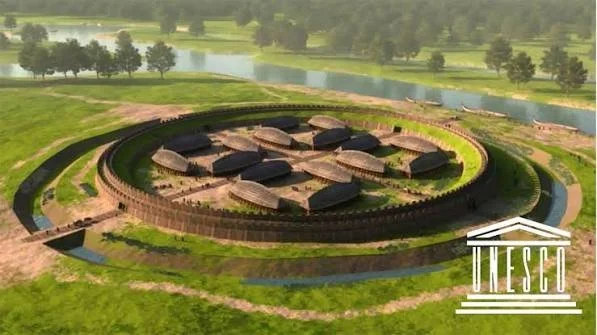
One of the most distinctive features of Angel Mounds was its impressive wooden palisade, which surrounded much of the settlement. Constructed from massive upright logs placed closely together, the palisade protected the community from potential attacks and controlled access through guarded entrance gates. Archaeological evidence indicates that the fortifications were repaired and rebuilt several times, suggesting that defense remained an important concern throughout the town's occupation.
In addition to providing military protection, the palisade also defined the sacred and political boundaries of the community, separating the ceremonial center from the surrounding countryside. The construction and maintenance of such large defensive works required significant cooperation and centralized organization among the town's inhabitants.
Religion and Ceremonial Life
Religion played a central role in the life of Angel Mounds. Temples built atop the platform mounds served as places of worship where priests conducted ceremonies honoring ancestral spirits, agricultural deities, and supernatural forces believed to control the natural world. The central plaza hosted seasonal festivals, ritual dances, communal feasts, and public gatherings that reinforced social unity and political authority.
Many ceremonial objects discovered at the site—including engraved shell gorgets, decorated pottery, stone pipes, and copper ornaments—reflect beliefs associated with the Southeastern Ceremonial Complex, a widespread religious tradition shared among many Mississippian societies. These artifacts illustrate the importance of symbolism, ritual, and sacred leadership within the community.
Archaeological Importance
Systematic excavations at Angel Mounds have uncovered thousands of artifacts, including pottery, stone tools, shell jewelry, copper ornaments, food remains, house foundations, storage pits, and evidence of specialized workshops. These discoveries have enabled archaeologists to reconstruct the daily lives, economic activities, and social organization of one of the largest prehistoric towns in the Midwest.
The exceptional preservation of the site has made Angel Mounds an invaluable resource for understanding Mississippian civilization. Its carefully planned layout, monumental architecture, and abundant archaeological remains provide one of the clearest pictures of life in a major Native American urban center before European colonization.
Conclusion
Angel Mounds stands as one of the finest examples of a Mississippian town, demonstrating the remarkable engineering, urban planning, and cultural achievements of Native American societies between 1000 and 1450 CE. Its monumental platform mounds, central ceremonial plaza, fortified palisade, organized residential districts, and thriving agricultural economy reveal a highly structured society capable of coordinating large-scale public works and maintaining extensive trade networks. Today, Angel Mounds remains one of North America's most important archaeological sites, preserving the legacy of a sophisticated Indigenous civilization whose political organization, religious traditions, and architectural accomplishments continue to deepen our understanding of prehistoric America.