Introduction
Situated along the Ohio River in southern Illinois, Kincaid Mounds was one of the most important regional centers of the Mississippian Civilization between approximately 1050 and 1450 CE. Covering nearly 141 acres (57 hectares), the settlement served as a fortified political, religious, and economic center that controlled trade routes throughout the lower Ohio River Valley. Although smaller than Cahokia, Kincaid was among the largest Mississippian towns in the Midwest and played a vital role in spreading Mississippian culture across the region. Its monumental earthworks, defensive fortifications, organized residential districts, and ceremonial architecture reveal a highly structured society with centralized leadership and advanced engineering capabilities.
Urban Planning and Fortified Layout
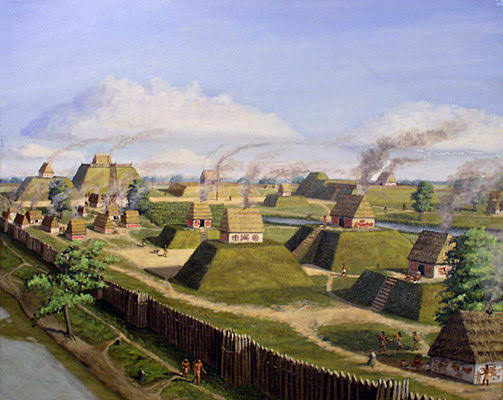
Kincaid Mounds was designed around a large central ceremonial plaza, surrounded by numerous earthen platform mounds, residential neighborhoods, public buildings, and defensive structures. Archaeologists have identified at least 19 platform mounds, although some were only partially completed or later modified during the site's occupation.
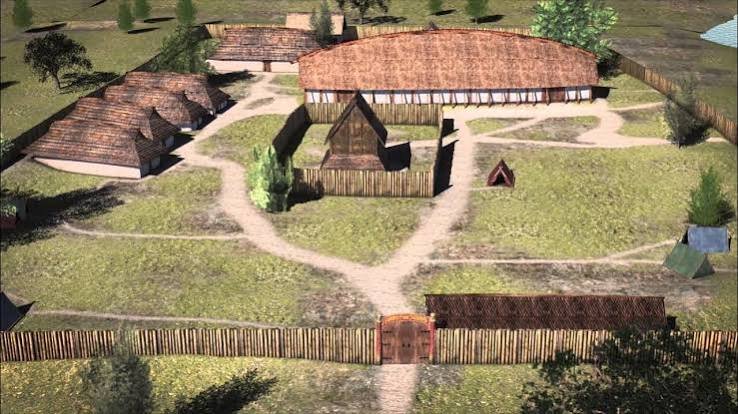
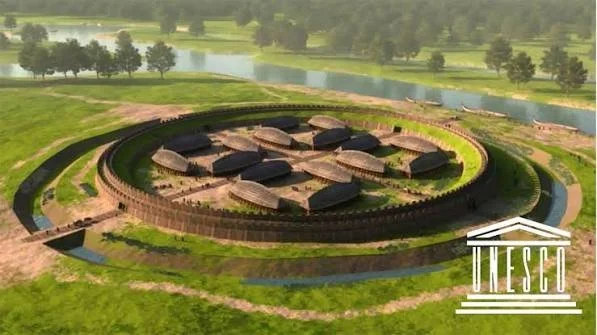
The town was enclosed by a substantial wooden palisade built from closely spaced upright logs. Guarded gateways controlled entry into the settlement, while portions of the fortification may have included watchtowers that overlooked surrounding fields and nearby river approaches. These defenses protected both the population and the ceremonial center while symbolizing the authority of the town's leaders.
The carefully planned arrangement of plazas, mounds, and residential areas demonstrates sophisticated urban planning designed to accommodate political administration, religious activities, and daily community life.
Platform Mounds and Public Buildings
The platform mounds of Kincaid served as elevated foundations for temples, council houses, elite residences, and ceremonial buildings. Builders transported thousands of basket loads of earth, constructing each mound through multiple phases over several generations. Layers of compacted clay and soil provided structural stability while protecting buildings from seasonal flooding along the Ohio River.
The largest mound overlooked the central plaza and likely supported the residence of the ruling chief or an important temple dedicated to community rituals. Additional mounds housed administrative structures where political decisions, religious ceremonies, and public gatherings reinforced the power of the governing elite.
Economy and Daily Life
The inhabitants of Kincaid practiced intensive agriculture centered on maize (corn) cultivation, supplemented by beans, squash, sunflowers, and other crops grown in the fertile floodplains of the Ohio River. Hunting deer, wild turkey, waterfowl, and fishing in nearby rivers provided additional food resources that supported a substantial permanent population.
Kincaid also developed into an important center of craftsmanship. Archaeological excavations have uncovered finely decorated pottery, stone tools, shell ornaments, copper artifacts, bone implements, and ceremonial objects reflecting both local production and long-distance trade. The settlement maintained commercial connections with Cahokia and numerous Mississippian communities throughout the Mississippi and Ohio River valleys, facilitating the exchange of raw materials, finished goods, and religious ideas.
Religion and Ceremonial Life
Religion played a central role in Kincaid's social organization. The large central plaza served as the setting for seasonal ceremonies, ritual dances, communal feasts, athletic competitions, and public assemblies. Temples atop the platform mounds housed priests who conducted ceremonies associated with agriculture, ancestor worship, fertility, and celestial cycles.
Many artifacts recovered from the site—including engraved shell gorgets, ceremonial stone pipes, copper ornaments, and symbolic pottery—reflect participation in the Southeastern Ceremonial Complex, a widespread religious tradition shared among Mississippian societies. These religious practices strengthened political authority while reinforcing cultural connections with neighboring communities.
Archaeological Importance
Excavations at Kincaid Mounds have revealed house foundations, storage pits, workshop areas, defensive palisades, ceremonial plazas, and thousands of artifacts that provide detailed information about Mississippian life. Archaeologists have reconstructed the site's settlement patterns, agricultural practices, and political organization, demonstrating that Kincaid functioned as an important regional capital rather than a simple farming village.
The site is particularly valuable because it illustrates how Mississippian urban planning and ceremonial architecture spread beyond Cahokia while adapting to local environments and regional political systems.
Conclusion
Kincaid Mounds stands as one of the most significant fortified towns of the Mississippian Civilization, showcasing advanced urban planning, monumental platform mounds, defensive palisades, organized agriculture, and extensive trade networks. Its carefully planned ceremonial plazas and elevated public buildings reveal a highly organized society capable of coordinating large-scale construction projects and maintaining complex political and religious institutions. Today, Kincaid Mounds remains a vital archaeological site for understanding the expansion and regional diversity of Mississippian culture throughout the Ohio River Valley before European contact.