Here’s what you’ll learn when you read this story:
Ruins of a prehistoric stone wall submerged off the northwest coast of France may be evidence that a sunken city of legend actually existed.
The megalithic structure is thought to be about 7,000 years old, and could have been used either as a trap for fish or to protect a nearby settlement from flooding.
This find could mean that more submerged ruins could be in the region, ready to tell the story of a time when Mesolithic hunter-gatherer societies transitioned to Neolithic settlements.
Atlantis may only exist in legends (unless it is actually recovered from the ocean someday), but another sunken city that inspired a myth is now rising from the deep.
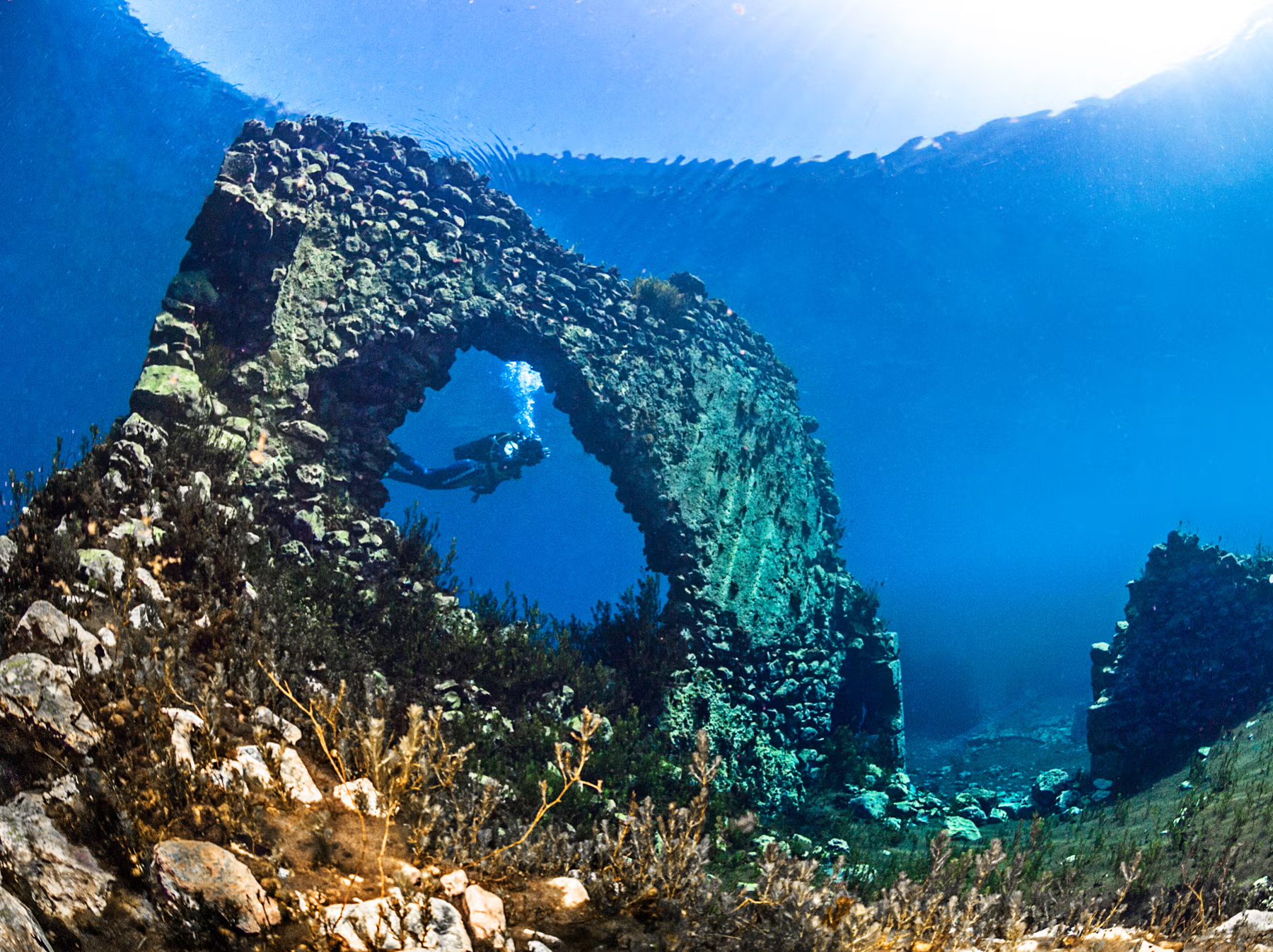
An island partly submerged in water gave the Brittany region of France its own local lore for thousands of years. Off the coast of the Ile de Sein, the ruins of a 7,000-year-old wall that once belonged to a Stone Age civilization were spotted by marine archaeologists almost thirty feet beneath the surface. Discovered by geologist Yves Fouquet while he was studying undersea depth charts determined by radar, it appeared as a suspicious line at the edge of an undersea valley, something nature could not have possibly created. What remains of this wall is thought to have been either a fish weir or a dyke built to protect against rising waves.
More From Popular Mechanics
Further analysis using LIDAR data found eleven structures, which could have only been made by the hands of humans, at the bottom of the ocean. Relative sea level data, which reflects changes in sea level and vertical land movement, showed that they dated back to sometime between 5,800 and 5,300 BCE, a time of transition between Mesolithic hunter-gatherer lifestyles and the permanent Neolithic settlements. Since the shoreline then was several miles from where it is today, evidence of human occupation has long since been submerged underwater.
Related Story
Archaeologists Found Ancient Relics Underwater
Fouquet and his research team realized that what they had found was at least 500 years older than the first megaliths raised by Neolithic populations in Brittany.
“Due to the difficulties in accessing these sites (strong tidal currents, high hydrodynamic conditions, seaweed cover), little archaeological work has been carried out in the deep areas of the Brittany coast,” he said in a study recently published in the International Journal of Nautical Archaeology. “The low resolution of nautical charts also explains the virtual absence of archaeological knowledge for these periods.”
While some evidence of Late Mesolithic coastal human populations in the region has been found, such as shell middens near the shore and megaliths in waters further out, the ocean has not given up many artifacts. Aerial observations did identify prehistoric fish weirs in the Molène archipelago where the island is located, and it is possible that at least some of the megalithic fragments near Ile de Sein had once supported a structure of sticks and branches meant to trap fish in the retreating tide. Together, the fragments weigh 3,300 metric tons, which can also support the idea of larger structures built to prevent flooding when the sea level rose.