New research finds that at least four individuals who died in the eruption were wearing woolen tunics and cloaks, which raises questions about the presumed date of the famous catastrophe
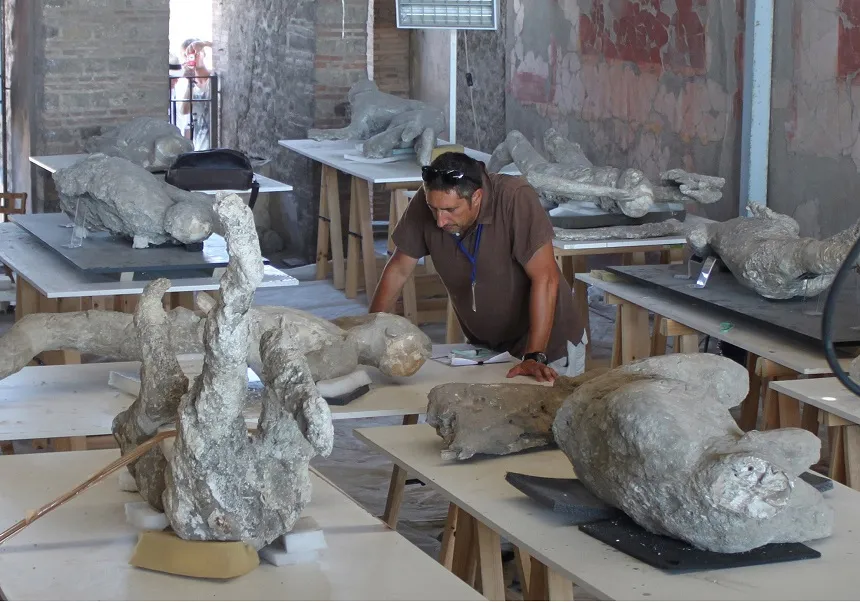
Llorenç Alapont, an archaeologist at the University of Valencia, led the recent research on plaster casts of Pompeii victims.
The late August eruption date stems largely from letters written by Pliny the Younger. The Roman author and administrator witnessed the disaster as a teenager but did not write about it for roughly 30 years. In letters to Tacitus, a Roman historian and politician, Pliny the Younger wrote that the eruption took place on August 24.
However, the date is still a source of debate. Some scholars point to seemingly contradictory evidence discovered at the site, including fruits that would have only been available in the fall, wine fermenting in clay vessels and a fragile inscription dated to mid-October.
This is not the first time researchers have discovered evidence that suggests victims were wearing wool clothing during their final hours on earth. In 2020, archaeologists found the remains of two men who appear to have survived the initial eruption but died during a second blast the next day. Plaster casts revealed that one of the men was likely wearing a woolen cloak, while the other was probably wearing a short, pleated tunic.
Researchers have now made more than 100 plaster casts of Pompeii victims, using a technique developed by Italian archaeologist Giuseppe Fiorelli in the mid-19th century.
“It is impossible to see those deformed figures, and not feel moved,” wrote Italian author Luigi Settembrini in 1863, according to the Pompeii Archaeological Park. “They have been dead for 18 centuries, but they are human beings seen in their agony. This is not art, it is not imitation; these are their bones, the remains of their flesh and their clothes mixed with plaster. It is the pain of death that takes on body and form.”