5,500-Year-Old Dairy Rituals and Early Wheeled Transport Discovered in Poland
Archaeologists working at the Neolithic site of Sławęcinek have uncovered evidence of complex ritual practices involving processed dairy products dating back around 5,500 years. The findings provide new insight into early farming societies in Europe, particularly those associated with the Funnel Beaker Culture.
The research suggests that these communities were not only advanced in early agriculture but also engaged in symbolic drinking rituals, social organization, and possibly even early technological representation.
A Major Neolithic Settlement Revealed
The site, first discovered in 2016, has yielded approximately 6,300 pottery fragments. Excavations were carried out by a team of Polish and British researchers studying the development of early farming societies in the region.
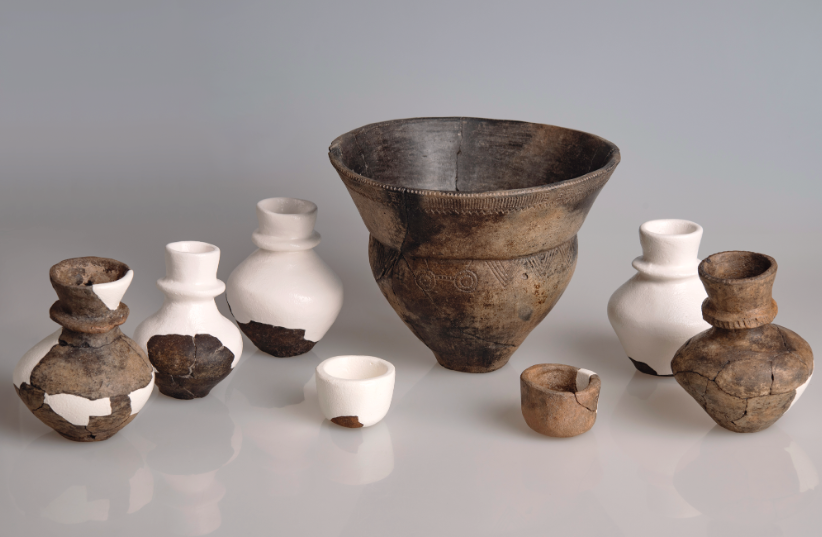
Among the most important finds were ritual drinking vessels, including:
Funnel beakers
Collared flasks
Ceramic cups
These vessels appear to have been used in structured ceremonial activities rather than everyday domestic life.
Dairy Processing and Lactose Reduction
Scientific residue analysis revealed traces of dairy products that had been processed to reduce lactose content.
This is especially significant because most Neolithic populations in Europe were largely lactose intolerant. According to researchers, this meant that milk had to be transformed into fermented or processed forms such as:
Yogurt-like products
Fermented dairy drinks
Other low-lactose derivatives
These techniques allowed early communities to safely consume a valuable nutritional resource long before widespread genetic lactose tolerance evolved.
As noted by researcher Łukasz Kowalski, processing milk in this way was essential for making dairy usable in daily life and ritual contexts.
Ritual Drinking and Possible Funerary Practices
Evidence suggests that these dairy-based drinks were consumed in ceremonial settings, possibly linked to funerary rituals.
A striking detail is that human remains found near the drinking vessels were predominantly female. This has led researchers to propose several interpretations, including:
Rituals centered around women
Social bonding ceremonies among female groups
Possible matrilineal social structures
The existence of women’s ritual or secret societies
While these ideas remain hypothetical, they point to a potentially more complex social organization than previously assumed for Neolithic Europe.
Feasting, Food, and Social Structure
Alongside the pottery, archaeologists also uncovered thousands of animal bone fragments, mainly from:
Cattle
Sheep
Pigs
These remains are interpreted as evidence of large-scale feasting events. The combination of animal consumption and specialized drinking vessels suggests that ritual gatherings played a key role in reinforcing community ties and social identity.
One of the Earliest Images of Wheeled Transport?
Perhaps the most intriguing discovery is a decorated ceramic cup featuring circular and linear patterns. Researchers believe the design may represent a wheeled vehicle.
If confirmed, this would make it one of the earliest known depictions of wheeled transport in the world, dating to around 3500 BCE. This interpretation remains tentative, but it adds an exciting technological dimension to the site.
Life in the Funnel Beaker Culture
The discoveries are associated with the Funnel Beaker Culture, a group described by researchers as early farming communities transitioning from subsistence agriculture toward more complex social and economic systems.
These societies:
Practiced mixed farming
Developed long-distance cultural connections
Created structured ritual traditions
Experimented with early symbolic art and technology
A Glimpse Into Early European Society
Together, the findings from Sławęcinek suggest a society that was far more socially and symbolically developed than previously thought.
Rather than simple farming communities, these Neolithic groups appear to have engaged in:
Ritualized consumption of specialized foods
Communal feasting practices
Symbolic representation of technology
Possibly gendered or kinship-based ceremonial systems
An Ongoing Archaeological Debate
Despite the excitement, researchers emphasize that some interpretations—especially those involving matrilineal societies and wheeled transport imagery—remain speculative.
Further analysis will be needed to confirm:
The exact function of the dairy rituals
The meaning of burial associations
Whether the ceramic imagery truly represents vehicles
Why This Discovery Matters
If fully confirmed, the findings could reshape our understanding of early European societies by showing that:
Dairy processing was central to ritual life
Social organization may have been more complex and gender-influenced than assumed
Symbolic and technological thinking existed alongside early farming
The Sławęcinek site continues to offer a rare and detailed window into Neolithic life—one where food, ritual, and emerging technology were deeply interconnected.