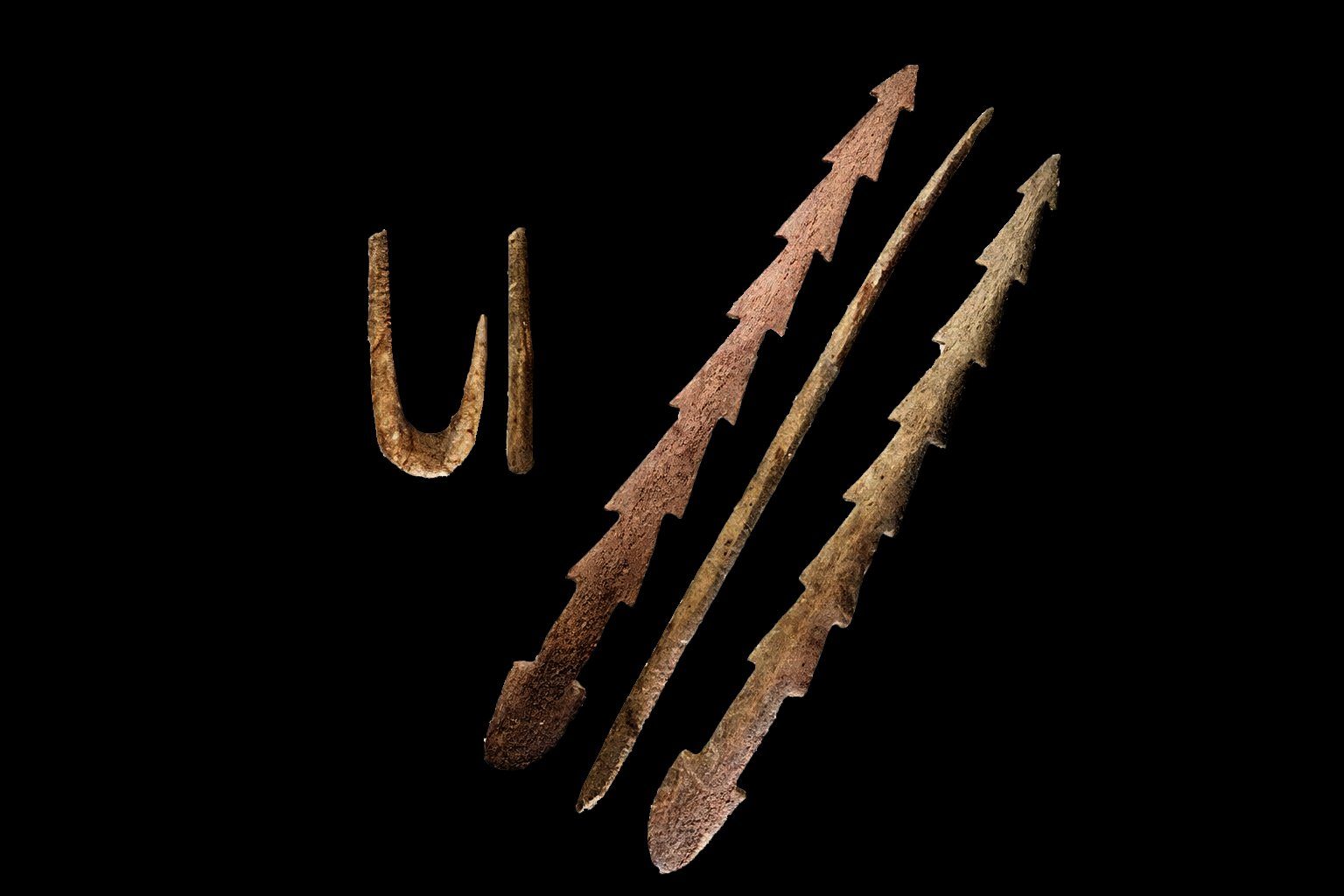
Archaeologists in Krasnoyarsk have uncovered fishing equipment dating back 9,000 to 10,500 years, offering rare insight into how early communities survived in the challenging river systems of Yenisei Siberia.
The artefacts were studied by specialists from the Museum of Archaeology and Ethnography of Yenisei Siberia at Siberian Federal University as part of ongoing research into prehistoric subsistence practices.
All of the recovered fishing tools were crafted from deer antler — a strong yet workable material that served as a primary resource for toolmaking in prehistoric times. Among the most striking finds are fishing hooks remarkably similar in overall shape to modern ones.
But here’s where it gets fascinating: instead of the looped eye found on modern hooks, these ancient versions feature small carved notches at the base. Fishing lines would have been secured in these grooves. Researchers suggest this design reflects a sophisticated understanding of tension and mechanical stress, as the notched system would help distribute force evenly — especially crucial in the fast-moving waters typical of Siberian rivers.
Another standout discovery is a 27-centimetre-long harpoon, also carved from deer antler. Its production required a multi-step, highly technical process:
The antler was cut with a stone axe.
It was then split lengthwise using burins (specialized chisel-like stone tools).
One half was shaped into a barbed harpoon head.
Finally, the surface was polished with abrasive stone to strengthen and smooth the tool.
This sequence shows not just craftsmanship, but accumulated technical knowledge passed down through generations.
Researchers emphasize that fishing for these early Siberian populations wasn’t casual — it was survival. In a harsh climatic environment, reliable equipment and deep knowledge of fish behavior would have been essential for maintaining stable food supplies.
Honestly, what stands out most is the precision. Ten thousand years ago, in one of the planet’s tougher environments, people weren’t improvising wildly — they were engineering. These artefacts reveal ingenuity, adaptation, and a level of technical sophistication that challenges any assumption that prehistoric life was “simple.”