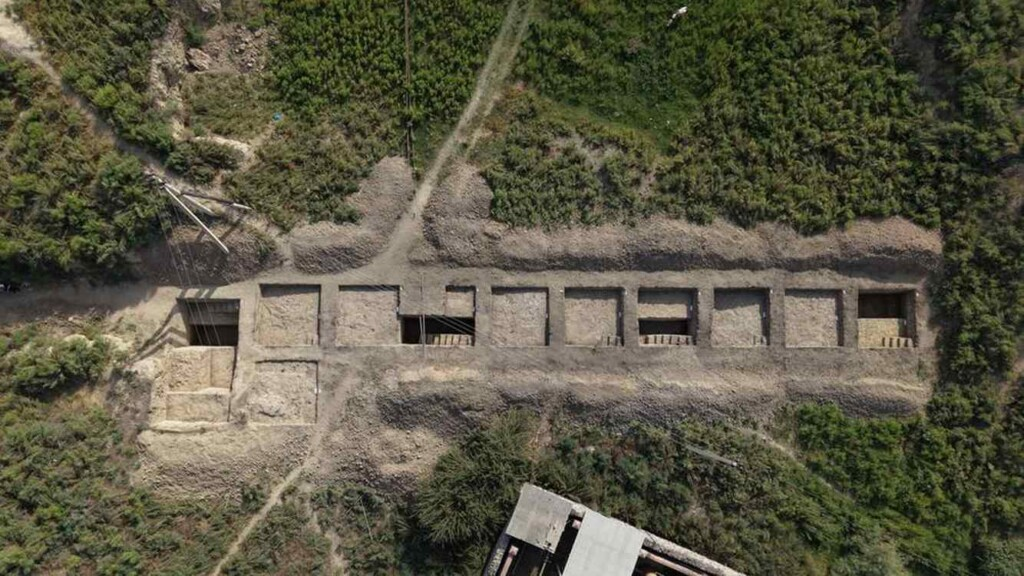
A joint archaeological team from China and Uzbekistan has uncovered sections of the walls of a significant Silk Road city, shedding new light on the region’s ancient past.
After two years of excavation, researchers have revealed the foundations of palaces, city gates, homes, street networks, and craft workshops at a site known as Kuva. The settlement lies in Uzbekistan’s Fergana Valley, close to the Chinese border, and would have been one of the earliest stops along the Silk Road after travellers crossed the harsh Tarim Basin.
Kuva is thought to have been occupied from the 3rd century BCE until the 10th century CE. Over that long period, it passed through the hands of several powers, including the Achaemenid Persians, Macedonians, Parthians, Sogdians, and later a new Persian dynasty.
In 2023, China’s Luoyang Archaeological Institute joined forces with Fergana State University to investigate a 110,000-square-metre area believed to contain the remains of the ancient city. Most recently, the team uncovered standing sections of city walls buried underground, confirming earlier theories that the walls were rebuilt multiple times throughout Kuva’s history.
Mr Liu Bin, head of the Chinese side of the expedition, told Xinhua that studying the construction techniques of the walls will help researchers establish more accurate dates for each phase of occupation and identify the architectural styles associated with different ruling groups.
Kuva and the wider Fergana Valley hold particular importance in Chinese history. During the Han Dynasty, China’s first unified empire, Han rulers fought repeated wars against the nomadic Xiongnu confederation to keep western routes open. These routes later formed the Great Silk Roads, with Fergana as one of their key early stops.
Historical records show that part of the Han Dynasty’s military success came from securing a supply of horses from the Fergana Valley. Known as “Heavenly Horses,” these animals were faster and stronger than those from northern China, giving the Han army a crucial advantage against the highly mobile Xiongnu. Kuva likely played a role in facilitating this trade of horses in exchange for silk and jade.
Along the Silk Roads, prosperous trading posts often grew into wealthy city-states. However, when trade networks were disrupted, such cities could quickly fall into decline, facing economic collapse and even starvation.
Many Silk Road routes are dotted with ruins left behind by these breakdowns in trade. One such example, reported last year, involved the first survey of two ancient settlements—Tugunbulak and Tashbulak—in southeastern Uzbekistan near the Afghan border. These sites appear to have functioned as centres for mining, iron smelting, and the production of finished goods for nomadic groups, effectively serving as semi-independent trade hubs.
Discovered as recently as 2015 in the Mal’guzar Valley, these settlements lay beyond the control of major kingdoms and relied heavily on trade along the Silk Road’s southern branch through Afghanistan and eastern Iran.
Cities such as Kuva and Tugunbulak are crucial for understanding the rise and decline of trade along the Silk Road. Excavations at Kuva are expected to continue for some time, with researchers hopeful that further discoveries will deepen knowledge of this famous trans-Asian network.
Looking ahead, Liu Bin said that systematic excavations of the palace areas are planned for next year to gain a clearer understanding of the settlement’s layout and functional zones.