Remarkable Petroglyph Discoveries in Southern Siberia
Archaeologists carrying out emergency excavations in southern Siberia have uncovered an extraordinary collection of petroglyphs that is transforming scholarly understanding of ancient rock art in the Republic of Khakassia.
The findings were announced by the Institute of the History of Material Culture (IHMC) of the Russian Academy of Sciences. The discoveries come from the burial grounds of Ust-Kamyshta-1 and Kamyshta-3 in the Askizsky district.
Rescue Excavations Reveal Hidden Treasures
Between 2021 and 2023, the Sayan Archaeological Expedition conducted rescue excavations to document and protect cultural heritage sites at risk of damage or destruction.
The burial grounds were used continuously for over three thousand years, beginning in the Early Bronze Age (3rd millennium BCE) and continuing into the early centuries AD. Over time, they became associated with nearly every major archaeological culture identified in Khakassia.
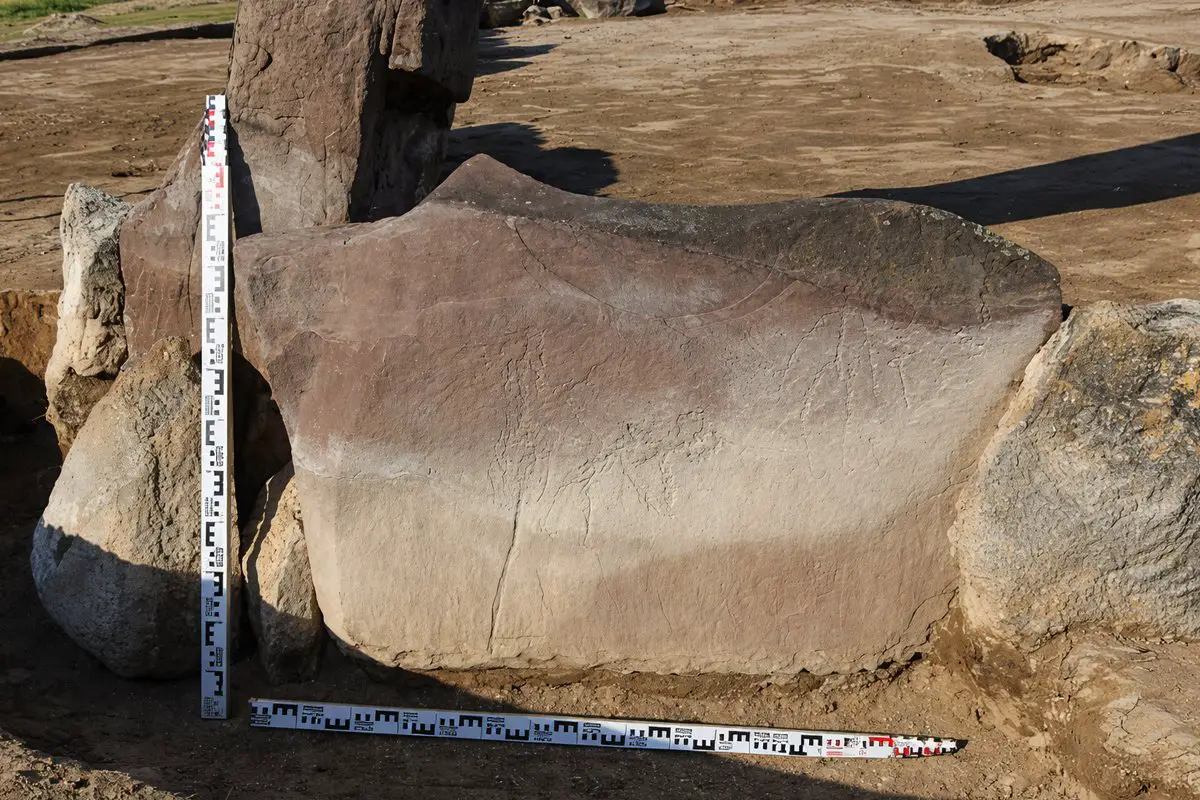
Among the most significant discoveries are ten stone slabs engraved with petroglyphs—images carved directly into stone surfaces.
Why These Petroglyphs Matter
In most parts of the region, petroglyphs are found on exposed cliffs and rocky outcrops. While visually impressive, such open-air carvings are notoriously difficult to date with precision.
These newly discovered examples are different.
The slabs were uncovered inside sealed burial mounds. Because they were found in closed archaeological contexts, researchers could determine their age more reliably using associated grave goods, construction methods, and stratigraphic layers.
This secure dating gives scholars a rare and valuable chronological anchor.
Tagar and Tesin Cultures of the Minusinsk Basin
Most of the slabs date to the Early Iron Age, roughly between the 8th century BCE and the 2nd century CE. They are linked to the Tagar culture and the Tesin culture, two major cultural traditions of the Minusinsk Basin and surrounding territories.
To confirm these attributions, researchers conducted detailed comparative analyses. They examined similarities in style and subject matter between the burial mound carvings and known open-air rock art panels from the region. They also compared depictions of weapons—such as daggers, chisels, and bows—with actual artefacts recovered from contemporary burials.
From Hunting Scenes to Abstract Symbols
Six of the ten slabs display elaborate narrative imagery.
The earlier examples, linked to the Tagar culture, feature dynamic hunting scenes. One particularly vivid carving shows a human figure accompanied by a dog pursuing a large animal. The prey may represent either real wildlife or a symbolic, possibly mythological creature.
In contrast, slabs associated with the later Tesin culture appear more abstract. These carvings include spirals, labyrinth-like designs, and simplified human forms. The shift suggests a possible evolution in artistic expression and symbolic meaning over time.
Changing Meanings Over Time
Researchers believe the carved slabs reached the burial mounds through different processes.
Some stones seem to have been intentionally created for funerary use and integrated directly into grave structures. Others were discovered broken, overturned, or reused as construction material. This suggests that later communities sometimes repurposed older carved stones, potentially altering or stripping away their original sacred significance.
A New Chronological Anchor for Siberian Rock Art
Because these petroglyphs were found in securely dated burial contexts, they now serve as critical chronological reference points. For scholars studying southern Siberian rock art, this is a major breakthrough.
The discoveries allow researchers to connect artistic traditions with specific historical periods more confidently. As a result, they provide fresh clarity about the cultural development of the region across many centuries.
What began as a rescue excavation has turned into a landmark contribution to understanding the long and complex history of rock art in southern Siberia.