High-resolution scans of a crushed skull reveal unexpected links to East African fossils
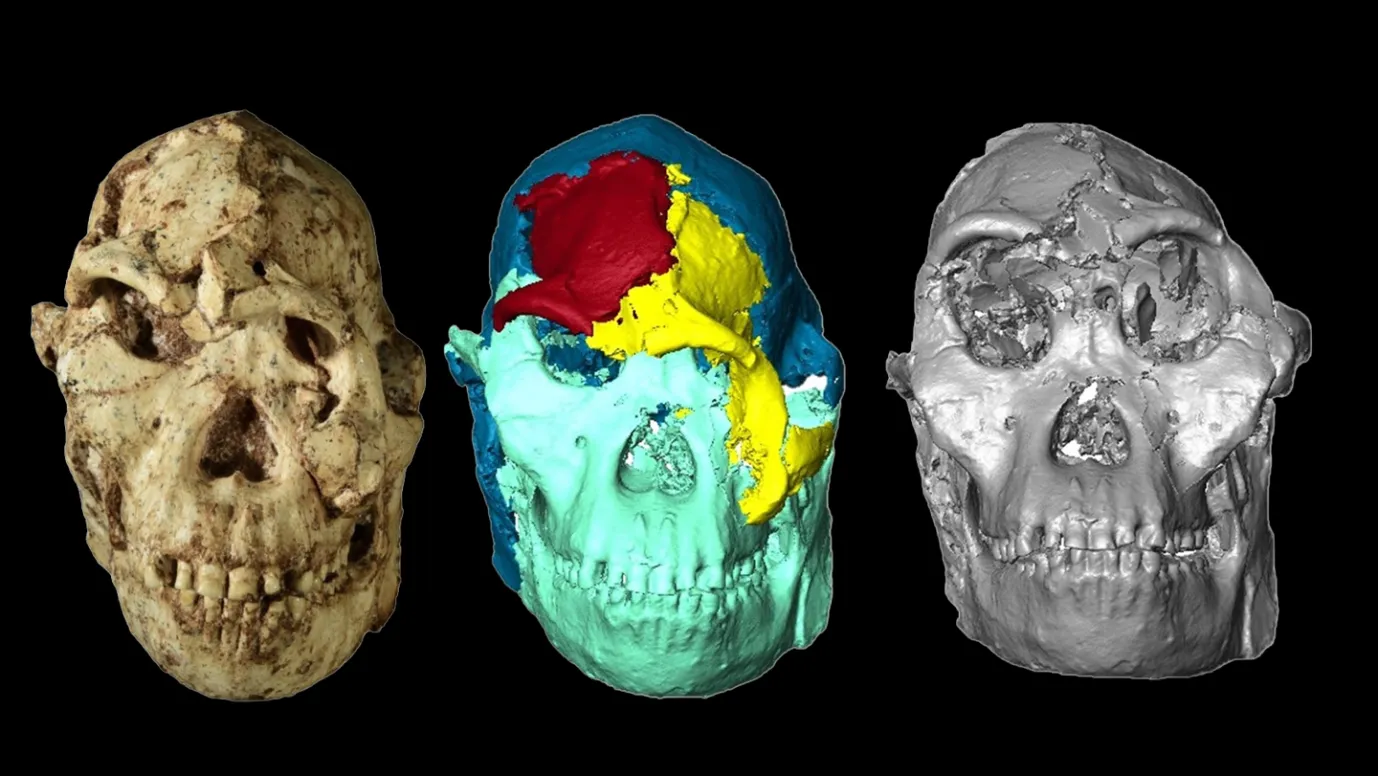
The original skull (left), digital scan (middle) and reconstructed face of Little Foot offer a closer look at this enigmatic ancient human relative.
Meeting “Little Foot”: A Window Into Early Human Evolution
Scientists have unveiled a striking digital reconstruction of an ancient human ancestor known as Little Foot. The new facial model, published March 2 in Comptes Rendus Palevol, offers one of the clearest views yet of this early relative—and provides valuable clues about the path of human evolution.
Who Was Little Foot?
Little Foot belongs to the genus Australopithecus, a key ancestral group that predates our own genus, Homo. These early hominins played a crucial role in shaping the evolutionary journey that eventually led to modern humans.
The fossil’s story began in 1994, when small foot bones were discovered in a fossil collection at the University of the Witwatersrand in Johannesburg. Three years later, researchers uncovered the rest of the skeleton embedded in rock inside the Sterkfontein Caves, located about 50 kilometers away.
Little Foot is one of the most complete Australopithecus skeletons ever found—making it an extraordinary scientific treasure.
Rebuilding a Face From Stone
Although much of the skeleton was remarkably preserved, parts of the skull and face had been crushed and warped by surrounding rock over millions of years.
In 2019, scientists scanned the skull at a synchrotron X-ray imaging facility in the United Kingdom. This advanced technology produced highly detailed digital models of the fossilized bones. Over the following years, researchers carefully reconstructed the face using digital tools, correcting distortions caused by geological pressure.
“Now we have a very accurate reconstruction—something that would not have been possible with the physical fossil alone,” says Amélie Beaudet, a paleoanthropologist at CNRS in France.
Surprising Features and a Possible Migration
After completing the reconstruction, Beaudet and her team compared Little Foot’s facial features with three other Australopithecus skulls, as well as with modern apes such as gorillas, chimpanzees, and orangutans.
One detail stood out: Little Foot’s unusually wide eye sockets. Intriguingly, some features appear more similar to Australopithecus fossils from East Africa than to those found in South Africa—where Little Foot was discovered.
This observation raises an interesting possibility. Little Foot may belong to a population that migrated from East Africa to southern Africa more than 3.5 million years ago. Such a movement could explain why this individual looks different from Australopithecus fossils found in the same region hundreds of thousands of years later.
However, Beaudet urges caution. The fossil record for Australopithecus is still limited, and conclusions must remain tentative. “We have only a small number of specimens, so we need to interpret the evidence carefully,” she notes.