• MAIN PAGE
  • LATEST NEWS
    • Lost Cities
    • Archaeology's Greatest Finds
    • Underwater Discoveries
    • Greatest Inventions
    • Studies
    • Blog
  • PHILOSOPHY
  • HISTORY
  • RELIGIONS
    • Africa
    • Anatolia
    • Arabian Peninsula
    • Balkan Region
    • China - East Asia
    • Europe
    • Eurasian Steppe
    • Levant
    • Mesopotamia
    • Oceania - SE Asia
    • Pre-Columbian Civilizations of America
    • Iranian Plateau - Central Asia
    • Indus Valley - South Asia
    • Japan
    • The Archaeologist Editor Group
    • Scientific Studies
    • Aegean Prehistory
    • Historical Period
    • Byzantine Middle Ages
    • Predynastic Period
    • Dynastic Period
    • Greco-Roman Egypt
  • Rome
  • PALEONTOLOGY
  • About us
Menu

The Archaeologist

  • MAIN PAGE
  • LATEST NEWS
  • DISCOVERIES
    • Lost Cities
    • Archaeology's Greatest Finds
    • Underwater Discoveries
    • Greatest Inventions
    • Studies
    • Blog
  • PHILOSOPHY
  • HISTORY
  • RELIGIONS
  • World Civilizations
    • Africa
    • Anatolia
    • Arabian Peninsula
    • Balkan Region
    • China - East Asia
    • Europe
    • Eurasian Steppe
    • Levant
    • Mesopotamia
    • Oceania - SE Asia
    • Pre-Columbian Civilizations of America
    • Iranian Plateau - Central Asia
    • Indus Valley - South Asia
    • Japan
    • The Archaeologist Editor Group
    • Scientific Studies
  • GREECE
    • Aegean Prehistory
    • Historical Period
    • Byzantine Middle Ages
  • Egypt
    • Predynastic Period
    • Dynastic Period
    • Greco-Roman Egypt
  • Rome
  • PALEONTOLOGY
  • About us
No results found

Avdeevo: Bone Tools from Russia's Gravettian Hunters

June 22, 2026

Located on the banks of the Rogozna River in the Kursk Oblast of western Russia, Avdeevo is a premier open-air campsite belonging to the Kostenki-Avdeevo Culture, an eastern extension of the Upper Paleolithic Gravettian Industrial Complex dating to approximately 22,000 to 25,000 years ago.

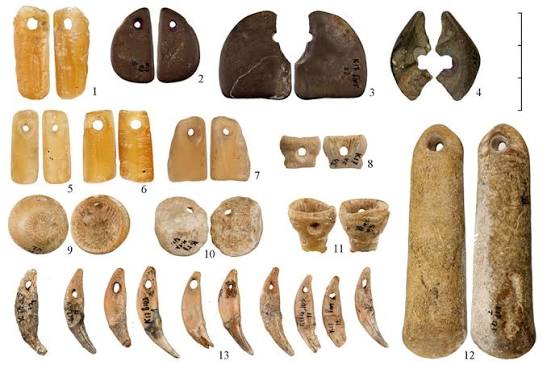
During the Last Glacial Maximum (LGM), this region was an unforgiving, wind-swept mammoth-steppe. Lacking abundant wood or high-quality flint, the hunter-gatherers of Avdeevo engineered a highly specialized, sophisticated technology using the bones, tusks, and antlers of the megafauna they hunted.

The Grid of Living Spaces

Excavations at Avdeevo revealed a highly organized, non-random spatial architecture. The site consists of a large, oval living area measuring roughly 30 by 20 meters, dominated by a central line of hearth pits wrapped by semi-subterranean earth lodges (pithouses).

These lodges were dug deep into the permafrost, roofed with interlocking mammoth ribs, and insulated with thick layers of loess soil and hides to provide a critical thermal defense against sub-zero Arctic winds.

The Organic Toolkit: Mammoth Ivory Needles and Awls

The bone-tool industry at Avdeevo is distinguished by its incredible precision and structural standardization. Rather than merely fracturing bone opportunistically, these hunters treated mammoth ivory as an early composite plastic, using an advanced sequence of operations:

  1. The Softening Matrix: Large segments of raw mammoth tusk were soaked in water or wrapped in damp animal fat for days to soften the dense, mineralized dentin layers.

  2. The Longitudinal Splitting: Using razor-sharp flint burins, craftsmen carved deep, parallel grooves along the length of the tusk, driving in bone wedges to split off long, straight, structural splinters (blanks).

  3. The Micro-Drilling: These ivory blanks were shaved down into incredibly thin, uniform sewing needles and awls. To create the needle eyes without splitting the fragile material, Avdeevo artisans used a mechanical bow-drill apparatus tipped with micro-lithic flint borers, creating clean perforations measuring less than 1 millimeter in diameter.

These needles enabled the fabrication of air-tight, multi-layered tailored fur clothing, boots, and insulated tents—the absolute baseline technology required for anatomically modern humans to survive the crushing climate of the Russian LGM.

Amud Cave: Japan's Twin Neanderthal Fossils? →
Featured
image_2026-06-21_222107159.png
June 22, 2026
Avdeevo: Bone Tools from Russia's Gravettian Hunters
June 22, 2026
Read more →
June 22, 2026
image_2026-06-21_221906754.png
June 22, 2026
Amud Cave: Japan's Twin Neanderthal Fossils?
June 22, 2026
Read more →
June 22, 2026
image_2026-06-21_221732901.png
June 22, 2026
Kebara Cave: Israel's Neanderthal Speech Evidence
June 22, 2026
Read more →
June 22, 2026
image_2026-06-21_221651426.png
June 22, 2026
Shanidar Cave: Iraq's Flower-Burying Neanderthals
June 22, 2026
Read more →
June 22, 2026
image_2026-06-21_221609462.png
June 22, 2026
Tabun Cave: Mount Carmel's 500,000-Year Acheulean Site
June 22, 2026
Read more →
June 22, 2026
image_2026-06-21_221527430.png
June 22, 2026
Skhul Cave: Levantine Neanderthal-Human Hybrids?
June 22, 2026
Read more →
June 22, 2026
read more

Powered by The archaeologist