Introduction
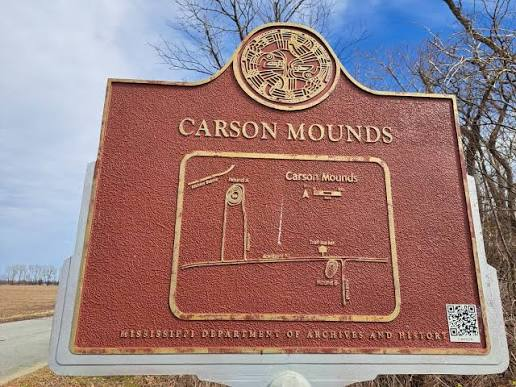
Situated near Clarksdale, Mississippi, in the fertile Yazoo Basin, the Carson Mounds comprise one of the largest prehistoric mound complexes in the Lower Mississippi Valley. Occupied primarily between 1200 and 1500 CE, the site served as a major regional center during the late Mississippian Period, functioning as a political, ceremonial, and economic metropolis. Spread across several hundred acres, Carson originally contained more than 80 earthen mounds, making it one of the most extensive mound groups ever constructed in North America. Its impressive scale demonstrates the remarkable organizational abilities and engineering expertise of the Indigenous societies that inhabited the Mississippi Delta.
Urban Planning and Monumental Earthworks
Unlike many Mississippian towns organized around a single plaza, Carson consisted of numerous mound groups distributed across a broad landscape connected by open spaces and residential districts. The largest platform mounds supported temples, council houses, and elite residences, while smaller mounds served ceremonial, administrative, or funerary purposes.
Builders transported enormous quantities of clay and earth using woven baskets, constructing each mound through repeated stages over several generations. The careful layering of soils improved stability and resistance to erosion, allowing many of the earthworks to survive for centuries despite periodic flooding.
The site's expansive layout suggests that Carson functioned as a regional capital serving numerous surrounding farming communities rather than a single compact settlement.
Political, Religious, and Economic Role
Carson Mounds served as an important political center where hereditary chiefs governed surrounding communities and organized large public ceremonies. Religious rituals conducted atop the platform mounds honored ancestral spirits, agricultural deities, and celestial forces believed to influence fertility and prosperity.
The central plazas hosted seasonal festivals, public feasts, ritual dances, athletic competitions, and diplomatic gatherings that strengthened regional alliances. Agricultural surpluses from nearby villages supported priests, craftsmen, political leaders, and other specialists living within the ceremonial center.
Carson also participated in extensive trade networks linking communities throughout the Mississippi Valley. Artifacts recovered from the site include decorated pottery, shell ornaments, stone tools, copper objects, and exotic materials imported from distant regions, demonstrating its importance as a commercial hub.
Engineering and Archaeological Importance
The construction of more than eighty mounds required careful planning, centralized leadership, and coordinated labor over many centuries. Archaeological excavations have uncovered house foundations, storage pits, workshops, ceremonial buildings, burial areas, and thousands of artifacts that provide valuable information about Mississippian social organization and urban development.
The sheer number and diversity of mounds make Carson one of the most significant archaeological landscapes in North America, illustrating how regional political centers evolved after the decline of Cahokia while maintaining many of the same religious and architectural traditions.
Conclusion
The Carson Mounds represent one of the largest and most impressive Mississippian mound complexes ever constructed in North America. Its vast network of platform mounds, ceremonial plazas, residential districts, and trade connections reflects a highly organized civilization capable of coordinating monumental public works and sustaining complex political and religious institutions. Today, Carson remains one of Mississippi's most significant archaeological sites, offering invaluable insight into the engineering achievements, urban planning, and cultural legacy of the Indigenous peoples who flourished in the Lower Mississippi Valley before European contact.