Introduction
Located in Jefferson County, Mississippi, overlooking the fertile floodplains of the Mississippi River, the Feltus Mounds represent one of the best-preserved ceremonial centers of the Plaquemine culture, which flourished between approximately 1200 and 1540 CE. The Plaquemine people were descendants of earlier Mississippian societies who developed distinctive political and religious traditions in the Lower Mississippi Valley. Covering more than 36 acres (15 hectares), Feltus consisted of several large platform mounds arranged around broad ceremonial plazas, serving as an important center for religious rituals, political gatherings, trade, and community celebrations.
Site Layout and Platform Mounds
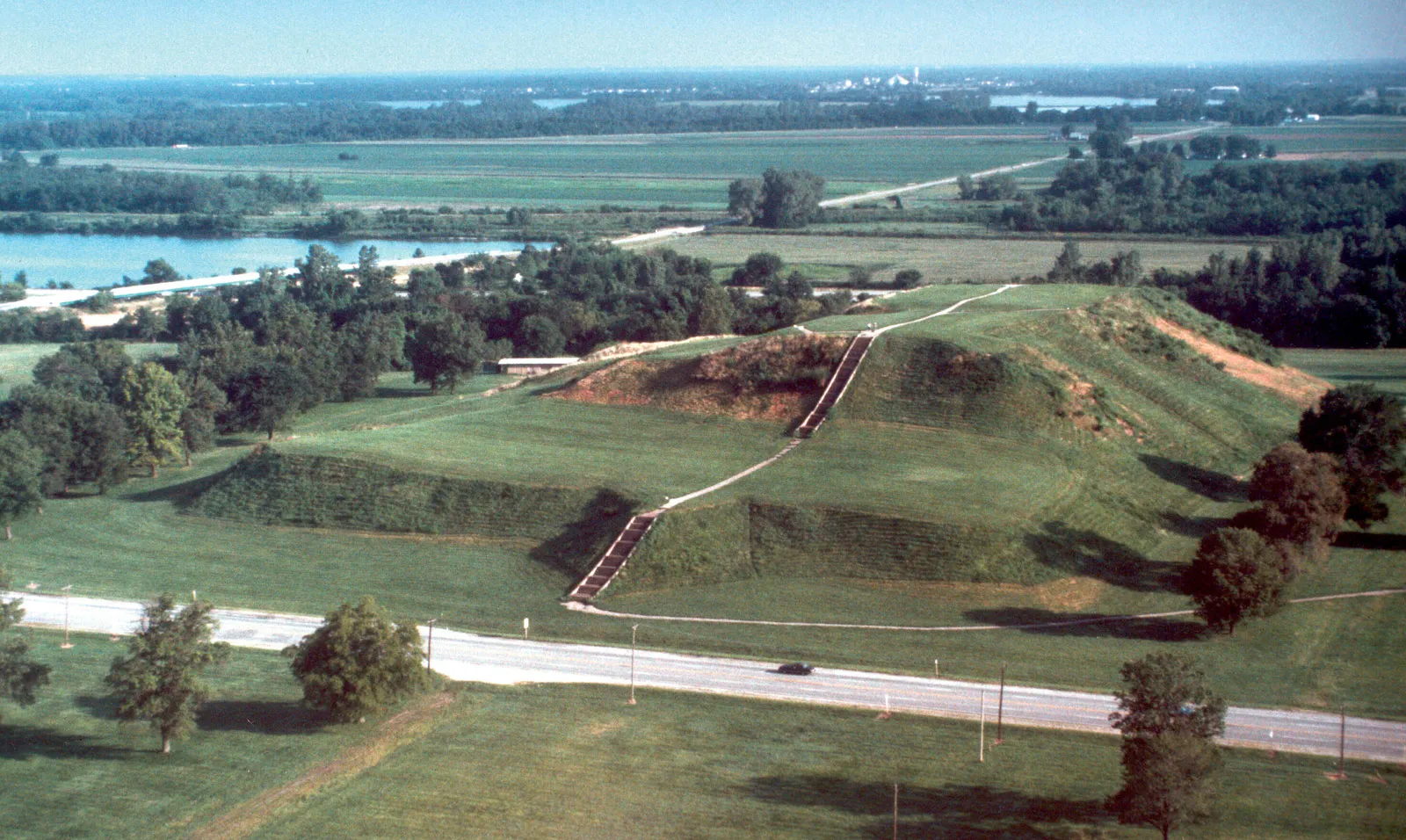
The Feltus complex contains four large earthen platform mounds surrounding a spacious rectangular plaza. These mounds were constructed through repeated additions of compacted clay and soil, transported in thousands of woven baskets over many generations. Their flat summits supported wooden temples, council houses, elite residences, and ceremonial buildings elevated above the surrounding landscape.
The carefully planned arrangement of the mounds created a formal ceremonial precinct where public rituals and community gatherings could take place. Broad ramps connected the plaza with the elevated structures, allowing processions to move between sacred spaces during religious festivals.
Religious and Ceremonial Functions
Feltus served primarily as a ceremonial center rather than a densely populated town. The expansive plaza hosted seasonal festivals, dances, feasts, athletic competitions, and diplomatic meetings involving neighboring communities. Priests conducted rituals atop the platform mounds to honor ancestral spirits, agricultural deities, and supernatural beings associated with fertility and cosmic order.
The site's architecture reflects the Plaquemine emphasis on sacred landscapes, where elevated mounds symbolized the connection between the human world and the spiritual realm. Ceremonial gatherings strengthened alliances between communities while reinforcing the authority of hereditary leaders.
Agriculture and Daily Life
Nearby villages surrounding Feltus cultivated maize, beans, squash, sunflowers, and other crops in the fertile alluvial soils of the Mississippi River Valley. Hunting deer, turkey, and small game, together with fishing and gathering wild plants, supplemented agricultural production.
Archaeological excavations have uncovered finely crafted pottery, stone tools, shell ornaments, and food remains, indicating a prosperous farming society supported by extensive regional trade. The community maintained cultural connections with neighboring Mississippian and Plaquemine settlements while preserving its own distinctive artistic traditions.
Archaeological Significance
The Feltus Mounds provide valuable evidence for understanding the evolution of the Plaquemine culture after the decline of Cahokia and other major Mississippian centers. Excavations have revealed multiple construction phases, ceremonial buildings, domestic structures, and numerous artifacts that illuminate changes in political organization, religious practices, and regional interaction.
Because the site remained relatively undisturbed for centuries, archaeologists have been able to reconstruct its original layout with considerable accuracy, making Feltus one of the most important Plaquemine archaeological sites in Mississippi.
Conclusion
The Feltus Mounds stand as an outstanding example of Plaquemine ceremonial architecture, demonstrating the continued tradition of platform mound construction in the Lower Mississippi Valley after the height of the Mississippian Civilization. Its monumental earthworks, organized plazas, agricultural economy, and rich ceremonial life reveal a sophisticated Indigenous society whose cultural achievements continued to shape the region well into the centuries preceding European contact.