Introduction
Located near present-day Natchez, Mississippi, the Grand Village of the Natchez served as the principal political, religious, and ceremonial center of the Natchez Nation during the 17th and early 18th centuries CE. Occupied from approximately 1680 to 1730 CE, the settlement became one of the last great Indigenous ceremonial centers in the Lower Mississippi Valley before European colonization permanently altered Native American societies. The site consisted of three large platform mounds surrounding an open central plaza, where temples, elite residences, and council buildings symbolized the close relationship between political leadership and religious authority. The Grand Village was also the residence of the Great Sun, the hereditary ruler of the Natchez, whose authority was believed to have divine origins. Today, the site provides one of the clearest archaeological and historical records of a Mississippian-descended society encountered by European explorers.
Settlement Layout and Monumental Mounds
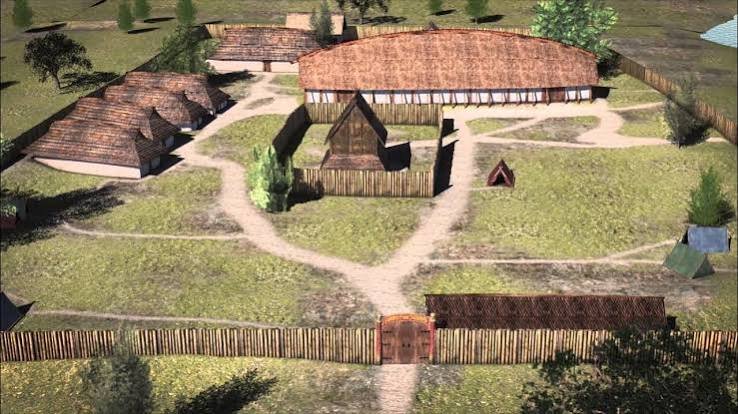
The Grand Village was carefully organized around a spacious central ceremonial plaza, bordered by three prominent earthen platform mounds. Each mound supported an important structure associated with government, religion, or elite residence. The largest mound, known as the Temple Mound, housed the sacred temple where an eternal fire was maintained by priests and priestesses. This fire symbolized the spiritual continuity and divine protection of the Natchez people.
A second mound supported the residence of the Great Sun, while another served as the location for council meetings and administrative functions. Surrounding the plaza were clusters of ordinary houses constructed from wooden poles covered with woven cane mats and coated with clay plaster. The orderly arrangement of buildings reflected a well-planned community centered on ceremonial and political life.
Political and Religious Organization
Natchez society was highly stratified, with hereditary social classes headed by the Great Sun, who functioned as both political ruler and sacred leader. His authority was reinforced through elaborate religious ceremonies held atop the platform mounds, where priests conducted rituals honoring the Sun, ancestral spirits, and agricultural deities.
Public festivals celebrated seasonal events such as planting and harvesting, while diplomatic councils and legal proceedings took place within the central plaza. The sacred temple also housed important ceremonial objects, including carved wooden statues, ritual offerings, and the remains of distinguished ancestors. These religious traditions preserved many features inherited from the earlier Mississippian Civilization while adapting to changing historical circumstances.
European Contact
French explorers first encountered the Natchez during the late seventeenth century and recorded detailed descriptions of the Grand Village, making it one of the best-documented Indigenous ceremonial centers in North America. The French observed the impressive platform mounds, the sacred temple with its perpetual fire, and the elaborate rituals performed by Natchez priests.
Relations between the Natchez and French settlers gradually deteriorated because of expanding colonial settlements and increasing demands for land. Tensions culminated in the Natchez Revolt of 1729, during which Natchez warriors attacked the French settlement at Fort Rosalie. The French and their Native allies eventually defeated the Natchez, leading to the destruction of the Grand Village and the dispersal of the Natchez Nation throughout the Southeast.
Archaeological Importance
Excavations at the Grand Village have uncovered house foundations, pottery, stone tools, shell ornaments, food remains, ceremonial objects, and evidence of multiple construction phases. Because these archaeological discoveries can be compared directly with historical accounts written by French observers, the site provides a rare opportunity to verify and better understand Indigenous political organization, religious practices, and daily life during the early colonial period.
The preservation of the platform mounds and ceremonial plaza continues to offer valuable insights into the final centuries of Mississippian cultural traditions.
Conclusion
The Grand Village of the Natchez represents one of the last flourishing ceremonial capitals of the Mississippian cultural tradition before European colonization transformed the Native societies of the Southeast. Its monumental platform mounds, sacred temples, centralized political system, and well-documented religious ceremonies demonstrate the remarkable continuity of Indigenous civilization in the Lower Mississippi Valley. Today, the site remains one of the most important archaeological and historical landmarks in Mississippi, preserving the legacy of the Natchez people and their enduring cultural achievements.