Introduction
Located in northeastern Mississippi, the Renfrew Mounds represent an important regional ceremonial center associated with the expansion of Mississippian culture across the Tennessee–Tombigbee river system. Occupied between approximately 1200 and 1450 CE, the settlement functioned as a smaller political and ceremonial community closely connected to the larger Mississippian centers of the Southeast, particularly Moundville in present-day Alabama. Because of similarities in architecture, pottery, and ceremonial artifacts, archaeologists regard Renfrew as one of the satellite communities that participated in the broader Moundville cultural network. The site demonstrates how Mississippian political influence extended across multiple river valleys through shared religious traditions, trade, and architectural practices.
Settlement Layout and Platform Mounds
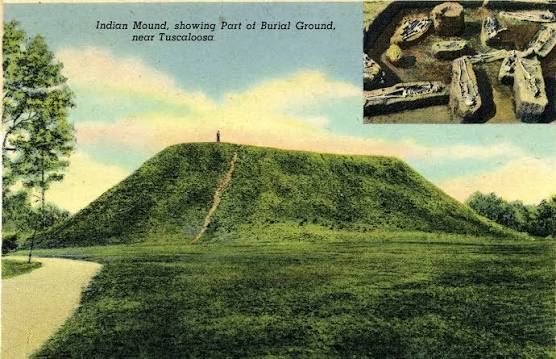
The Renfrew Mounds were organized around a central ceremonial plaza bordered by several earthen platform mounds. These elevated structures were constructed by transporting compacted clay and soil in woven baskets over many years. The largest mound likely supported a temple or the residence of a local chief, while smaller mounds served as council houses, ceremonial buildings, and elite residences.
The surrounding residential area consisted of rectangular wooden houses arranged around the ceremonial center. Storage pits, workshops, and agricultural fields indicate that Renfrew supported a permanent farming population while serving as an important gathering place for nearby villages.
Connections to Moundville
Archaeological evidence demonstrates strong cultural ties between Renfrew and Moundville, one of the largest Mississippian cities in the Southeast. Pottery styles, engraved shell ornaments, ceremonial stone tools, and architectural layouts closely resemble those found at Moundville, suggesting frequent interaction through trade, migration, or political alliances.
The site likely functioned as a regional administrative center where local leaders maintained relationships with larger chiefdoms while governing surrounding farming communities. These connections illustrate the widespread influence of Mississippian civilization throughout the southeastern United States.
Economy and Religious Life
Residents cultivated maize, beans, squash, and sunflowers while hunting deer and fishing in nearby rivers. Agricultural surpluses supported priests, craftsmen, and community leaders responsible for organizing ceremonies and maintaining public buildings.
Religious festivals held within the central plaza included ritual dances, feasting, ancestor veneration, and agricultural ceremonies associated with seasonal cycles. Temples atop the platform mounds reinforced the sacred authority of local chiefs and strengthened community identity.
Archaeological Importance
Excavations have uncovered pottery, shell ornaments, stone tools, food remains, and building foundations that reveal the daily life of a regional Mississippian community. Renfrew is especially important because it demonstrates how large ceremonial capitals such as Moundville influenced surrounding settlements without direct political control.
Conclusion
The Renfrew Mounds illustrate the regional expansion of Mississippian civilization beyond its major urban centers. Its platform mounds, ceremonial plaza, agricultural economy, and strong cultural ties with Moundville highlight the interconnected political and religious landscape of the prehistoric Southeast. The site remains an important example of how smaller ceremonial communities contributed to the success and spread of Mississippian culture.