Introduction
Located along the Crawfish River in present-day Jefferson County, Wisconsin, Aztalan was one of the northernmost settlements influenced by the Mississippian Civilization. Occupied between approximately 1000 and 1300 CE, the site flourished as a fortified ceremonial, political, and trading center that connected the cultures of the Upper Midwest with the great Mississippian cities farther south, particularly Cahokia in present-day Illinois. Covering nearly 20 acres (8 hectares), Aztalan featured massive earthen platform mounds, defensive stockades, residential neighborhoods, ceremonial plazas, and specialized workshops. Although considerably smaller than Cahokia, Aztalan demonstrates how Mississippian culture spread hundreds of kilometers beyond the Mississippi Valley while adapting to the forests and river systems of Wisconsin.
Urban Planning and Settlement Layout
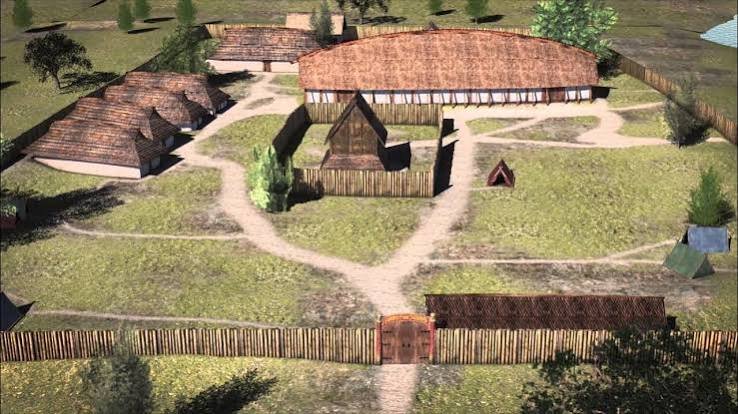
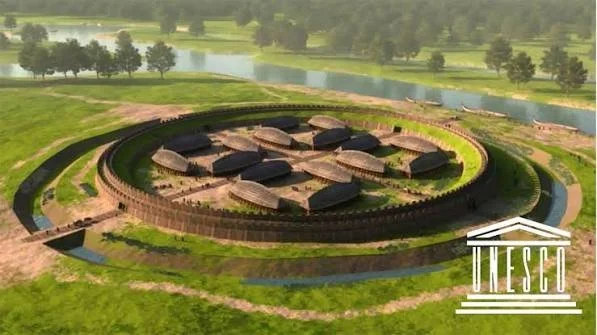
Aztalan was carefully planned around a large rectangular central plaza, which served as the heart of religious ceremonies, public gatherings, athletic competitions, and community celebrations. Surrounding the plaza were several earthen platform mounds that supported important public buildings, including temples, council houses, and the residences of political and religious leaders.
The community's houses were arranged in organized neighborhoods enclosed within the defensive walls. Storage pits, workshops, cooking areas, and refuse deposits indicate that the settlement supported a permanent population engaged in farming, trade, and specialized craft production. Pathways connected the residential districts to the ceremonial center, reflecting a well-organized urban design that balanced daily life with religious and political functions.
Platform Mounds and Monumental Construction
The most recognizable features of Aztalan are its three large platform mounds, constructed by transporting thousands of basket loads of clay and earth. Builders carefully layered soils to improve stability and reduce erosion, creating flat-topped platforms that elevated important structures above the surrounding landscape.
The largest mound likely supported the residence of the ruling chief or a temple where priests conducted religious ceremonies. Other mounds housed public buildings used for administration, community meetings, and ceremonial rituals. These elevated structures symbolized political authority while protecting important buildings from seasonal flooding.
The engineering techniques used at Aztalan closely resemble those found at Cahokia, demonstrating the influence of Mississippian architectural traditions throughout the Upper Midwest.
The Defensive Stockade
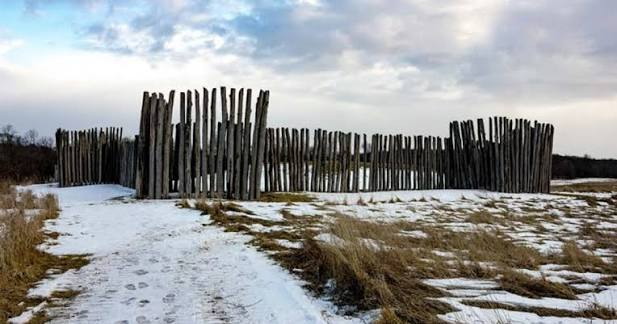
One of Aztalan's most distinctive features was its impressive wooden stockade, which surrounded much of the settlement. The wall consisted of closely spaced oak posts driven deeply into the ground and reinforced with horizontal beams. At regular intervals, rectangular bastions projected outward from the wall, allowing defenders to observe approaching visitors and protect vulnerable sections of the enclosure.
The stockade served several purposes. It provided military defense against potential enemies, controlled entry through designated gateways, and clearly marked the political and ceremonial boundaries of the community. The construction of such an extensive fortification required coordinated labor and careful planning, illustrating the organizational abilities of Aztalan's inhabitants.
Agriculture, Trade, and Daily Life
The people of Aztalan practiced intensive agriculture centered on maize (corn) cultivation, supplemented by beans, squash, and sunflowers. Hunting deer, elk, waterfowl, and fishing in the Crawfish River provided additional sources of food, allowing the community to maintain a stable year-round population.
Archaeological excavations have uncovered evidence of extensive trade with distant regions. Artifacts made from Gulf Coast marine shells, Great Lakes copper, southern chert, and exotic stone demonstrate that Aztalan participated in the widespread Mississippian trade network. Skilled artisans produced decorated pottery, stone tools, shell ornaments, and ceremonial objects that reflected both local traditions and southern cultural influences.
Religion and Ceremonial Life
Religion played a central role in Aztalan's society. Ceremonies held within the central plaza and atop the platform mounds reinforced the authority of community leaders while honoring ancestors, agricultural spirits, and supernatural beings associated with the Mississippian religious tradition.
Priests likely conducted seasonal rituals connected to planting and harvesting, while public festivals brought together neighboring communities for feasting, trade, and ceremonial performances. Decorative artifacts recovered from the site—including engraved pottery and ceremonial objects—indicate that Aztalan participated in the broader Southeastern Ceremonial Complex, sharing religious symbols and beliefs with other Mississippian centers.
Archaeological Importance
Excavations at Aztalan have revealed house foundations, defensive walls, storage pits, pottery workshops, burial areas, and thousands of artifacts that illuminate daily life in one of the northernmost Mississippian communities. The remarkable preservation of the site has enabled archaeologists to reconstruct its urban layout, defensive architecture, and cultural connections with Cahokia and other Mississippian centers.
Today, Aztalan is recognized as one of Wisconsin's most important archaeological sites, providing valuable evidence of cultural interaction, long-distance trade, and the spread of Mississippian civilization throughout eastern North America.
Conclusion
Aztalan stands as one of the finest examples of a Mississippian-influenced fortified village in the Upper Midwest. Its platform mounds, wooden stockade, central ceremonial plaza, organized neighborhoods, and thriving agricultural economy demonstrate the successful adaptation of Mississippian urban planning to Wisconsin's river valleys. The site remains a testament to the engineering skill, political organization, and cultural achievements of the Indigenous peoples who flourished there nearly one thousand years ago.