Introduction
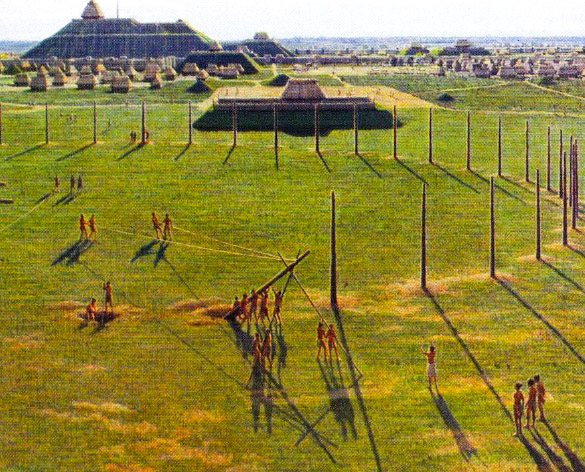
Located within the ancient city of Cahokia near present-day Collinsville, Illinois, Woodhenge was a remarkable circular arrangement of massive wooden posts that functioned as a prehistoric solar observatory and ceremonial calendar. Constructed between approximately 900 and 1200 CE, Woodhenge formed part of the largest urban center of the Mississippian Civilization, whose population may have reached 15,000 to 20,000 people at its peak, making Cahokia the largest city north of Mexico before European contact. Archaeologists have identified at least five successive versions of Woodhenge, each consisting of carefully positioned wooden posts arranged in concentric circles of increasing diameter. These structures demonstrate the advanced astronomical knowledge of the Cahokian people and reveal how celestial observations were closely integrated with religion, agriculture, and political authority.
Construction and Design
Woodhenge consisted of large red cedar posts placed upright in circular patterns surrounding a central observation point. The earliest circle contained approximately 24 posts, while later versions expanded to as many as 72 posts, with diameters exceeding 120 meters (394 feet). Builders dug deep postholes, inserted massive tree trunks, and packed the surrounding soil tightly to ensure stability. The cedar posts likely stood several meters above the ground, creating a prominent ceremonial landmark visible from nearby mounds and plazas.
Each successive reconstruction expanded the circle while preserving its astronomical alignments, demonstrating careful planning and long-term maintenance over several centuries. The repeated rebuilding of Woodhenge suggests that the structure remained central to Cahokia's ceremonial life and reflected the growing importance of astronomical observations within the city.
Astronomical Functions
Woodhenge functioned as an accurate solar calendar. Standing at the center of the circle, an observer could watch the rising sun align precisely with specific wooden posts during important events in the solar year.
During the spring (vernal) and autumn (autumnal) equinoxes, the rising sun appeared directly above designated posts marking equal lengths of day and night. Other posts aligned with the sunrise during the summer solstice, when daylight reached its maximum length, and the winter solstice, when daylight was shortest. These observations allowed Cahokian priests and astronomers to determine the changing seasons with remarkable accuracy.
The solar calendar helped establish the timing of agricultural activities such as planting maize, harvesting crops, and organizing seasonal ceremonies. By monitoring the movement of the sun throughout the year, religious leaders could predict important seasonal transitions and maintain ceremonial calendars essential to community life.
Religious and Political Significance
Woodhenge served not only as an astronomical instrument but also as a sacred ceremonial space. Many scholars believe priests conducted rituals at sunrise during solstices and equinoxes, celebrating the renewal of life, agricultural fertility, and the cosmic order believed to govern the universe.
The site's location west of Monks Mound, the largest earthen pyramid at Cahokia, suggests a symbolic relationship between the solar observatory and the city's political-religious center. Chiefs and priests may have used the accurate prediction of celestial events to reinforce their spiritual authority, demonstrating their ability to interpret divine signs and maintain harmony between the heavens and the human world.
Large public gatherings likely accompanied these astronomical events, strengthening community identity while reinforcing the legitimacy of Cahokia's ruling elite.
Engineering and Scientific Achievement
The construction of Woodhenge required remarkable mathematical precision and engineering skill. Builders carefully surveyed the landscape to establish a true central observation point before placing each cedar post according to specific astronomical alignments. Maintaining accurate orientations across multiple generations demonstrates sophisticated knowledge of geometry, horizon observations, and solar movement.
Unlike Europe's Stonehenge, which was built from massive stone blocks, Cahokia's Woodhenge utilized renewable timber resources available in the Mississippi Valley. Although the wooden posts eventually decayed, successive generations reconstructed the observatory with impressive consistency, preserving its scientific and ceremonial functions for centuries.
Archaeological Importance
Excavations at Cahokia have uncovered the circular arrangement of postholes left by the wooden structures, allowing archaeologists to reconstruct the observatory's original design. These discoveries have confirmed that Woodhenge was intentionally aligned with significant solar events rather than randomly arranged. Today, a modern reconstruction of one of the circles enables visitors to witness the same sunrise alignments observed by Cahokia's inhabitants over a thousand years ago.
Woodhenge remains one of the finest examples of prehistoric astronomy in North America and provides valuable evidence that Indigenous societies possessed advanced observational science long before European contact.
Conclusion
Cahokia's Woodhenge stands as one of the greatest scientific and ceremonial achievements of the Mississippian Civilization. Its carefully engineered circles of cedar posts functioned as an accurate solar calendar, enabling the people of Cahokia to track the seasons, organize agriculture, and conduct religious ceremonies according to celestial events. The monument demonstrates the civilization's sophisticated understanding of astronomy, mathematics, engineering, and urban planning, highlighting the remarkable intellectual accomplishments of North America's largest prehistoric city.