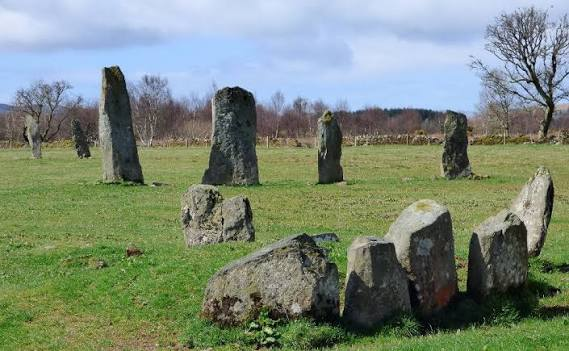
Ballymeanoch is part of the extraordinary prehistoric landscape surrounding Kilmartin Glen.
Its archaeological significance comes from its relationship to nearby standing stones, burial monuments, and other prehistoric remains.
The site illustrates how prehistoric communities used stone not simply as a building material but as a means of organizing ritual space.
The Meaning of a Kerbed Cairn
A kerbed cairn is a burial monument in which the outer edge of the stone mound is deliberately defined by a kerb or boundary of stones.
This feature gives the monument a clearly structured perimeter.
Such boundaries may have helped distinguish the sacred burial space from its surroundings.
The Kilmartin Landscape
Ballymeanoch exists within one of Scotland's richest concentrations of prehistoric monuments.
The surrounding landscape includes:
standing stones;
cairns;
stone alignments;
rock art;
and ceremonial monuments.
This concentration indicates that the area was repeatedly used for ritual purposes.
Stone and Ceremony
The movement and placement of stones required organized labor.
Even relatively modest monuments could involve considerable effort.
Large stones had to be selected, transported, positioned, and stabilized.
Burial Practices
Prehistoric cairns were frequently associated with funerary activity.
However, not every monument necessarily served a single function throughout its history.
Sites could be altered, reused, or incorporated into later ceremonial landscapes.
The Importance of Context
The archaeological importance of Ballymeanoch becomes clearer when the monument is studied together with neighboring features.
Rather than asking only “What was this cairn used for?”, archaeologists can ask:
Why was it built here?
What monuments could people see from it?
How did people move through the landscape?
Was it associated with particular communities or ancestors?
Conclusion
Ballymeanoch: Argyll's Kerbed Cairn represents the complexity of prehistoric monument-building in Kilmartin Glen.
Its value lies not only in its physical remains but also in its relationship to the surrounding ceremonial landscape.
The monument provides another piece of evidence for a prehistoric society that invested substantial effort in creating meaningful places connected to death, memory, and ritual.