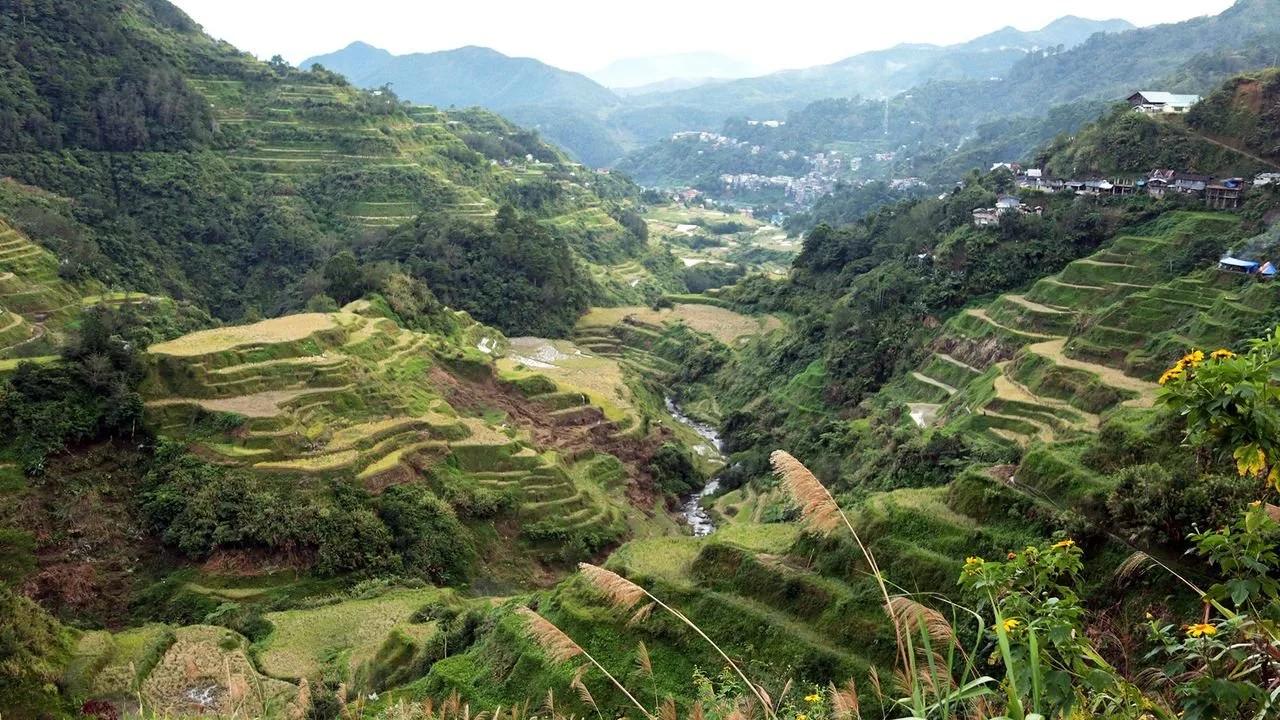
Within the cluster of Cordilleran agricultural networks, the Banaue rice terraces stand out for their sheer vertical scale and advanced masonry engineering. Unlike terraced fields built on gentle clay slopes, the Banaue structures are carved into near-vertical mountain inclines, requiring the construction of massive stone retaining walls that function as functional megastructures.
The engineering of a Banaue stone wall begins with the creation of a stable foundation trench cut deep into the mountain's bedrock. Ifugao masons then selected heavy, water-worn river stones, transport-carrying them up from the valley floors below. These stones were laid dry—without cement or mortar—using a specialized interlocking pattern that allows the wall to flex safely during the region's frequent earthquakes. The wall is built with a slight inward lean (batter) to press directly into the hillside, resisting the immense outward pressure of the water-saturated mud inside the rice pond.
To manage the heavy weight of the water, the interior of each terrace is layered like a geological filter. The base is packed with large boulders, followed by layers of river gravel, coarse sand, and finally a thick, impermeable top layer of puddled volcanic clay that forms the agricultural bed. This specific configuration allows excess groundwater to seep slowly through the dry-stone joints without causing the wall to burst, preventing the cataclysmic mudslides that regularly threaten lesser terraced hillsides during the typhoon season.