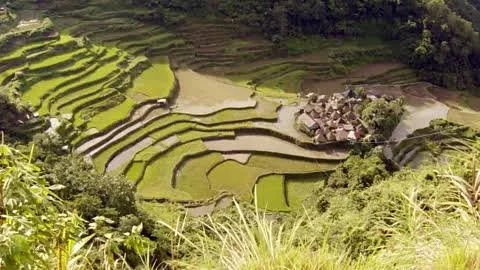
The rice terraces of the Cordillera mountains in northern Luzon, Philippines, represent an exceptional monument to sustainable agricultural engineering. Carved into steep mountainsides by the indigenous Ifugao people over generations, these terraced landscapes cover thousands of square kilometers. While early historical estimates suggested the terraces were over 2,000 years old, current archaeological investigations indicate the intensive terracing system expanded rapidly around 400 years ago, driven by social reorganization and the need for food security during the Spanish colonial incursion into the lowlands.
The engineering of the terraces is a masterpiece of landscape modification accomplished entirely without iron tools, draft animals, or sophisticated surveying equipment. The Ifugao builders worked by following the natural contours of the mountain ridges, transforming near-vertical slopes into flat, stepped pond fields (payo). The entire system is built out of compacted clay and local river stones, carefully stacked to prevent landslides and manage water flow.
The long-term survival of the terraces depends on an advanced understanding of watershed dynamics and communal water management. The system relies on a continuous supply of water from intact, high-altitude rainforests (muyong) preserved directly above the terrace fields. These protected forests function as a natural sponge, storing monsoon rainwater and releasing it slowly into a network of mountain springs and streams. The Ifugao built a complex web of hand-carved stone channels, bamboo pipes, and earth dikes to route this water down through the terraced steps, ensuring that every individual pond field receives an equal, controlled flow of nutrient-rich water.