Introduction
Few archaeological landscapes demonstrate the relationship between geology and human settlement as clearly as Bandelier National Monument in northern New Mexico.
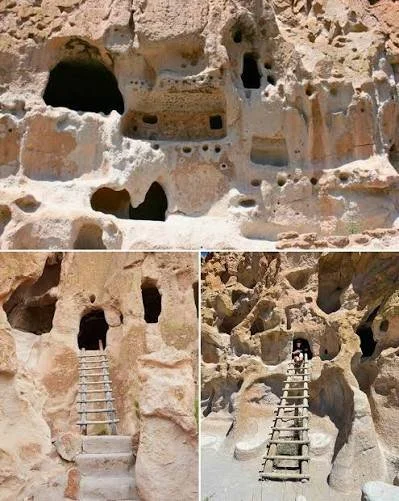
Located within a spectacular landscape of volcanic cliffs, canyons, mesas, forests, and streams, Bandelier preserves thousands of years of human activity. Its most recognizable archaeological features are the ancestral Pueblo homes carved into soft volcanic tuff, along with masonry pueblos, kivas, agricultural features, trails, and rock imagery.
The site is often described through its dramatic cliff dwellings, but that description can obscure the complexity of the community that once occupied the region.
Bandelier was not simply a collection of caves.
It was a landscape in which people farmed, built houses, stored food, traveled between settlements, practiced ceremonies, processed resources, and maintained relationships with the surrounding environment.
The Geological Foundation
Bandelier's archaeology begins with volcanic geology.
The cliffs consist largely of volcanic tuff produced by ancient eruptions. Ash and volcanic debris accumulated, compacted, and eventually formed relatively soft rock.
For prehistoric builders, this material was extremely useful.
The tuff could be carved using relatively simple tools. Instead of constructing every room entirely from stone, people could excavate cavities directly into cliff walls.
This produced the distinctive cavate rooms associated with Bandelier.
The combination of carved rooms and masonry construction is one of the defining characteristics of the archaeological landscape.
Human Occupation Before the Pueblo Communities
Bandelier has a long human history.
The National Park Service notes evidence of hunter-gatherer occupation reaching back into the Paleoindian period. A projectile point found in the monument represents some of the earliest known human evidence in the area.
The landscape therefore cannot be reduced to the period of the famous cliff dwellings.
Human use occurred over thousands of years.
People hunted, gathered plants, moved across the landscape, and gradually incorporated agriculture into their economies.
The development of farming was transformative.
Domesticated maize provided a more predictable source of calories, allowing communities to invest more heavily in permanent architecture and food storage.
The Rise of Ancestral Pueblo Communities
The major ancestral Pueblo occupation of Bandelier occurred much later.
The National Park Service identifies a major reoccupation beginning around A.D. 1150 and continuing into approximately A.D. 1550.
This period coincided with broader demographic and cultural transformations across the Southwest.
Communities associated with the Four Corners region were experiencing environmental pressures, changing settlement patterns, and population movements.
Bandelier became part of this wider world.
Tuff Houses
The phrase "tuff houses" captures the distinctive architecture of Bandelier.
Instead of constructing houses entirely as independent buildings, inhabitants often combined masonry walls with the natural cliff.
A room could therefore have:
a carved rear wall
masonry side walls
wooden roof beams
packed-earth floors
plastered surfaces
storage spaces
connecting pathways
This created architecture that was simultaneously natural and constructed.
The distinction between "cave" and "house" can therefore be misleading.
These were intentionally modified living spaces.
The Cavates
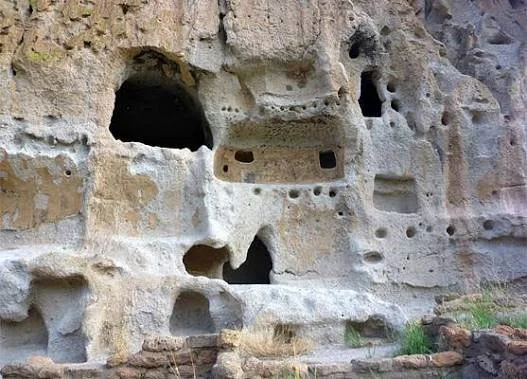
Cavates are among Bandelier's most recognizable archaeological features.
A cavate is essentially a room excavated into soft volcanic rock.
The excavation process left physical evidence.
Tool marks can survive on the walls. Smoke staining can provide clues about the use of fire. Plaster remnants may indicate attempts to improve interior surfaces.
Some cavates are relatively small, while others form larger complexes.
Their precise functions varied.
Some were undoubtedly associated with domestic activity, but archaeologists must avoid assuming that every cavity served the same purpose.
Long House and Pueblo Architecture
Bandelier's architecture also includes substantial masonry pueblos.
Long House, for example, was constructed along the base of a cliff and reached several stories in some areas. The structure illustrates how ancestral Pueblo builders combined masonry architecture with natural geological walls.
This was not primitive construction.
Multi-story buildings required planning, materials, labor, structural knowledge, and cooperation.
Timber had to be obtained and transported.
Stone had to be shaped and positioned.
Mud was needed for mortar and plaster.
Roof systems required beams and smaller branches.
Food production had to support the people participating in construction.
Architecture therefore provides evidence for social organization.
A large pueblo represents not merely a collection of rooms but a coordinated community.
Tyuonyi
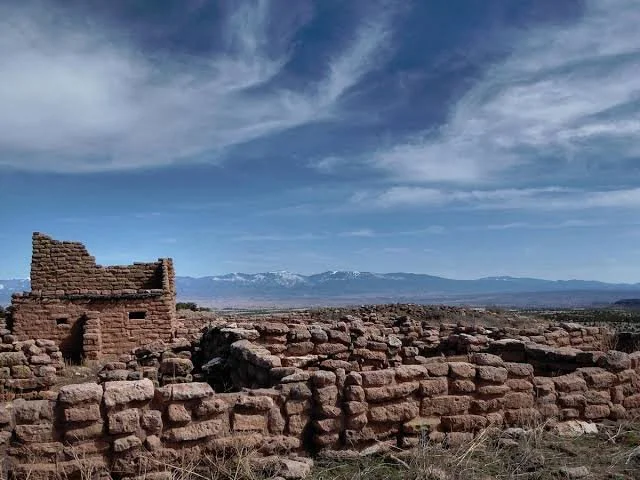
One of Bandelier's best-known archaeological features is Tyuonyi, a large circular or roughly circular pueblo structure.
Its walls demonstrate the scale of communal architecture.
The settlement included numerous rooms arranged around an open central space.
Central plazas were important elements of many Pueblo communities because they provided shared space for social, economic, and ceremonial activities.
The architectural organization suggests that Bandelier was a community rather than an assortment of unrelated households.
Kivas and Community Life
Kivas are another critical component of ancestral Pueblo architecture.
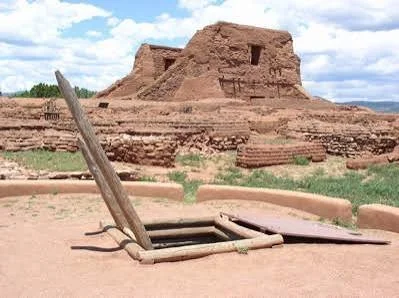
These circular, often semi-subterranean spaces are generally associated with ceremonial and social activities.
However, it is important to avoid reducing kivas to a simplistic definition such as "religious rooms."
Archaeological interpretations suggest that kivas could be involved in ritual, social organization, community gatherings, and other activities.
The exact significance of individual structures depended on time and place.
Modern Pueblo communities are essential sources of perspective when archaeologists consider the meaning of ancestral ceremonial architecture.
Farming in the Canyon
The canyon environment was not simply a backdrop.
It provided resources.
People cultivated crops on suitable land while also collecting wild plants and hunting animals.
Maize, beans, and squash were fundamental crops across many Southwestern agricultural communities.
Yet agriculture in a semi-arid environment was challenging.
Rainfall could be unpredictable.
Drought could reduce harvests.
Soil could erode.
People therefore needed extensive environmental knowledge.
Agricultural strategies included choosing suitable locations, managing soil, conserving moisture, storing food, and combining cultivated crops with wild resources.
Water and Survival
Water was central to Bandelier life.
Streams and seasonal water sources provided drinking water and supported plants and wildlife.
But water availability could fluctuate.
The architecture and settlement distribution of Bandelier should therefore be studied together with its hydrology.
Where people lived was partly influenced by access to water, agricultural land, natural shelters, and transportation routes.
The canyon was both a resource and a constraint.
Its cliffs offered protection and architectural opportunities, but steep terrain could make movement difficult.
Trails as Archaeological Evidence
The paths connecting Bandelier's archaeological features are important.
Trails reveal how people navigated the landscape.
They can connect agricultural fields with houses, houses with water sources, and settlements with ceremonial locations.
A modern trail is not necessarily identical to an ancient pathway, but many landscapes preserve evidence of repeated human movement.
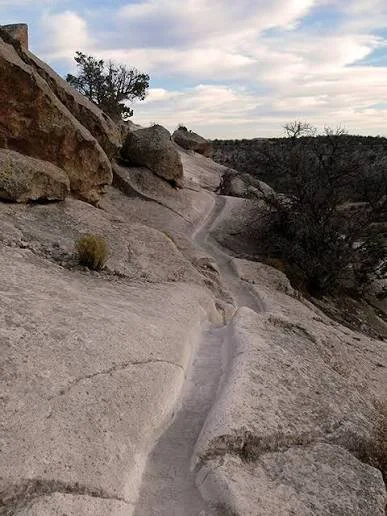
At Tsankawi, another section of Bandelier, the National Park Service notes that visitors can walk routes associated with ancestral Pueblo use and encounter carved pathways, cavates, petroglyphs, and the remains of a mesa-top village.
Why People Built on Cliffs
The popular imagination often assumes that cliff dwellings were primarily defensive.
The reality was probably more complicated.
Cliffs offered several advantages.
They could provide:
shade
shelter
storage
architectural foundations
access to protected spaces
visibility
proximity to agricultural areas
Security may sometimes have mattered, but archaeology does not support a single explanation for every cliff dwelling.
The meaning of architecture must be understood within its specific context.
The Wider Pueblo World
Bandelier was part of a much larger ancestral Pueblo world.
Connections existed between communities across New Mexico, Arizona, Utah, and Colorado.
Archaeologists identify similarities and differences through:
pottery styles
architectural techniques
agricultural systems
settlement patterns
stone tools
trade materials
ceremonial architecture
The National Park Service emphasizes that Bandelier, Mesa Verde, and Chaco Canyon were all associated with the broader ancestral Pueblo tradition, although they were occupied during different periods and developed distinctive local histories.
This regional perspective is essential.
No single site tells the complete story.
Population Movement
The archaeological history of Bandelier is also connected to migration.
Communities in the Four Corners and Rio Grande regions experienced major population changes during the late prehistoric period.
The movement of people should not be interpreted as cultural disappearance.
Modern Pueblo peoples are descendants of ancestral communities that experienced generations of movement and reorganization.
Consequently, the archaeological record is part of an ongoing Indigenous history.
Archaeological Research
Bandelier has played an important role in Southwestern archaeology.
Researchers have used excavation, architectural recording, ceramic analysis, tree-ring dating, paleoenvironmental reconstruction, and other techniques to understand the site's history.
Tree-ring evidence can be particularly valuable because wooden beams sometimes preserve annual growth patterns.
These records can provide extremely precise chronological information when suitable wood samples survive and can be correlated with regional tree-ring sequences.
Ceramics provide another important chronological and cultural tool.
Changes in pottery style can help archaeologists identify different periods and connections between communities.
Preservation Challenges
The same geology that made Bandelier attractive to ancient builders creates preservation challenges today.
Tuff is relatively soft.
Rain, snow, freezing temperatures, erosion, vegetation, rockfall, and human contact can gradually alter archaeological features.
Modern visitors therefore have an unusual responsibility.
Walking directly on fragile archaeological surfaces can accelerate erosion.
Touching walls can transfer oils and moisture.
Removing artifacts destroys archaeological context.
The National Park Service repeatedly emphasizes that archaeological remains should remain undisturbed.
Bandelier as a Living Cultural Landscape
One of the most important developments in archaeological interpretation is the recognition that ancestral Pueblo sites are not simply "dead civilizations."
The people who built these communities have descendants.
Modern Pueblo communities maintain relationships with ancestral places through oral traditions, cultural practices, ceremonies, and identity.
The National Park Service describes these landscapes as places containing both tangible and intangible connections to Pueblo descendants.
This perspective changes the language archaeologists use.
A site may be "ruined" architecturally while remaining culturally alive.
Conclusion
Bandelier is one of the most extraordinary archaeological landscapes in North America because it demonstrates how human communities adapted architecture to geology.
The volcanic tuff became a building material.
Cliffs became walls.
Cavates became rooms.
Mesa surfaces became agricultural landscapes.
Kivas became communal spaces.
Trails connected the different parts of the settlement.
The resulting landscape was not merely a collection of archaeological remains. It was a functioning community shaped by environmental knowledge, social cooperation, agriculture, architecture, and cultural tradition.
Today, Bandelier provides archaeologists with evidence for understanding ancestral Pueblo lifeways while simultaneously remaining connected to living Pueblo communities.
Its importance therefore lies not only in the remarkable structures that survive but in the human stories those structures continue to carry.