Introduction
Frijoles Canyon is one of the most archaeologically significant landscapes within Bandelier National Monument.
Cut deeply into the volcanic terrain of northern New Mexico, the canyon contains archaeological remains that reveal how ancestral Pueblo communities adapted to a landscape of soft volcanic tuff, limited water, steep cliffs, forests, and agricultural possibilities.
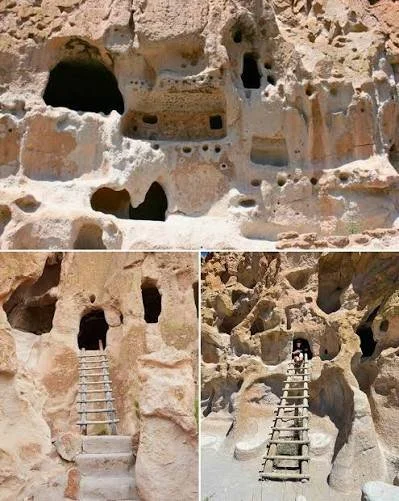
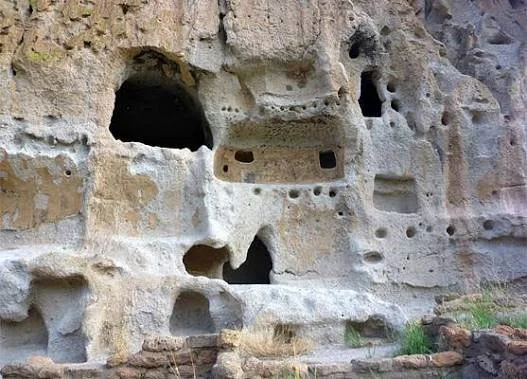
Among its most fascinating features are the cavate rooms—human-made chambers carved directly into the canyon's soft rock.
At first glance, these rooms can look like natural caves.
They are not.
They are architectural spaces deliberately excavated and modified by people.
Their existence demonstrates a sophisticated understanding of local geology and an ability to transform natural formations into usable domestic and communal environments.
The Geography of Frijoles Canyon
Frijoles Canyon is a dramatic environment.
Its steep walls rise above the canyon floor, while volcanic formations create alcoves, cliffs, ledges, and sheltered spaces.
The canyon also contains vegetation and water resources that made human occupation possible.
The landscape was attractive because it brought several resources together.
People could obtain water, gather plants, hunt animals, cultivate crops, and construct buildings within a relatively compact area.
Yet the terrain was challenging.
Movement required climbing and navigating uneven surfaces.
Agricultural land was limited.
Weather conditions could change rapidly.
The inhabitants therefore needed extensive knowledge of the environment.
What Is a Cavate?
The term cavate refers to a room or cavity intentionally excavated into soft volcanic tuff.
The word is particularly associated with the archaeology of the Southwest.
Cavates should not be confused with naturally occurring caves.
Their walls often show evidence of deliberate excavation.
Tool marks, flattened surfaces, niches, plaster remains, smoke deposits, and architectural modifications can reveal how people used and maintained them.
The rooms vary considerably.
Some are small.
Others form interconnected spaces.
Their differences suggest that they did not necessarily have identical functions.
How Were the Rooms Created?
The softness of volcanic tuff was crucial.
The rock could be excavated with stone tools and other relatively simple implements.
Workers could gradually remove material from a cliff face, creating a chamber large enough for human use.
The process would still have required considerable labor.
Excavation produced debris that had to be removed.
Surfaces had to be prepared.
Entrances had to be designed.
Some rooms required additional construction to make them comfortable or structurally secure.
In this sense, the cavates represent an architectural technology adapted to local geology.
Why Carve Instead of Build?
One obvious question is why people would excavate rooms instead of simply building houses.
The answer probably involves several factors.
A carved room could provide excellent thermal buffering.
Thick rock surrounding an interior space could moderate temperature fluctuations.
The rock also provided a ready-made rear wall.
A cavate could require less masonry than a completely freestanding building.
It could also provide shelter from sunlight and weather.
The location of a room might additionally have social or ceremonial importance.
Therefore, cavates should not be interpreted as evidence of technological simplicity.
They represent technological adaptation.
Domestic Life
Some cavates were associated with everyday activities.
Archaeologists can investigate domestic use through artifacts and deposits.
Pottery fragments can indicate cooking or storage.
Stone tools can reveal food processing and manufacturing.
Plant remains can indicate agricultural practices.
Animal bones can provide evidence of hunting and diet.
Charcoal can reveal the use of fire.
The combination of these materials helps archaeologists reconstruct daily life.
Food and Agriculture
The people of Frijoles Canyon were agriculturalists, but farming in the region was difficult.
Maize required adequate moisture.
Beans provided additional nutritional value.
Squash contributed food and other useful plant materials.
Agriculture also required seed selection, planting knowledge, soil management, harvesting, and storage.
Wild foods remained important.
The distinction between "farmer" and "hunter-gatherer" is therefore not absolute.
Ancestral Pueblo communities could practice agriculture while continuing to collect wild plants and hunt animals.
Storage and Food Security
Food storage was essential in an environment where harvests could vary.
Storage facilities allowed communities to preserve surplus crops for future use.
This was particularly important during drought or poor harvest years.
Archaeological storage spaces can therefore tell us about economic planning.
A household that stored significant quantities of food had a different relationship with the environment than a group relying entirely on immediate consumption.
Storage also raises questions about social organization.
Who controlled stored food?
Was food stored by individual households, extended families, or communities?
Archaeology can sometimes provide evidence, but these questions remain difficult to answer conclusively.
Long House
Frijoles Canyon contains one of Bandelier's best-known architectural complexes: Long House.
Unlike a simple cavate, Long House represents substantial masonry construction against a cliff face.
The building reached multiple stories in some sections.
Its existence demonstrates the ability of ancestral Pueblo builders to coordinate large construction projects.
The combination of natural cliff and masonry architecture also demonstrates continuity with the broader principle of using geology as part of architecture.
Tyuonyi and Community Organization
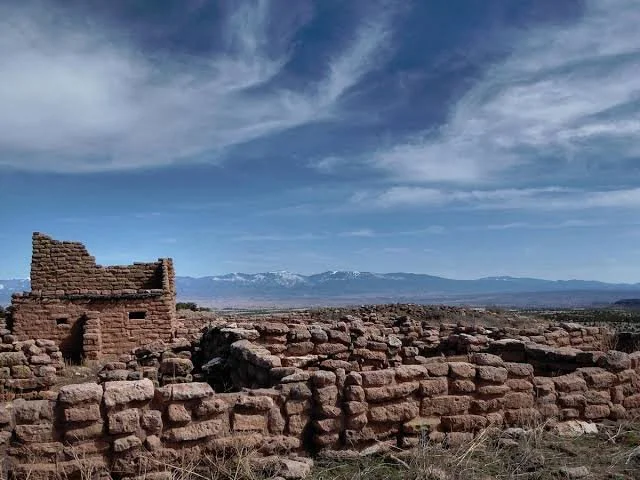
Nearby Tyuonyi provides another important example.
Its circular arrangement of rooms around an open central area suggests communal organization.
Archaeologists can examine such architectural layouts to investigate household relationships, public space, movement, and community structure.
A settlement containing numerous households requires some form of cooperation.
Construction, agriculture, water management, ceremonies, food storage, and defense—where necessary—could all involve collective activity.
Architecture therefore provides evidence not only about buildings but about social relationships.
The Meaning of Kivas
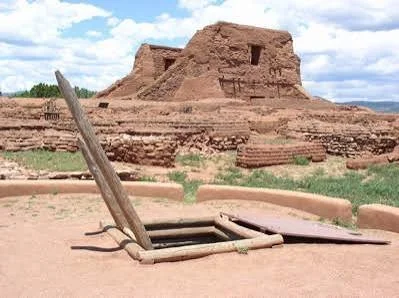
Frijoles Canyon also contains kivas.
Kivas are among the most recognizable architectural forms associated with ancestral Pueblo communities.
They are often circular and partly subterranean.
Archaeological evidence indicates that they were associated with ceremonial and social activities.
However, modern interpretations must be careful.
It is easy to impose a single category such as "religious building" onto a structure that may have served multiple social purposes.
Indigenous consultation and comparative archaeological research help create more nuanced interpretations.
Rock Imagery
Canyons such as Frijoles also contain rock imagery.
Petroglyphs and pictographs can provide evidence of symbolic communication.
Some images may be associated with animals, people, geometric designs, or other motifs.
Dating rock art can be difficult.
Unlike pottery or wooden architecture, rock imagery does not always contain materials that can be directly dated.
Archaeologists therefore use several methods:
superimposition
weathering
pigment analysis
associated archaeological deposits
stylistic comparison
geological context
Each method has limitations.
Climate and Environmental Change
Environmental change is crucial to understanding Frijoles Canyon.
The Southwest experienced significant climatic fluctuations during the period of ancestral Pueblo occupation.
Droughts could affect crops, water sources, and food supplies.
Long-term climate records derived from tree rings and other environmental proxies allow archaeologists to compare settlement changes with periods of environmental stress.
However, climate should not be treated as a simple explanation for migration.
People respond to environmental stress through technology, cooperation, trade, movement, and cultural adaptation.
A drought might contribute to migration without being the sole cause.
Migration and Cultural Continuity
The ancestral Pueblo population of Frijoles Canyon eventually relocated.
This should not be described as the disappearance of the people.
Archaeological evidence from Bandelier forms part of a much wider network of Pueblo population movements.
Modern Pueblo communities maintain ancestral connections to the region.
The National Park Service emphasizes that Bandelier's archaeological remains are connected to descendant communities and broader ancestral Pueblo history.
The Archaeological Value of Fragile Remains
Cavates are exceptionally valuable archaeological evidence because they can preserve surfaces that would otherwise disappear.
A carved wall can preserve tool marks.
A plastered surface can preserve pigment.
A hearth can preserve charcoal.
A floor can preserve microscopic remains of human activity.
This means even seemingly empty rooms may contain enormous amounts of information.
Archaeologists therefore treat the interiors as fragile scientific evidence rather than simply as spaces for visitors to enter.
Modern Tourism and Preservation
Frijoles Canyon is heavily visited.
The canyon's scenic beauty makes it attractive to hikers, photographers, historians, and archaeologists.
But tourism creates challenges.
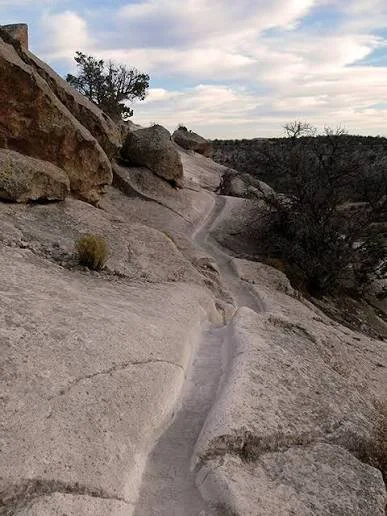
Foot traffic can erode trails.
Touching surfaces can damage fragile archaeological remains.
Water runoff can undermine structures.
Wildfires and floods can transform the landscape.
Bandelier has also experienced major wildfire and flooding impacts, requiring continuing conservation work.
The National Park Service maintains trails and infrastructure while attempting to protect archaeological resources. Current trail information notes that portions of Frijoles Canyon have undergone rebuilding following fire and subsequent flooding.
Why Frijoles Canyon Matters
Frijoles Canyon is important because it preserves an unusually complete relationship between architecture and environment.
The archaeological record includes:
cavates
pueblos
kivas
agricultural areas
trails
rock art
storage spaces
food remains
tools
ceramics
architectural debris
Together these remains create a more complete picture than any single artifact could provide.
Conclusion
The cavate rooms of Frijoles Canyon represent one of the most remarkable architectural adaptations in the ancient Southwest.
People transformed soft volcanic cliffs into living spaces.
They combined carved rooms with masonry buildings, agricultural fields, storage areas, ceremonial structures, and trails.
The resulting community was shaped by the environment but was not passively controlled by it.
Its inhabitants actively engineered their surroundings.
Today, Frijoles Canyon offers archaeologists an extraordinary laboratory for understanding ancestral Pueblo architecture and lifeways.
More importantly, however, it remains part of a cultural landscape connected to living Pueblo peoples.
The carved rooms are therefore not simply empty chambers.
They are physical traces of families, communities, work, ceremony, movement, and memory.