Introduction
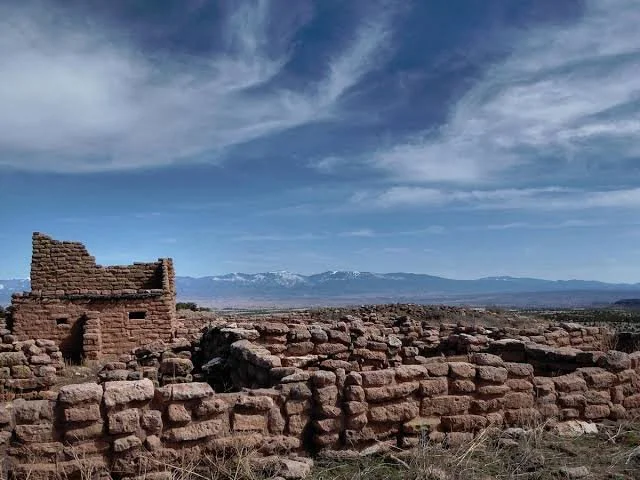
High on the volcanic mesas of northern New Mexico, where the landscape rises above the valleys surrounding the modern communities of Santa Clara and Los Alamos, a remarkable archaeological landscape preserves the homes, trails, agricultural areas, and rock shelters of ancestral Tewa communities. Among the most important of these places are the Puye Cliff Dwellings and the nearby Tsankawi landscape.
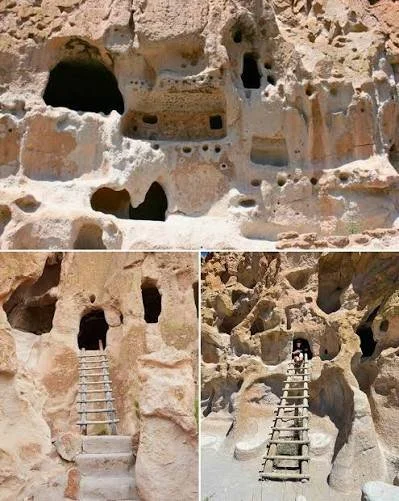
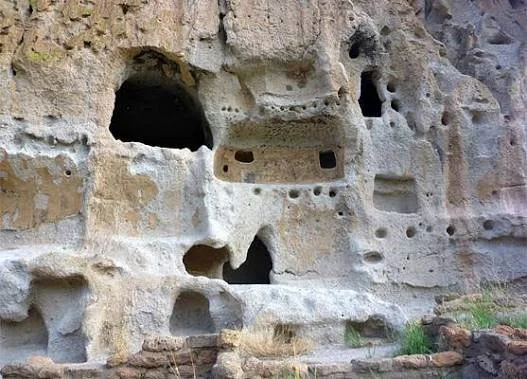
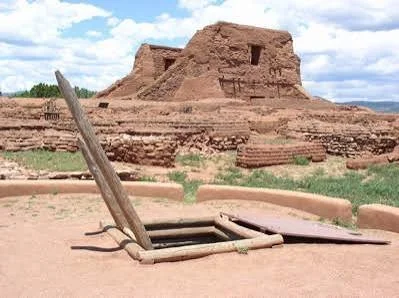
The Puye complex is particularly significant because it preserves evidence of communities adapting to a dramatic volcanic environment. Rather than constructing settlements only on open ground, ancestral Pueblo people used the soft volcanic tuff itself. They carved rooms into cliffs, constructed masonry buildings on mesa tops, created pathways along exposed rock faces, and organized settlements around the practical requirements of agriculture, water, movement, storage, and community life.
Today, Puye Cliff Dwellings are recognized as the ancestral homeland of the Santa Clara Pueblo people. The site is not simply an abandoned archaeological ruin. It is part of a living cultural landscape whose significance extends beyond architecture and artifacts. The modern interpretation of Puye emphasizes its connection to the ancestors of today's Santa Clara Pueblo community.
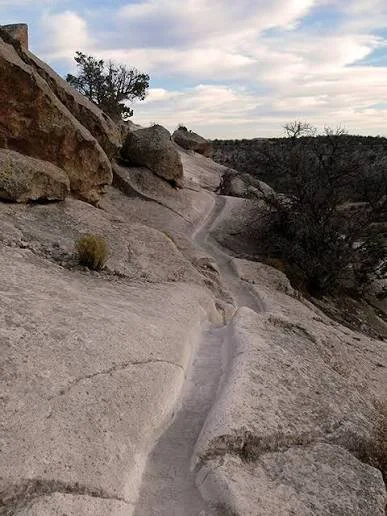
The nearby Tsankawi landscape provides another extraordinary expression of this relationship between people and volcanic terrain. Its trails include narrow passages, hand-and-foot holds, ladders, cavates, petroglyphs, and mesa-top settlement remains. The National Park Service describes Tsankawi as part of the ancestral lands of modern San Ildefonso Pueblo and notes that ancestral Pueblo people used the soft volcanic rock for houses while practicing dry farming on the surrounding mesa lands.
The Volcanic Landscape of Northern New Mexico
Understanding Puye requires understanding its geology.
The region was shaped by volcanic activity associated with the Jemez Mountains. Vast deposits of volcanic ash and other materials eventually formed relatively soft tuff formations. Unlike hard granite or massive sandstone, tuff can be worked comparatively easily using stone and wooden tools.
This geological characteristic created opportunities for architecture.
People could carve shallow rooms directly into cliff faces while simultaneously building masonry structures on the mesa above. The resulting landscape combined natural geology and human construction.
This is one reason the archaeological remains can appear unusual to modern visitors. A structure may not look like a conventional building. A room might consist partly of a carved cavity and partly of a constructed wall. A pathway may follow a natural ledge but contain deliberately carved steps and handholds.
The architecture therefore represents an interaction between geology and human planning.
The Puye Settlement
Puye developed into a substantial ancestral Pueblo settlement.
The archaeological complex contains cliff dwellings, mesa-top remains, agricultural areas, and pathways. The cliff dwellings were not isolated shelters. They formed part of a broader settlement system.
The location offered several practical advantages.
The cliffs provided protected spaces for habitation and storage. The mesa offered relatively open surfaces where people could cultivate crops and move between settlement areas. The surrounding valleys and mountains supplied wild plants, animals, fuel, and stone resources.
Agriculture remained fundamental.
Like other ancestral Pueblo communities in the Southwest, the inhabitants depended heavily on maize and other cultivated foods while continuing to exploit wild resources. Farming in this environment required careful management of limited moisture.
Dry farming was particularly important.
Rather than relying entirely on large irrigation systems, communities could take advantage of seasonal precipitation, soil characteristics, runoff, and carefully selected agricultural locations.
Architecture Carved into the Cliff
One of the most remarkable aspects of Puye is the use of cliff faces as architectural space.
The soft volcanic tuff could be excavated to produce rooms and sheltered areas. The resulting cavities could be combined with masonry walls, roofs, storage spaces, and other architectural features.
This approach demonstrates an important principle of Southwestern archaeology: architecture cannot be understood independently from the environment.
The builders were not simply constructing houses wherever convenient. They were exploiting specific properties of the landscape.
A cliff offered elevation, shelter, visibility, and a natural architectural foundation.
At the same time, living in such places required movement systems.
Trails and ladders connected different levels of the settlement. The relationship between mesa top and cliff face was therefore essential to everyday life.
The Trails of Tsankawi
Tsankawi provides some of the clearest evidence of how ancestral Pueblo people physically moved through this environment.
The modern trail follows portions of pathways associated with ancestral use. Visitors encounter narrow trenches, carved steps, exposed ledges, ladders, and mesa-top areas. The National Park Service describes the modern Tsankawi route as approximately 1.5 miles and notes that ladders are an essential part of the experience.
These pathways are important archaeological evidence in their own right.
A trail tells us about more than transportation.
It can reveal how different areas of a settlement were connected, where people repeatedly traveled, and how the physical landscape shaped daily routines.
Some routes required climbing or moving through narrow passages. Such paths may initially appear difficult to modern visitors, but for people familiar with the landscape, they formed part of a functioning transportation system.
Cavates: Rooms Cut into Volcanic Tuff
One of Tsankawi's most distinctive features is the presence of cavates, human-carved rooms excavated into volcanic cliffs.
These spaces are particularly valuable archaeologically because they preserve evidence of how people modified geological formations for human purposes.
Cavates could serve different functions, and archaeologists must be cautious about assigning a single purpose to every room.
Some spaces may have been domestic. Others could have been used for storage, work, ritual, or combinations of these activities.
The interiors may preserve traces of architectural modification, soot, plaster, pigment, tool marks, and other evidence.
The absence of modern construction materials makes such spaces especially important for reconstructing ancient life.
Petroglyphs and Cultural Memory
Tsankawi also contains rock imagery.
Petroglyphs are images produced by modifying the rock surface through pecking, carving, scraping, or related techniques. They may depict humans, animals, geometric forms, abstract symbols, or other imagery.
Interpreting these images is difficult.
Archaeologists cannot automatically translate a petroglyph into a specific meaning simply by looking at it. The cultural knowledge required to understand an image may not survive in written form.
This is why Indigenous perspectives are particularly important.
The National Park Service explicitly recognizes that Tsankawi contains tangible and intangible connections for descendants of the people who lived in these landscapes. It also warns that modern graffiti can be deeply disturbing because it damages evidence connected to ancestral identity and memory.
Life on the Mesa
Life at Tsankawi and Puye required adaptation.
The mesa environment could be dry and exposed. Farming required careful timing and knowledge of precipitation. People had to understand seasonal changes, soil conditions, local plants, and animal behavior.
The National Park Service notes that ancestral inhabitants became highly skilled in dry farming while also hunting available wildlife and collecting resources provided by the surrounding environment.
This combination of farming and gathering was not unusual in the Southwest.
Agricultural communities did not necessarily abandon wild foods after adopting domesticated crops. Instead, subsistence could remain diverse.
Corn was extremely important, but people also depended on wild plants, game, gathered resources, and stored food.
Why the Cliffs Matter
It is tempting to describe cliff dwellings as defensive structures.
Sometimes elevation and difficult access could certainly provide security.
However, archaeologists increasingly recognize that cliff locations should not automatically be interpreted as fortresses.
There were many possible reasons to construct or occupy spaces along cliffs:
protection from weather
storage
architectural convenience
proximity to water or agricultural land
social organization
ritual activities
visibility
inherited settlement traditions
defense or security
The meaning of a particular structure must therefore be established through archaeological context rather than appearance alone.
Migration and the Changing Southwest
Puye and Tsankawi belong to a much larger history of population movement across the Southwest.
Ancestral Pueblo communities did not remain permanently fixed in one settlement. Communities expanded, contracted, relocated, and reorganized over centuries.
At Bandelier, for example, archaeological evidence documents major ancestral Pueblo reoccupation beginning around A.D. 1150 and continuing into the sixteenth century, with connections to broader population movements from the Four Corners region.
These movements should not necessarily be interpreted as simple "disappearances."
When an archaeological settlement was abandoned, its inhabitants did not vanish.
People moved to other communities, joined relatives, established new settlements, or became ancestors of later Pueblo populations.
The archaeological record therefore represents movement rather than disappearance.
Puye and Modern Santa Clara Pueblo
One of the most important aspects of Puye is its continuing connection to living Pueblo communities.
The site is recognized as the ancestral homeland of today's Santa Clara Pueblo people.
This changes how the archaeology should be presented.
Rather than treating Puye exclusively as a window into a vanished civilization, it is more accurate to understand it as a place connected to continuing Indigenous history.
Modern Pueblo communities preserve traditions, identities, oral histories, languages, artistic practices, and relationships to landscapes that provide essential context for interpreting archaeological evidence.
Archaeological Preservation
Volcanic tuff is comparatively soft.
That makes it useful for carving—but also vulnerable.
Weathering, water erosion, freeze-thaw cycles, vegetation, visitor traffic, and human vandalism can damage archaeological surfaces.
Tsankawi is particularly sensitive because visitors physically walk across archaeological terrain.
The National Park Service therefore emphasizes staying on designated trails and avoiding disturbance to artifacts, plants, rocks, and architectural remains.
This is not merely a matter of preserving attractive ruins.
Archaeological context is evidence.
A pottery fragment left beside a wall can provide information about chronology and activity. Once removed, that relationship may be permanently lost.
Conclusion
Puye Cliff Dwellings and the Tsankawi trails represent an extraordinary example of how ancestral Pueblo communities transformed a volcanic landscape into a lived environment.
Their architecture was not imposed upon the landscape from outside. It emerged from the properties of the rock itself.
Cliffs became rooms.
Ledges became pathways.
Mesa surfaces became agricultural landscapes.
Petroglyphs became part of the cultural record.
And the entire landscape became embedded within generations of Pueblo history.
The trails of Tsankawi are therefore more than hiking routes. They are physical evidence of movement, adaptation, architecture, and cultural continuity.
For archaeologists, they offer an opportunity to study ancient settlement organization and environmental adaptation. For descendants, they remain part of a much deeper cultural landscape.
That combination of archaeological evidence and living heritage is what makes Puye and Tsankawi among the most important ancestral Pueblo landscapes of northern New Mexico.
Sources: National Park Service; Puye Cliff Dwellings/Santa Clara Pueblo cultural information; archaeological research on Bandelier and ancestral Pueblo settlement.