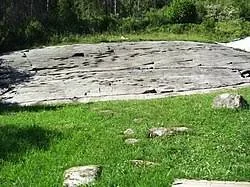
Bardal in Norway is particularly valuable because its rock carvings represent multiple phases of prehistoric artistic development. Rather than belonging to one narrowly defined period, the imagery reflects changing traditions over long spans of time.
This makes Bardal important for studying how prehistoric societies changed their visual representations of animals, humans, weapons, ships, and other subjects.
Rock Carving as Technology
Petroglyphs were produced by removing portions of a rock surface.
Prehistoric artists could use hard stones to peck, grind, or incise the exposed bedrock. Producing a large image was therefore physically demanding.
The artwork became permanent because the image was incorporated into the stone itself.
This permanence distinguished rock art from paintings on temporary materials.
Different Artistic Traditions
Scandinavian rock art is often divided into broad traditions based on subject matter and style.
Earlier hunter-gatherer imagery tends to emphasize large animals and scenes associated with hunting and movement.
Later Bronze Age art includes more human figures, ships, weapons, and geometric motifs.
Bardal is particularly valuable because imagery associated with different traditions occurs within the same broader landscape.
Animals and Hunters
Animals were central to early Scandinavian rock art.
Large mammals could represent important prey, but their symbolic significance may have been equally important. Hunter-gatherer societies often developed complex relationships with animals, incorporating them into stories, rituals, and cosmological beliefs.
The act of depicting an animal could therefore have had a meaning beyond simple representation.
Bronze Age Ships
Later Scandinavian art frequently features ships.
These images correspond to the increasing importance of maritime transportation during the Bronze Age. Ships allowed people to travel along Norway's coast and connect communities across the Scandinavian and wider European worlds.
Their appearance in rock art may reflect both technological pride and symbolic associations with journeys.
Reading Prehistoric Images
Archaeologists must distinguish between observation and interpretation.
It is possible to identify a ship, animal, weapon, or human figure with reasonable confidence. Determining what that figure meant to its creator is much more difficult.
A ship might represent an actual vessel, a supernatural vehicle, a funerary journey, or a combination of meanings.
Consequently, Bardal's carvings should be treated as evidence for prehistoric symbolism rather than as illustrations whose stories can be reconstructed with certainty.
Cultural Significance
Bardal demonstrates that rock art can function as a historical record even when written documents are absent.
The images reveal changing artistic conventions and provide clues about technology, subsistence, mobility, and social identity.
Most importantly, they show that prehistoric Norwegians actively used visual communication to express ideas about their world.