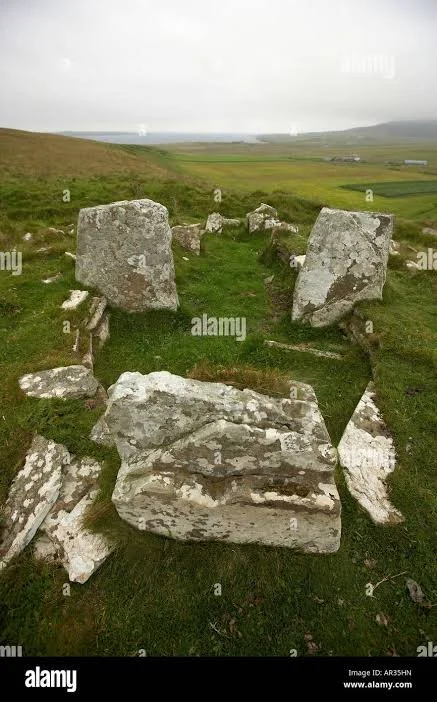
The archaeological landscape of Rousay, an island in Scotland's Orkney archipelago, is remarkable for the extraordinary concentration of prehistoric monuments preserved across a relatively small area. Among its numerous cairns, burial monuments, settlements, and later archaeological remains, Bigland Round belongs to a wider tradition of prehistoric construction that transformed the island's hills and fields into a monumental landscape. Although comparatively less famous than monuments such as Midhowe Chambered Cairn, Bigland Round is significant precisely because it forms part of the dense archaeological network that demonstrates how extensively prehistoric communities organized, commemorated, and used the landscape of Rousay.
The term "cairn" covers a broad category of monuments constructed primarily from stone. In prehistoric Scotland, cairns could serve as burial monuments, ceremonial structures, territorial markers, or monuments whose original purpose remains difficult to determine. Their meaning was therefore not necessarily limited to the practical disposal of the dead. A cairn could become a visible statement about ancestry, community identity, and a group's relationship with a particular place.
Rousay and Its Prehistoric Landscape
Rousay occupies a particularly important position within Orkney archaeology. The island contains monuments dating from several thousand years of human occupation, including chambered tombs associated with Neolithic communities, Bronze Age remains, Iron Age structures, and later Norse and medieval sites.
This chronological depth means that a prehistoric cairn should not be considered in isolation. Its importance comes partly from its relationship to surrounding monuments. Communities repeatedly returned to the same landscapes, sometimes building new monuments near older ones. In this way, archaeological landscapes became palimpsests: places where successive generations left physical traces of their activities.
The landscape itself would have been highly visible to prehistoric inhabitants. Rousay's elevated ground, coastal cliffs, fertile areas, and views toward neighboring islands provided natural reference points. A monument positioned within such a landscape could communicate its presence over considerable distances.
How Cairns Were Constructed
The construction of a stone cairn required substantial communal labor. Individual stones could be gathered locally, transported short distances, and arranged into carefully planned structures. Even when the stones were not individually dressed, their placement could be deliberate.
The basic appearance of a cairn can be misleading. A mound of stones may look simple from the modern perspective, but its internal organization could involve chambers, passages, kerbs, revetments, or carefully selected structural stones. Some monuments were designed to withstand weathering for generations.
The labor involved also had social significance. Constructing a monument required people to cooperate, organize work, acquire materials, and maintain a shared understanding of the monument's purpose. Monument construction was therefore simultaneously an architectural and social activity.
Cairns and the Treatment of the Dead
Across Neolithic Britain, monumental tombs demonstrate that prehistoric communities developed complex relationships with death and ancestry. Human remains could be placed within chambers, rearranged over time, or incorporated into collective burial traditions.
This suggests that prehistoric attitudes toward death differed substantially from modern individual-centered burial practices. Some communities may have emphasized collective ancestry rather than the permanent separation of individual bodies.
A cairn such as Bigland Round must therefore be considered within this broader cultural context. Its significance lies not merely in its stones but in the social practices that created and maintained the monument.
The Importance of Preservation
Orkney's archaeological sites survive unusually well in part because many prehistoric monuments were constructed from durable stone and because some areas experienced relatively limited modern development. However, preservation is not guaranteed.
Agriculture, erosion, vegetation growth, tourism, and changing environmental conditions can gradually damage archaeological structures. Even seemingly insignificant alterations to a cairn can destroy information about its construction.
Archaeologists therefore treat surviving stone arrangements as evidence rather than simply as ruins. The location of stones, soil layers, charcoal, animal remains, pottery, and other materials can reveal information about how monuments were built and used.
Bigland Round in the Broader Orkney Story
Bigland Round is best understood as one element within Rousay's exceptionally rich archaeological environment. The island demonstrates that prehistoric Orkney was not a marginal or isolated region. It was home to communities capable of organizing substantial construction projects, maintaining long-distance connections, exploiting marine resources, practicing agriculture, and creating sophisticated ceremonial landscapes.
The monument's value therefore extends beyond its individual physical remains. It contributes to the larger archaeological argument that prehistoric Orkney possessed highly organized communities whose landscapes were deliberately structured around memory, ancestry, ritual, and community identity.
The cairns of Rousay remind us that prehistoric people did not simply inhabit the landscape. They actively transformed it, creating monuments that connected generations to particular places. Bigland Round forms part of that enduring archaeological record.