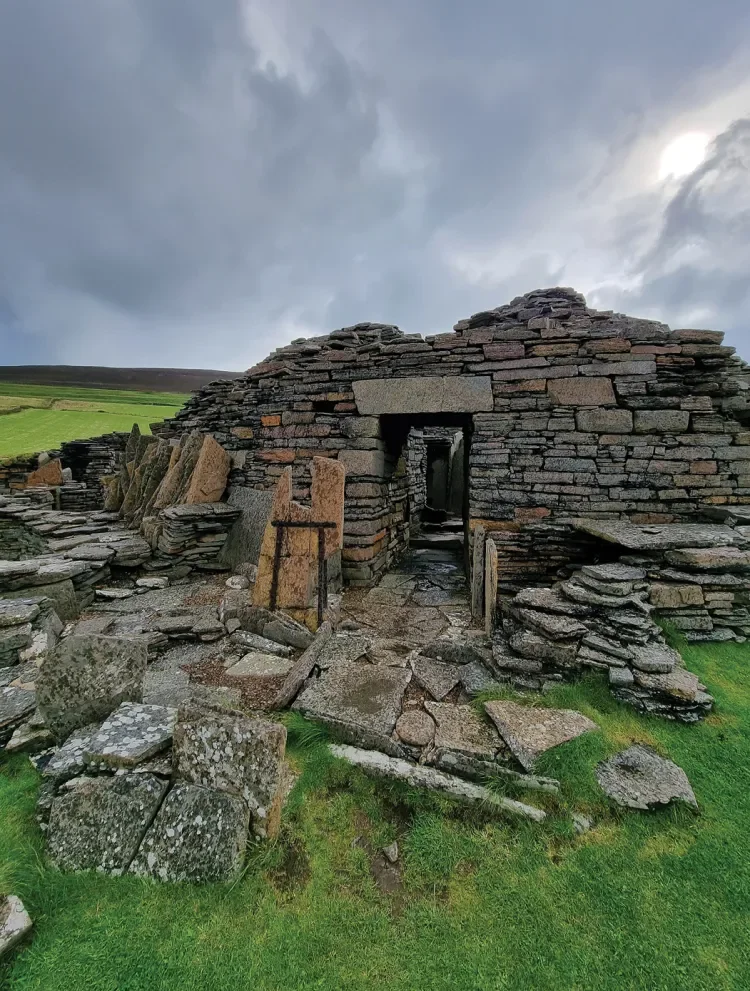
The Knowe of Scarrva belongs to the extraordinary collection of prehistoric monuments that make Rousay one of Orkney's most important archaeological islands. Its association with the Neolithic period places it within a transformative era of British prehistory, when communities increasingly practiced agriculture, constructed permanent settlements, developed monumental architecture, and established elaborate traditions for commemorating the dead.
The Neolithic period in Orkney was not simply an era when people began farming. It was a period of profound changes in social organization, architecture, food production, technology, ritual, and relationships with ancestors. Sites such as the Knowe of Scarrva help demonstrate how deeply these changes affected the landscape.
The Neolithic Transformation
The Neolithic period generally began in Britain during the fourth millennium BCE, although the transition was gradual and varied between regions. Farming communities introduced domesticated crops and animals, while continuing to rely on wild resources.
Orkney developed a particularly distinctive Neolithic culture. The islands contain monumental tombs, stone houses, ceremonial complexes, stone circles, and settlements of remarkable preservation.
The Knowe of Scarrva belongs within this monumental environment.
Monumental Landscapes
The prehistoric inhabitants of Rousay did not construct monuments randomly. Tombs and other structures were often integrated into landscapes containing natural features, settlements, agricultural areas, and views across the sea.
The word "knowe" is particularly appropriate to the Orcadian landscape because many prehistoric monuments survive as low artificial or natural-looking mounds. Archaeological excavation can reveal that these apparently ordinary hills contain carefully constructed monuments.
Such structures can be difficult to interpret because later activity may alter their original appearance.
Collective Memory
One of the most important interpretations of Neolithic chambered monuments concerns ancestry.
Burial monuments were places where communities could interact with the remains of previous generations. The dead may have been remembered collectively rather than as isolated individuals.
The construction of a monument therefore created a physical link between the living community and its ancestors. A mound could remain visible for centuries, allowing later inhabitants to recognize that previous generations had occupied and transformed the same landscape.
This created what archaeologists sometimes describe as a "monumental memory"—a landscape in which the past remained physically present.
Architecture and Social Organization
Building a Neolithic monument required planning.
People had to identify suitable stone, transport it, organize labor, construct stable walls, and maintain the structure. Even a modest monument could represent a significant investment.
This provides evidence for cooperative social organization. The community was capable of mobilizing labor for purposes that were not immediately necessary for food production.
Such projects may have reinforced community identity. Participating in construction could itself have been a social or ritual experience.
Rousay's Wider Archaeological Importance
The Knowe of Scarrva should be considered alongside Rousay's better-known prehistoric monuments, especially the chambered cairns of the island's western and northern areas.
Together, these sites demonstrate the density of Neolithic activity in Orkney. They also provide opportunities to study differences between monuments.
Some tombs contain complex internal chambers and passages. Others have different layouts or later modifications. Comparing these structures helps archaeologists understand regional traditions and chronological change.
Why the Site Matters
The significance of the Knowe of Scarrva is therefore broader than the survival of a single prehistoric mound. It represents the transformation of Rousay into a monumental landscape.
The people who created these monuments had sophisticated knowledge of stone construction, landscape geography, social organization, and ritual practice. Their buildings were intended to last, and many have survived for thousands of years.
Today, the site provides a valuable reminder that Neolithic Orkney was a highly organized cultural world rather than a collection of isolated prehistoric settlements.