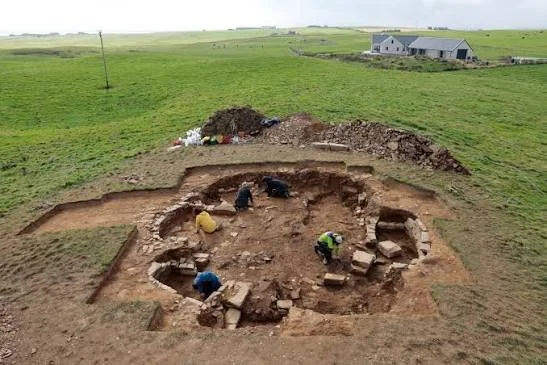
The farm mound at Stree on Rousay contributes to the archaeological record of agricultural settlement in the Orkney Islands. Farm mounds are particularly valuable because they often preserve evidence accumulated through generations of domestic and agricultural activity.
Unlike monumental sites constructed for ceremonial or defensive purposes, a farm mound can represent the everyday lives of ordinary communities: farming, cooking, animal husbandry, storage, craft production, waste disposal, and household maintenance.
What Is a Farm Mound?
A farm mound is generally an archaeological accumulation created through the repeated occupation and rebuilding of a settlement.
As houses are constructed, modified, demolished, and rebuilt, layers of stone, soil, ash, food waste, building debris, and household refuse accumulate.
Over centuries, these layers can form a substantial mound.
The mound is therefore effectively a physical archive of settlement history.
Agriculture on Rousay
Rousay's environment supported mixed farming.
Cereal cultivation was possible in suitable soils, while livestock provided meat, milk, wool, hides, and other materials.
Farmers had to adapt their agricultural practices to the northern climate.
The sea provided additional resources, reducing dependence on crops and livestock alone.
Household Organization
A farm was not simply an agricultural workplace.
It was a household.
Families lived, cooked, slept, worked, and socialized within the settlement.
Different areas may have been used for food preparation, storage, textile production, tool manufacture, and animal management.
The archaeological remains can therefore provide information about both economic and social life.
Rebuilding and Continuity
Repeated rebuilding is one reason farm mounds become archaeologically significant.
Instead of abandoning a settlement whenever a building deteriorated, communities often rebuilt in the same general location.
This demonstrates attachment to place.
The reasons may have included access to fertile land, proximity to water, established fields, and social connections.
Food Evidence
Food remains are among the most valuable discoveries in settlement archaeology.
Charred cereal grains can survive when accidentally burned.
Animal bones can reveal which species were raised and consumed.
Shells can demonstrate marine resource exploitation.
Pottery residues may provide additional evidence for cooking practices.
Together, these materials allow archaeologists to reconstruct ancient diets.
Textile Production
Orkney's agricultural economy supported textile production.
Sheep supplied wool, which could be spun into yarn and woven into fabric.
Spindle whorls and loom weights are common indicators of textile manufacture at archaeological sites.
Textiles themselves rarely survive in dry environments, making these indirect indicators particularly important.
Tools and Technology
Farm settlements can preserve evidence for numerous technologies.
Iron knives and tools demonstrate metalworking.
Stone tools reveal continuing use of lithic technology.
Bone tools may have been used for sewing, weaving, fishing, or other tasks.
The combination of materials illustrates how prehistoric and historic households used whatever resources were available.
Maritime Connections
Rousay's farmers were also islanders.
Fishing and marine gathering could supplement agricultural production.
Boats provided transportation between communities.
During the Norse period, maritime connections became even more important as Orkney became integrated into wider North Atlantic networks.
Archaeological Importance
Farm mounds are particularly useful because they preserve long sequences.
A single mound can contain layers from different generations, sometimes spanning several centuries.
Archaeologists can study these layers to reconstruct changes in technology, diet, architecture, agriculture, and environmental conditions.
Threats to Farm Mounds
Agricultural activity, erosion, construction, vegetation, and weather can damage archaeological mounds.
Coastal environments are especially vulnerable.
Recording and monitoring are therefore essential.
Modern archaeological survey methods allow researchers to document sites through detailed mapping and digital models.
Conclusion
Stree's farm mound represents the archaeology of everyday life on Rousay.
Its importance lies not in monumental architecture but in the accumulated evidence of ordinary activities repeated over generations.
Farming, animal husbandry, cooking, textile production, storage, fishing, and household life all contributed to the formation of archaeological deposits.
By studying farm mounds such as Stree, archaeologists can reconstruct the lives of communities whose names were never recorded but whose daily routines shaped the landscape of Rousay for centuries.
The mound is ultimately a record of continuity: generation after generation returning to the same land, maintaining homes, raising animals, cultivating food, and adapting to the changing world around them.