The Roman Villa of La Olmeda, located in Pedrosa de la Vega (Palencia, Spain), is one of the most significant late Roman archaeological sites in Europe. Dating primarily to the 4th century CE, the villa serves as a remarkable testament to the wealth and cultural sophistication of the Roman rural elite during the waning years of the Empire.
I. Architectural Splendor
La Olmeda was a large, opulent rural mansion (domus) centered around a square peristyle courtyard. Its layout was rigorously symmetrical, featuring 27 rooms, 12 of which were adorned with intricate mosaic floors. The complex included elite residential quarters, private thermal baths (balnea) connected by a grand covered passageway, and auxiliary buildings such as kilns and storage areas. The residential design featured towers at the corners, reflecting the defensive and prestige-driven architecture of the Late Antique period.
II. The Mosaics: A Masterpiece of Detail
The villa is most famous for its stunning collection of mosaics, which remain largely in their original positions.
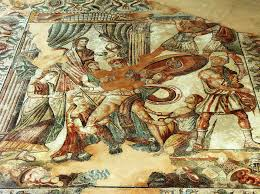
The Oecus (Reception Hall): This room contains the villa’s most iconic mosaic, covering approximately 175 square meters. It depicts the mythological scene of the discovery of Achilles by Odysseus on the island of Skyros. Achilles is shown being revealed while dressed in women’s clothing, surrounded by the princesses of the court. The central scene is framed by an elegant frieze containing portraits, which archaeologists speculate may be the residents of the villa themselves.
Geometric Precision: Beyond the figurative scenes, the gallery and corridors are paved with complex geometric mosaics. These patterns demonstrate the high level of craftsmanship and the "branding" of wealth that characterized the late Roman villa culture in Hispania.
Conservation: The site is now protected by a modern architectural structure designed by Paredes Pedrosa. This design provides a controlled environment to preserve the mosaics while using a translucent perimeter and walkways to allow visitors to view the layout of the villa without physically damaging the fragile floors.
III. Daily Life and Technology
Archaeological excavations have provided a vivid look into the functional life of the mansion:
Heating Systems: Several rooms, including the dining areas and parts of the baths, were equipped with a hypocaustum—a sophisticated under-floor heating system that circulated hot air from furnaces through a crawlspace beneath the floor.
Artifacts: The associated museum, housed in the Church of San Pedro in nearby Saldaña, displays a wide array of findings from the site, including coins, terra sigillata pottery, glasswork, and tools. These objects, combined with the presence of multiple necropolises nearby, offer insights into the social hierarchy, trade connections, and burial customs of the region’s inhabitants.
IV. Discovery and Legacy
Discovered by chance in 1968 by Javier Cortés Álvarez de Miranda, a local landowner, the site was meticulously excavated and later donated to the Provincial Council of Palencia. Its professionalization in the 1980s and the subsequent modern architectural intervention in 2009 have made La Olmeda a model for the preservation and presentation of archaeological heritage. It has received numerous accolades, including a Special Mention from the Europa Nostra Awards, recognizing the successful integration of modernity with ancient history.