Introduction
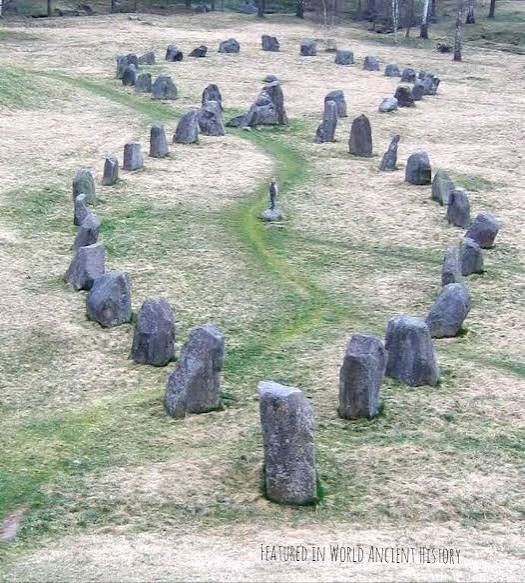
The boat graves at Salme in Estonia are among the most important archaeological discoveries for understanding the earliest stages of Viking-Age maritime warfare.
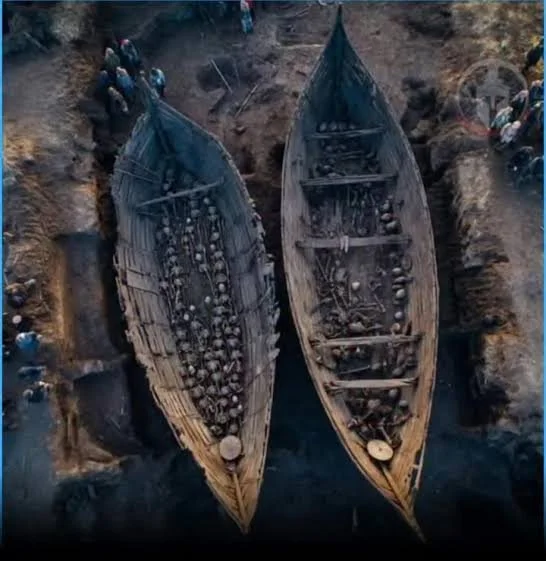
Discovered on the island of Saaremaa, the graves contained the remains of dozens of individuals buried in two boats along with weapons, gaming pieces, animal remains, and other objects.
Their significance is enormous.
The burials date to the eighth century, before the conventional beginning of the Viking Age in many historical narratives.
They therefore provide evidence for organized Scandinavian maritime activity at a surprisingly early date.
Discovery of the Boats
The archaeological discoveries revealed two boat burials.
The larger vessel contained numerous individuals and substantial quantities of military equipment.
The second boat was smaller and contained fewer individuals.
The arrangement indicates that the boats were used for funerary purposes after a violent event or military expedition.
The exact circumstances remain uncertain.
Archaeologists continue to debate whether the individuals died in battle, were killed after combat, or were deliberately buried following an expedition.
Scandinavian Origins
The artifacts strongly suggest that many of the buried individuals originated from Scandinavia.
Weapons, clothing elements, and other objects have parallels in Swedish and broader Scandinavian archaeological traditions.
Some researchers have proposed connections with central Sweden, although identifying exact geographic origins is difficult.
Scientific methods such as isotope analysis and ancient DNA research can provide additional evidence.
These methods allow researchers to investigate diet, mobility, ancestry, and biological relationships.
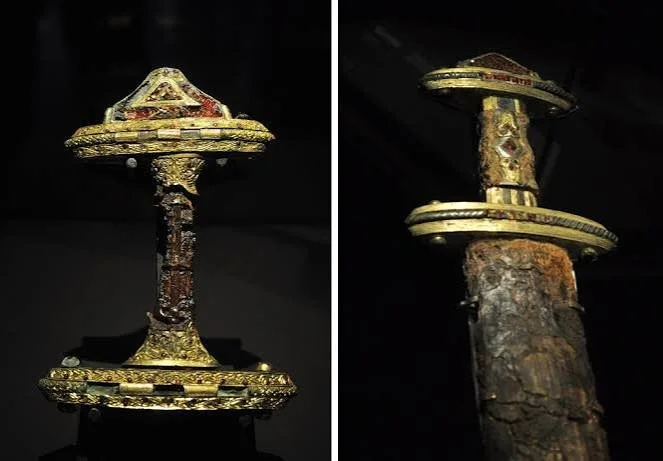
Weapons
The graves contained numerous weapons.
Swords were among the most significant.
Spears and shields were also represented.
The quantity of military equipment suggests that the group consisted largely of warriors.
This is particularly important because it demonstrates that organized Scandinavian seaborne expeditions existed before the famous Viking raids on places such as Lindisfarne.
The Evidence of Combat
Human remains from the graves preserve evidence relevant to violence.
Trauma patterns can sometimes reveal whether individuals experienced injuries before death.
However, the absence of visible wounds does not necessarily mean that people did not die violently.
Soft-tissue injuries leave no archaeological trace, and some forms of trauma may be difficult to detect.
The archaeological evidence therefore has to be combined with contextual analysis.
The Ships
The boats themselves provide important technological information.
They were constructed using Scandinavian boatbuilding traditions.
Their wooden components had been arranged in ways consistent with clinker-built construction.
Clinker construction involves overlapping planks attached along their edges.
This technique produced lightweight but flexible vessels capable of operating effectively in coastal waters.
The Salme boats therefore provide evidence for the maritime technology that later became central to Viking expansion.
Gaming Pieces
The presence of gaming equipment is particularly interesting.
Gaming pieces have been found in many Scandinavian elite burials.
Games could be associated with strategy, social interaction, and elite leisure.
Their presence in a warrior burial suggests that the individuals were not represented exclusively through violence.
They were members of a culture with complex social identities.
Burial and Status
The burial itself required significant organization.
Transporting bodies, constructing or preparing the burial vessels, assembling weapons, and arranging the grave goods required coordinated labor.
This suggests that the group belonged to a socially organized community.
The burial may also have been intended to preserve group identity.
The Meaning of the Mass Burial
Why were so many people buried together?
This remains one of the most fascinating questions.
One possibility is that they died during a military expedition.
Another is that they were defeated by local inhabitants and subsequently buried together.
The archaeological evidence does not allow researchers to reconstruct every event with certainty.
This uncertainty is scientifically valuable.
Archaeology provides evidence, but evidence does not always produce a single uncontested narrative.
Salme and the Viking Age
The Salme graves challenge traditional ideas about when Viking activity began.
The eighth century is often treated as the threshold of the Viking Age.
Yet Salme demonstrates that Scandinavian maritime warfare and long-distance expeditions were already occurring.
The famous raids of the late eighth and ninth centuries were therefore part of a longer development.
The Baltic Sea as a Zone of Interaction
The Baltic was not a barrier separating communities.
It was a transportation network.
Scandinavian sailors could cross between islands and coastlines.
Trade, migration, warfare, and cultural exchange occurred across the sea.
Salme illustrates the importance of these maritime connections.
Modern Scientific Research
Modern investigation of the Salme burials has employed multiple scientific techniques.
Bioarchaeology can reveal age, sex, trauma, and health.
Isotope analysis can provide clues about geographical mobility and diet.
Ancient DNA can investigate biological relationships and ancestry.
Artifact analysis can reveal technological traditions.
Together, these methods produce a much more detailed picture than traditional excavation alone.
Conclusion
The Salme boat graves provide extraordinary evidence for the early development of Viking maritime culture.
They demonstrate that Scandinavian warriors were traveling across the Baltic in organized groups before the Viking Age's most famous raids.
Their weapons reveal military organization.
Their boats demonstrate advanced maritime technology.
Their gaming pieces and personal equipment reveal elite culture.
Their burial demonstrates complex social and funerary practices.
Salme therefore occupies a crucial place in the history of the Viking world.
It shows that the Viking Age did not begin suddenly with a single raid.
Its foundations were already being laid across the Baltic generations earlier.