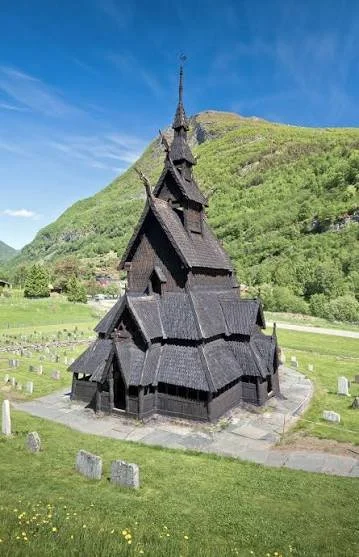
Borgund Stave Church is one of Norway's best-preserved medieval stave churches and one of the most famous examples of Scandinavian timber architecture. Although the surviving church is medieval rather than literally a Viking Age building, its architectural tradition developed from a Scandinavian cultural environment shaped by the transition from the Viking Age to medieval Christianity.
Its extraordinary preservation allows historians and archaeologists to study medieval timber architecture in unusual detail.
Construction and Design
Borgund is built around a structural framework of massive wooden staves.
The walls are formed from vertical timber boards placed between the structural posts, while beams and braces reinforce the building.
The roof rises in multiple levels, creating the distinctive appearance associated with stave churches.
The complexity of the structure demonstrates that medieval Scandinavian builders possessed highly developed woodworking skills.
From Viking Age to Christianity
The architecture contains features that appear distinctly Scandinavian even though the building served Christianity.
Decorative elements include carved animal-like forms and interlaced patterns that resemble broader Scandinavian artistic traditions.
These motifs demonstrate that Christian architecture in Norway developed through cultural adaptation rather than complete rejection of earlier artistic vocabulary.
The Importance of Woodworking
Stone monuments often dominate discussions of medieval architecture because they survive more easily.
Borgund demonstrates why this can create a misleading picture.
Medieval Scandinavia possessed an extensive timber-building tradition. Builders understood timber selection, joinery, structural reinforcement, weather protection, and roofing.
The knowledge required was substantial.
Church and Community
A medieval church served many purposes.
It was a place for Mass and religious ceremonies, but it also represented the institutional presence of Christianity within the community.
The church calendar structured time through festivals, fasts, saints' days, and seasonal celebrations.
Churches also became places where legal, economic, and social relationships intersected.
Preservation and Archaeology
Borgund's survival is partly due to later conservation efforts and the replacement or protection of vulnerable components.
The building provides researchers with an unusually complete case study in medieval Scandinavian timber architecture.
It can be examined not only as a religious monument but also as evidence of engineering, forestry, craft organization, and social history.
Cultural Legacy
Borgund became an important model for understanding Norwegian stave churches.
Its distinctive appearance has influenced modern architectural reconstructions and scholarship concerning medieval Scandinavian building techniques.
The church stands as a reminder that medieval Europe was architecturally diverse. Monumental religious architecture was not restricted to stone cathedrals.
In Norway, wood itself became the medium for some of the most sophisticated surviving medieval architecture.