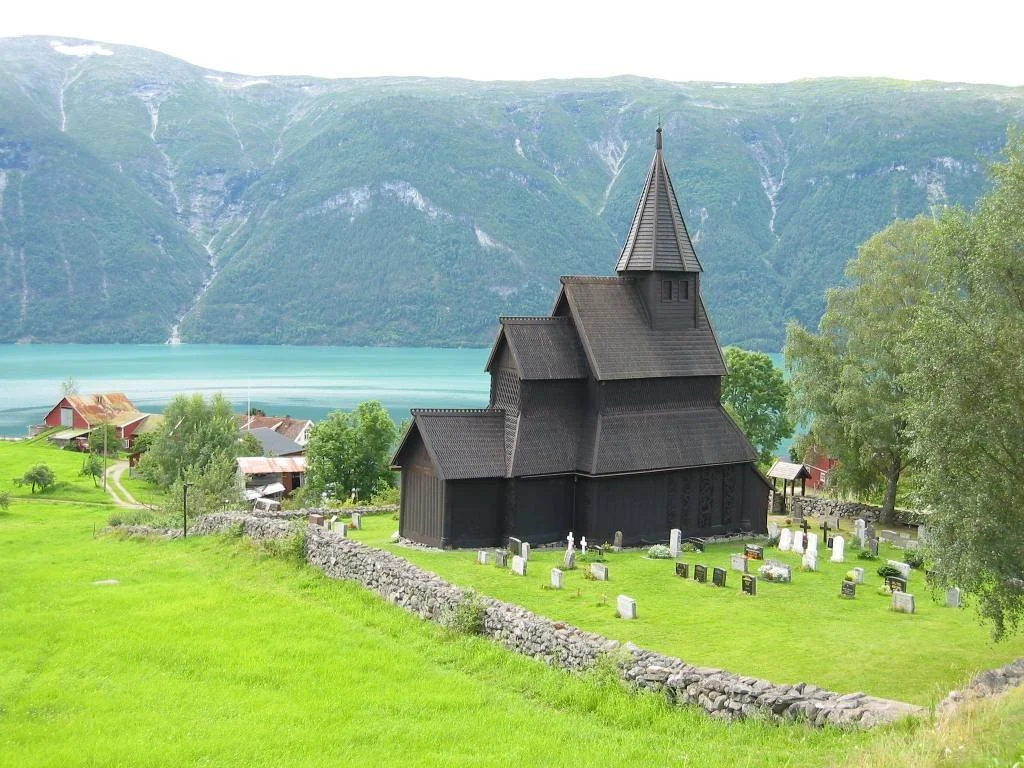
Urnes Stave Church is one of Norway's most important medieval architectural monuments and is particularly famous for the artistic style now known as the Urnes style. The church demonstrates how Scandinavian woodworking traditions interacted with the broader Romanesque culture of medieval Christian Europe.
Its significance extends far beyond its physical beauty. Urnes provides evidence for religious change, artistic exchange, timber engineering, and the transformation of Scandinavian visual culture.
The Urnes Style
The Urnes style developed in Scandinavia during the eleventh and twelfth centuries.
Its most recognizable features include slender animal figures, flowing bodies, intertwined forms, and elegant ornament.
The animals are often elongated and arranged within complex compositions.
This artistic vocabulary is distinctly Scandinavian while also participating in wider European developments in medieval ornament.
A Christian Building With Scandinavian Artistic Heritage
Urnes illustrates an important feature of medieval cultural transformation.
Christianization did not erase earlier artistic traditions overnight. Instead, Scandinavian craftsmen adapted familiar visual forms to new religious contexts.
The resulting architecture combined Christian function with local artistic traditions.
This makes Urnes particularly important for understanding cultural transition.
Timber Engineering
The church's structure relies on traditional stave construction.
Vertical posts carry the principal loads, while beams, braces, and other components stabilize the building.
Wooden churches required continuous maintenance because timber was vulnerable to moisture and biological decay.
The survival of Urnes is therefore remarkable.
Romanesque Connections
Urnes was built during a period when Norway became increasingly integrated into European Christian networks.
Church institutions, religious texts, clerics, artistic styles, and architectural ideas moved across Europe.
The church's Romanesque character reflects these connections.
Yet the building remained unmistakably Scandinavian in its construction and decorative traditions.
The Medieval Religious World
A church such as Urnes was part of a larger religious system.
Christian worship structured the calendar, burial practices, marriage ceremonies, and community identity.
The church connected local society with bishops, monasteries, royal authority, and the wider Christian world.
Archaeological Importance
Urnes is particularly valuable because it preserves elements from different phases of church construction.
Earlier structural and decorative components were incorporated into the surviving building.
This creates a layered archaeological record.
Rather than representing a single moment in history, the church embodies centuries of architectural and cultural development.
UNESCO and Global Significance
Urnes Stave Church is recognized as a major example of medieval Scandinavian architecture and forms part of Norway's internationally significant cultural heritage.
Its importance lies in the combination of engineering, art, religion, and cultural exchange.
Urnes demonstrates that medieval Norway was not culturally isolated. It participated actively in European Christianity while maintaining distinctive Scandinavian artistic traditions.