Introduction
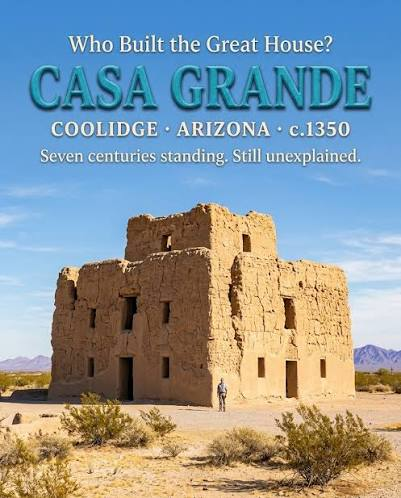
Few prehistoric structures in North America are as visually striking as the Casa Grande, the enormous earthen building preserved at Casa Grande Ruins National Monument in southern Arizona.
Standing approximately four stories high, the Great House is one of the most impressive surviving examples of prehistoric earthen architecture in the American Southwest. The structure was constructed by ancestral Sonoran Desert people during the late prehistoric period and demonstrates remarkable knowledge of materials, architecture, astronomy, and environmental adaptation.
The National Park Service describes Casa Grande as a particularly significant surviving example of Hohokam architectural achievement.
A Monument of Earth
Casa Grande was not built from stone blocks.
Its walls were made largely from caliche, an earth material containing sand, clay, and calcium carbonate. The material could be formed into massive walls capable of supporting a multi-story structure.
The engineering achievement is remarkable.
A structure standing more than 35 feet above the desert required carefully planned walls, internal divisions, wooden beams, and controlled construction techniques.
The building consisted of multiple rooms and levels rather than being a single hollow tower. Archaeological documentation indicates that several portions contained multiple habitable floors.
When Was It Built?
The Great House belongs to the later prehistoric period of the region.
Current archaeological evidence places its construction around the fourteenth century, probably during the Classic period of Hohokam development.
It was part of a larger walled settlement rather than an isolated monument.
The surrounding community contained residential compounds, agricultural systems, canals, and public architecture.
The Irrigation Landscape
Casa Grande was connected to the enormous canal systems that transformed central Arizona.
The surrounding agricultural economy depended on controlled water.
The Great House itself stood near the end of a major canal system, and archaeologists have suggested that it may have had a role in organizing irrigation activities.
However, its exact function remains uncertain.
It may have served administrative, ceremonial, observational, residential, or combined purposes.
Astronomy and Architecture
One of Casa Grande's most fascinating characteristics is its relationship with the sky.
The building's orientation and architectural openings have encouraged archaeologists to investigate possible astronomical functions.
Certain openings align with celestial events or directions associated with the movement of the sun.
This does not necessarily mean that Casa Grande was an "observatory" in the modern scientific sense.
Ancient astronomical knowledge could have been embedded within agricultural calendars, ceremonial practices, architecture, and social traditions.
Observing the sky could help communities recognize seasonal changes important for planting and harvesting.
The Great House and Social Organization
Constructing Casa Grande required a coordinated workforce.
Workers needed to gather earth, prepare building material, construct walls, install wooden supports, and maintain the structure.
This suggests that the surrounding society possessed mechanisms for organizing large projects.
The monument therefore provides evidence not only for engineering but also for social organization.
Why Did the Community Decline?
By approximately the fifteenth century, major changes affected many Hohokam settlements.
Population movements, environmental stress, political changes, water-management problems, and other factors have all been considered.
The evidence does not support a single universally accepted explanation.
Importantly, abandonment should not be interpreted as disappearance.
The descendants of ancestral Sonoran Desert peoples remain part of living Indigenous communities today. The National Park Service specifically emphasizes connections between ancestral communities and present-day Indigenous peoples.
Preservation
Casa Grande has survived despite centuries of environmental exposure.
Rain, wind, temperature changes, and biological processes can damage earthen architecture.
Preserving the Great House has therefore required continuous conservation.
Its protection also reflects a broader change in American attitudes toward archaeological heritage. Casa Grande became an important early example of federal archaeological preservation following the Antiquities Act.
Conclusion
Casa Grande is one of the great architectural achievements of prehistoric North America.
Its four-story structure demonstrates the ability of ancient builders to work with earth on a monumental scale.
Its relationship with irrigation, settlement organization, astronomy, and regional exchange makes it far more than an impressive ruin.
Casa Grande represents a society that understood its environment deeply and transformed that knowledge into architecture.