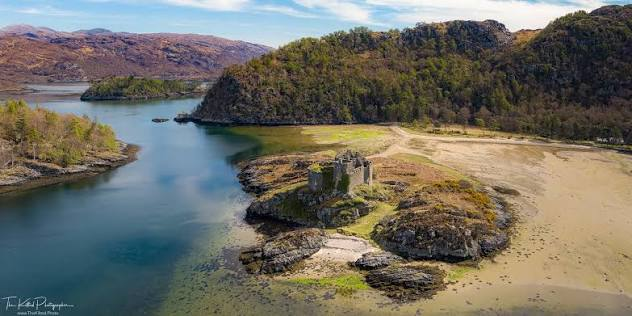
Castle Tioram is one of the most dramatic medieval fortifications in the western Highlands.
Situated on a tidal island at the entrance to Loch Moidart, the castle was associated with the Clan MacDonald of Clanranald and became closely connected with the political struggles of the seventeenth and eighteenth centuries.
Its ruined walls preserve evidence of a turbulent period in Highland history.
The Island Fortress
Castle Tioram occupies a naturally defensive location.
The surrounding waters provided protection from land-based attack, while the castle's position allowed its occupants to control access through the surrounding sea routes.
Clanranald
The castle became an important stronghold of the MacDonalds of Clanranald.
Clanranald was one of the major branches of the powerful MacDonald political network in the western Highlands and Islands.
The Lordship of the Isles
The castle's historical setting cannot be separated from the wider history of the Lordship of the Isles.
The MacDonalds controlled extensive territories across the western seaboard.
Their power depended heavily on:
land;
maritime transport;
alliances;
kinship;
and armed retainers.
The Jacobite Era
Castle Tioram became particularly associated with the Jacobite cause.
During the early eighteenth century, political divisions between supporters of the Stuart monarchy and the Hanoverian government deeply affected Highland society.
The castle was destroyed or deliberately rendered unusable during the 1715 Jacobite Rising. The destruction reflects the government's concern about fortified Highland strongholds.
The 1745 Rising
The Jacobite Rising of 1745 further transformed the region.
Prince Charles Edward Stuart's campaign attracted support from numerous Highland clans.
The failure of the rising eventually resulted in severe political consequences for Jacobite families.
Architecture
Castle Tioram consists primarily of a substantial stone enclosure and tower structures.
Its walls adapted to the island's natural shape.
The defensive position was particularly advantageous because attackers approaching by land had limited options.
A Maritime Stronghold
Unlike many mainland castles, Castle Tioram's environment was fundamentally maritime.
Boats could transport:
people;
food;
weapons;
messages;
and supplies.
The sea was therefore both a defensive barrier and a transportation network.
Archaeological Importance
The ruined castle preserves evidence of centuries of occupation and adaptation.
Its significance lies not only in its architecture but in its association with clan politics and the changing relationship between Highland communities and the Scottish state.
Conclusion
Castle Tioram: Lochaber’s Jacobite Stronghold is a powerful symbol of Highland political history.
Its island location, medieval architecture, MacDonald connections, and association with the Jacobite era demonstrate how castles functioned as both military structures and expressions of political authority.