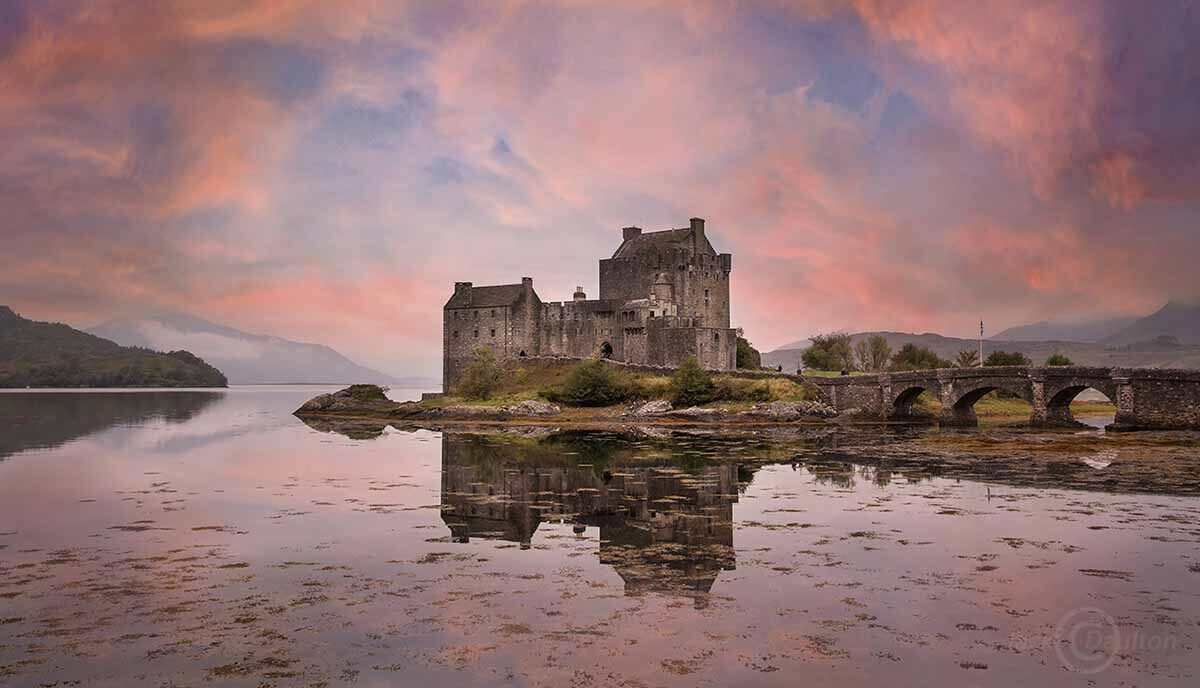
Eilean Donan is among Scotland's most recognizable castles.
Although often associated with the landscapes of Skye and the western Highlands, the castle itself stands near Dornie on the mainland, at the meeting point of three sea lochs. Its position illustrates the extraordinary strategic importance of maritime geography in the Highlands.
The castle's modern appearance is the result of extensive twentieth-century reconstruction, but its history stretches back many centuries.
The Island of Donan
The name Eilean Donan means “Island of Donan.”
The site is traditionally associated with Saint Donnan, an early Christian figure.
According to the castle's historical tradition, the island may have hosted a religious community before the construction of the medieval fortress.
Medieval Fortification
The first fortified castle was constructed during the medieval period, probably in the thirteenth century.
Its purpose was connected with the defense of the surrounding territory of Kintail and the western seaboard.
The island's location was exceptionally advantageous.
The Sea as a Highway
In medieval western Scotland, the sea was not simply an obstacle.
It was a major transportation network.
Ships and galleys could move people and supplies between coastal settlements.
Eilean Donan therefore occupied an ideal location for controlling movement through the sea lochs.
The Mackenzies and MacRaes
Over the centuries, the castle became strongly associated with the Mackenzies of Kintail and the MacRae clan.
The MacRaes later became closely associated with the castle's defense and administration.
Changing Fortifications
The castle was repeatedly modified.
At different times it included:
curtain walls;
towers;
a keep;
defensive platforms;
and artillery positions.
The development of firearms eventually changed the castle's military architecture.
The Jacobite Rising of 1719
Eilean Donan played a major role during the Jacobite rising of 1719.
Spanish troops supporting the Jacobites occupied the castle.
Government naval forces attacked it.
The castle was bombarded for several days before government troops captured it.
A large store of gunpowder was discovered and subsequently used to destroy much of the remaining structure.
Two Centuries of Ruin
After 1719, Eilean Donan remained largely abandoned.
Its ruined walls became part of the landscape.
For nearly two centuries, the castle existed primarily as a romantic ruin.
Reconstruction
In 1911, Lieutenant Colonel John MacRae-Gilstrap purchased the island.
A major restoration project began.
Over approximately two decades, the castle was reconstructed according to surviving evidence and historical plans.
The restored castle reopened in 1932.
Historical Interpretation
Modern Eilean Donan is therefore a combination of:
medieval remains;
eighteenth-century destruction;
twentieth-century reconstruction;
and modern heritage interpretation.
Understanding this distinction is essential when studying the site academically.
Conclusion
Eilean Donan: Skye’s Iconic Island Castle Ruins is a title that captures the castle's association with the wider Skye and western Highland landscape, although geographically the castle stands on the mainland near Dornie.
Its history demonstrates the importance of maritime defense, clan politics, Jacobite warfare, and heritage restoration.
The castle's present appearance is not simply a medieval survival—it is also the product of a remarkable twentieth-century reconstruction project.