Introduction
Nestled within the famous Vézère Valley of Dordogne, Combe Grenal is one of the world's most important Middle Paleolithic archaeological sites. The rock shelter preserves an exceptionally long sequence of occupation spanning approximately 200,000 to 40,000 years ago, documenting numerous climatic changes and repeated Neanderthal settlement. Its remarkable succession of archaeological layers has made Combe Grenal one of the key reference sites for studying the development of the Mousterian culture and the long-term adaptation of Neanderthals to fluctuating Ice Age environments.
A Long Archaeological Record
Unlike many prehistoric sites representing only a single occupation period, Combe Grenal contains more than 60 distinct archaeological layers, each recording separate episodes of human activity. These layers preserve evidence of changing climates, evolving stone tool technologies, shifts in hunting practices, and repeated returns by Neanderthal groups over tens of thousands of years.
The site's exceptional stratigraphy allows archaeologists to reconstruct one of the most complete chronological records of the European Middle Paleolithic.
Mousterian Technology
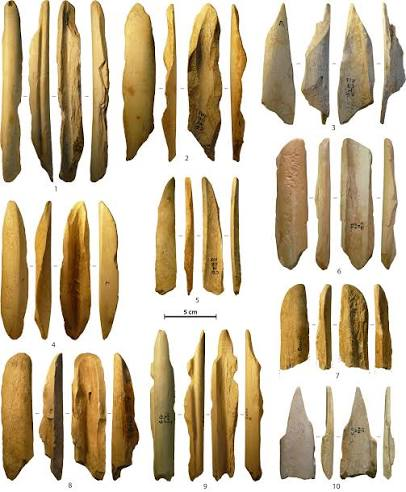
The archaeological sequence contains numerous varieties of Mousterian stone industries, reflecting technological adaptations through time. Neanderthal toolmakers employed prepared-core techniques such as the Levallois method to manufacture standardized flakes, which were transformed into scrapers, knives, denticulates, notched tools, and spear points.
Changes in tool design between different occupation layers demonstrate how Neanderthals adjusted their technology in response to shifting climates, available raw materials, and hunting strategies.
Hunting and Environmental Change
Animal remains recovered throughout the sequence include horse, bison, reindeer, red deer, mammoth, ibex, and woolly rhinoceros. Variations in species composition reflect repeated climatic shifts between warmer forested environments and colder open grasslands during the Pleistocene.
Cut marks, broken bones, and hearth remains demonstrate that Neanderthals consistently hunted, butchered, cooked, and processed large mammals throughout these environmental transitions.
Scientific Importance
Combe Grenal is considered one of Europe's most valuable archaeological sequences because it documents nearly the entire history of Neanderthal occupation in southwestern France. Its detailed stratigraphy has enabled researchers to correlate archaeological evidence with climatic fluctuations and technological development over more than 150,000 years.
The site continues to serve as a benchmark for studies of Neanderthal evolution, settlement patterns, and adaptation.
Conclusion
Combe Grenal provides one of the most complete records of Middle Paleolithic life ever discovered. Its extensive Mousterian sequence, well-preserved archaeological layers, and evidence of long-term Neanderthal occupation make it an indispensable site for understanding human adaptation during the European Ice Age.